
Lukaku-Donnarumma: the psychology of provocation
27 September 2026Youth dropout: how many kids will still want to be here in June?
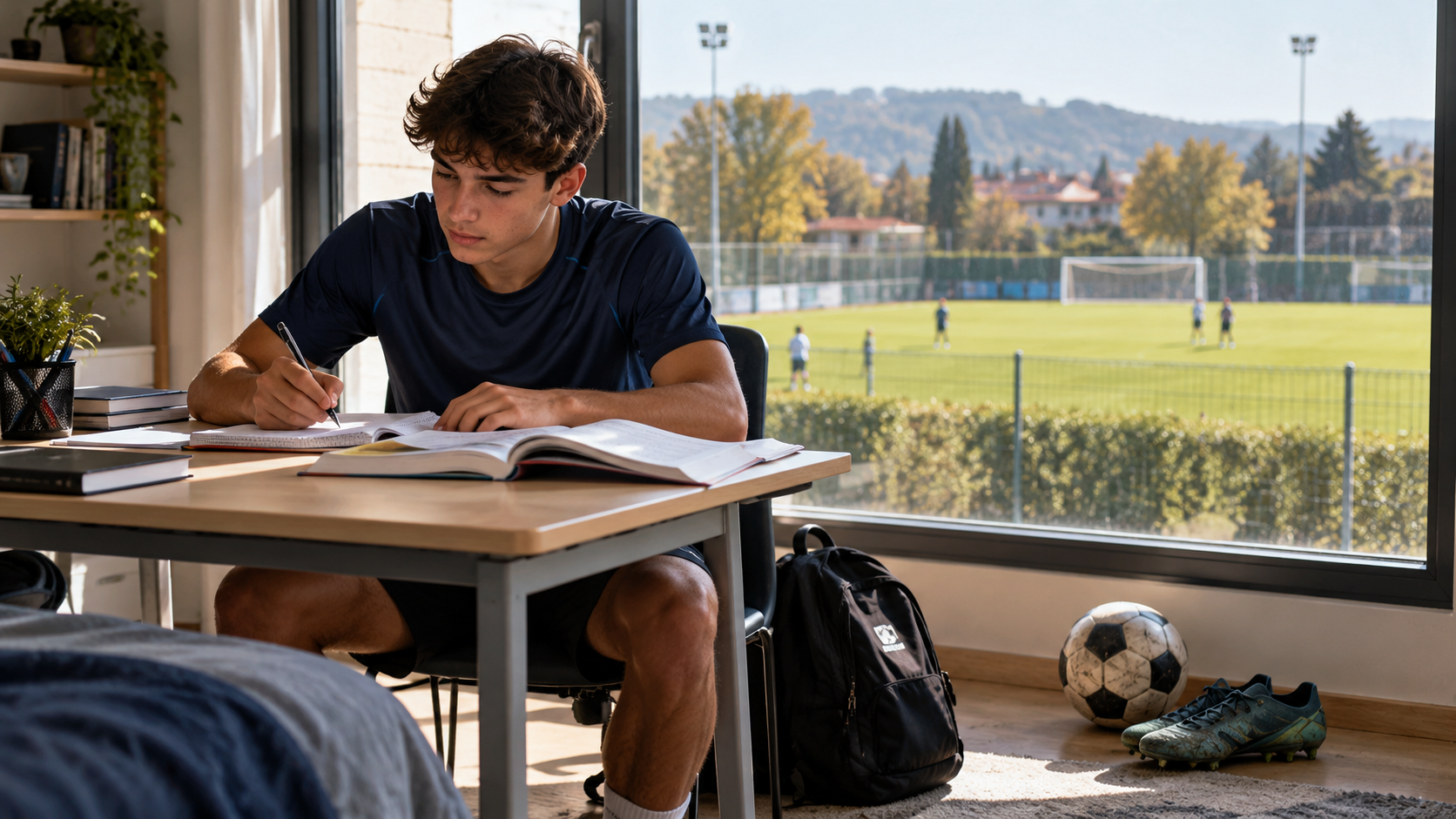
6 October 2026With the start of the school year, the Student-Athlete project is back in the spotlight. Behind timetables, away games and tests lies a psychological question: allowing a young person to grow in both sport and study without experiencing every day as a choice between two parts of themselves.
By Fabio Zarra
01 — THE STARTING POINT
Two calendars, one person
September brings two rhythms back together: lessons resume, while training and competitions continue to demand time and energy. For a student-athlete, the day may begin in class and end at the books after training. In between there is travel, recovery, relationships and expectations.
For the 2026/2027 school year, the experimental teaching project “High-level Student-Athlete” continues. The project is aimed at students of state and state-recognised upper secondary schools who meet the required sporting criteria. Its goal is to reconcile school with competitive commitments through personalised teaching. The Personalised Learning Plan (PFP) and the link between school tutor and sports tutor are central tools of this organisation. [1–2]
I contributed to the development and implementation of the project during my role as head of the Foresteria (youth residence) and psychologist at Cagliari Calcio. It's an experience I bring to today's reflection: how can we make the demands placed on these young people compatible?
The issue involves both education and psychological health. The young person who walks into class in the morning is the same person who steps onto the pitch in the afternoon.
02 — THE SCIENCE OF DUAL CAREERS
Organising hours is only part of the work
The literature defines a dual career as a path that combines sport with study or work. In their review of European research, Stambulova and Wylleman (2019) place this experience in a perspective that considers athletic, psychological, social and educational development together. [3]
This framework invites us to look beyond the diary. An away game may clash with a test, but also with the sense of belonging to the class. A move up a category may coincide with a new school cycle. Different changes may require adaptation in the same period.
For those supporting the young person, an operational question follows: which demands are overlapping, what resources do they have, and who can help? It is an application of the dual-career perspective to everyday work. The 2019 review synthesises 42 contributions from European research published between 2015 and 2018: it offers a framework for understanding the path, without constituting an evaluation of the effectiveness of the Italian ministerial project. [3]
03 — WHEN EACH ENVIRONMENT ONLY SEES ITS OWN PART
The young person as a permanent go-between
Imagine a week with an away game, two tests and a training session moved earlier. The school knows its own schedule; the sports club knows its own calendar. If the information stays separate, the young person has to explain, justify and negotiate every overlap.
They can certainly learn to manage their commitments. But adults must offer a system in which this autonomy is workable.
The link between school tutor and sports tutor takes on concrete value here: making commitments visible, anticipating problems and agreeing solutions. The ministerial guidelines provide for collaboration between these figures in defining and implementing the path. [2]
The PFP is aimed at achieving the competence targets in all subjects and can be updated during the year when teaching or sporting needs change. [2]
From a psychological point of view, we propose using this organisation also to contain uncertainty: clarifying who to talk to and how to make up an activity. This is an applied suggestion, not a psychological effect of the PFP already demonstrated by the cited sources.
A personalised path works when it fits into the student's real week.
04 — FATIGUE WORTH LISTENING TO
When “I have to make it” becomes the only answer
A full diary does not automatically mean burnout. Research describes sport burnout through physical and emotional exhaustion, a reduced sense of accomplishment and devaluation of sport. The review by Gustafsson, DeFreese and Madigan (2017) reports associations between burnout, negative social experiences and perfectionistic concerns, including fear of making mistakes and of being negatively evaluated. These associations do not imply that every athlete exposed to such conditions will develop burnout. [4]
More specific research by Sorkkila and colleagues (2020) followed Finnish adolescent student-athletes through the first year of upper secondary school: 391 at the first assessment and 373 at the second. The study identified four school and sport burnout profiles; interviews with 17 athletes explored differences in perceived demands and resources. The results highlight different pathways, without authorising us to consider dual careers inevitably harmful or to automatically transfer the data to the Italian context. [5]
For a student-athlete, a useful question concerns the meaning of mistakes: can they get a low grade or play badly without feeling like a disappointment to everyone?
The problem deserves attention when the demand to succeed leaves little room for difficulty. Persistent tiredness, irritability, loss of enjoyment or difficulty concentrating should be listened to in their context: on their own they do not allow us to identify burnout.
As a suggestion for a conversation, it can start like this: “Which part of the week is weighing on you most?”. The answer helps identify a concrete need, instead of immediately turning fatigue into a judgement on commitment.
05 — WHAT TO DO AT THE START OF THE YEAR
A pact involving school, sport and family
The following proposals translate the reflection into work to be adapted to each individual path. They are practical suggestions consistent with the themes discussed; the cited studies do not test this list as an intervention protocol:
- Share the busiest periods. Flag away games, competitions and school deadlines in good time, updating the picture when it changes.
- Agree realistic ways to catch up. Assess how to distribute missed work and the time needed to prepare it.
- Protect recovery. Factor sleep, breaks and personal time into the planning, avoiding automatically filling every free slot.
- Listen to the student. Ask them which solutions work and which are creating other difficulties.
- Review the path. Periodically check whether the agreements are being applied and whether they still meet their needs.
The student's responsibility remains central: communicating, respecting agreements and taking part in decisions. The adults' responsibility is to make those agreements coherent and sustainable.
06 — CLOSING THOUGHTS
Growing up without having to give up a part of yourself
At the start of the school year we have the opportunity to organise support before difficulties pile up.
The Student-Athlete project invites school and sport to collaborate around the education of a person. Its quality is also measured in everyday life: a shared calendar, a timely conversation, a young person who can flag a difficulty and find people ready to help.
The goal is to allow them to build skills and opportunities in both paths. So that their growth continues to have room, whatever direction their sporting career takes.
Sport Psychology Center supports young athletes, families and sports organisations in working on managing demands, motivation and mental skills. Discover our programmes at sportpsychologycenter.com (https://www.sportpsychologycenter.com/).
Scientific references
[3] Stambulova, N. B., & Wylleman, P. (2019). Psychology of athletes’ dual careers: A state-of-the-art critical review of the European discourse. Psychology of Sport and Exercise, 42, 74–88. https://doi.org/10.1016/j.psychsport.2018.11.013 https://www.sciencedirect.com/science/article/abs/pii/S1469029218305120
[4] Gustafsson, H., DeFreese, J. D., & Madigan, D. J. (2017). Athlete burnout: Review and recommendations. Current Opinion in Psychology, 16, 109–113. https://doi.org/10.1016/j.copsyc.2017.05.002
[5] Sorkkila, M., Ryba, T. V., Selänne, H., & Aunola, K. (2020). Development of school and sport burnout in adolescent student-athletes: A longitudinal mixed-methods study. Journal of Research on Adolescence, 30(Suppl. 1), 115–133. https://doi.org/10.1111/jora.12453
Institutional sources
[1] Ministry of Education and Merit. Note AOODGSIP prot. 3964 of 15 September 2026, A.S. 2026/2027 — High-level Student-Athlete Project, published by the Regional School Office for Emilia-Romagna. Ministerial document (https://www.istruzioneer.gov.it/2026/09/15/sperimentazione-studente-atleta-di-alto-livello-a-s-2026-2027/?download=91769).
[2] Ministry of Education and Merit. Annex 1 — Technical and operational information for the trial of the High-level Student-Athlete Project, a.y. 2026/2027, in particular the section on tutors and the PFP. Ministerial document (https://www.istruzioneer.gov.it/2026/09/15/sperimentazione-studente-atleta-di-alto-livello-a-s-2026-2027/?download=91770).

Fabio Zarra