
Visualization and mental activation: what we can learn from Weghorst and Martín
22 September 2026La scuola è ricominciata: come sostenere la doppia carriera degli studenti-atleti
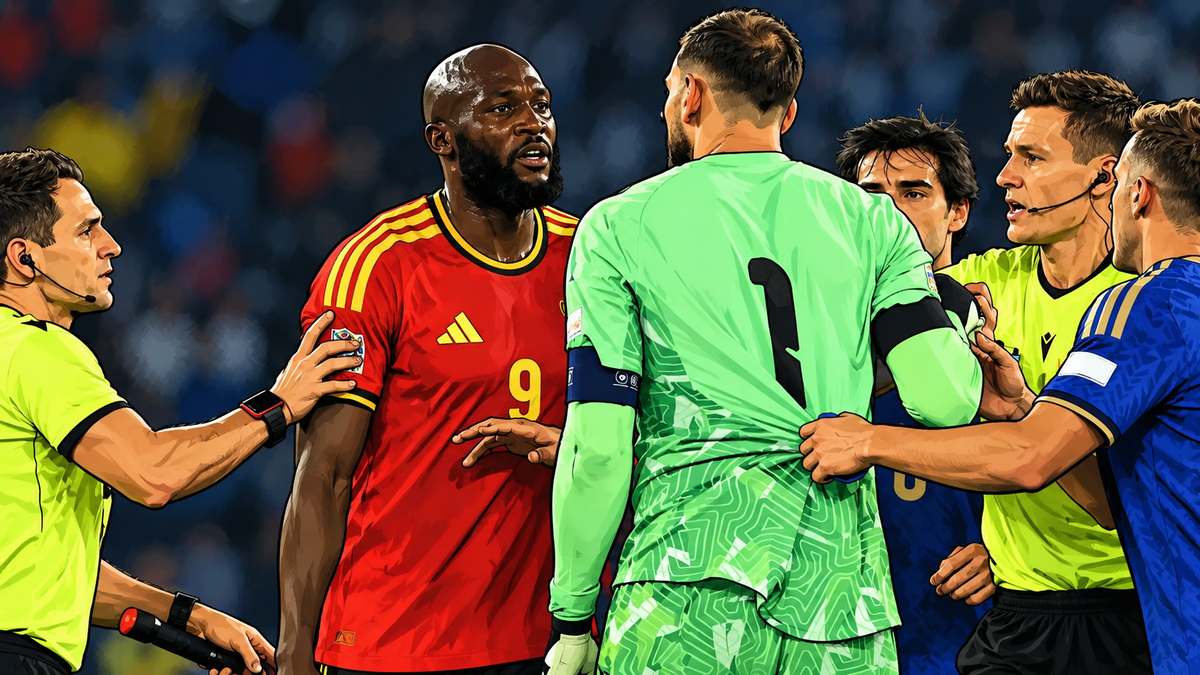
1 October 2026On Friday evening, at Rome's Olimpico, Roberto Mancini's second spell in charge of the national team began with a 2-0 defeat to Belgium in the first round of the Nations League group stage. But the episode that sparked the most debate wasn't about the result: in the final minutes, Romelu Lukaku — who had come on in the second half and was booed by the Italian crowd — turned to Gianluigi Donnarumma making the shush gesture and holding up two fingers, a clear reference to Belgium's 2-0 lead. Donnarumma, the Azzurri captain, reacted immediately, going up to the Belgian forward at midfield for a heated confrontation, coming close to physical contact before the referee stepped in and booked both players.
Edited by Fabio Zarra
The facts
This isn't the first time the two have clashed: at Euro 2020, Lukaku had already converted a decisive penalty against Italy while exchanging words with Donnarumma himself. Friday's gesture, then, doesn't come out of an isolated episode, but fits into a history of prior tension between the two players. For sport psychology, this detail isn't background colour: it's the variable that lets us tell a run-of-the-mill provocation apart from a more specific, better-studied psychological phenomenon — rivalry.
Not a generic provocation, but a rivalry
The distinction between an “opponent” and a “rival” is at the heart of the work by Kilduff, Elfenbein and Staw (2010, Academy of Management Journal), who proposed an analysis of rivalry as a relational phenomenon: two competitors don't simply compete for the objective stakes of a single encounter, but bring into the competition the whole history of their previous interactions, which amplifies the subjective psychological stakes independently of the objective ones. Applied to Friday's case: Lukaku and Donnarumma weren't just two players facing each other for the first time in a group-stage match — they were two rivals with a specific history, and it's precisely that shared history that makes such a disproportionate reaction plausible against the otherwise unremarkable backdrop of a September Nations League match.
The mechanism: why rivalry makes people go off the rails
A second study by the same researchers — Kilduff, Galinsky, Gallo and Reade (2016, Academy of Management Journal) — documented, through an archival study and a series of experiments (including real football matches), that rivalry systematically increases the likelihood of unfair or unsporting behaviour compared with competition against neutral opponents. The most interesting finding of this work isn't just the correlation, but the psychological mechanism that explains it: the authors show that rivalry raises the psychological stakes of competition by increasing two specific factors — competitors' self-esteem contingency and their status concerns — and that it's precisely this increase that produces more aggressive or unfair behaviour.
The self-esteem contingency construct referenced in this study is the one systematised by Crocker and Wolfe (2001, Psychological Review): the idea that people's self-esteem isn't a fixed level, but depends on specific domains on which each person has “staked” their personal worth — others' approval, competence, physical appearance, and for an athlete, almost inevitably, sporting performance. When a rivalry is under way, the outcome of the contest stops being just a technical fact and becomes a terrain on which the person's very worth is at stake — a condition that, according to Kilduff and colleagues, predisposes both sides of the rivalry to more intense emotional reactions and less controlled behaviour.
The targeted gesture: why trash talking also affects the person on the receiving end
There's one last piece that helps explain not Lukaku's gesture, but Donnarumma's response. A study by Yip, Schweitzer and Nurmohamed (2018, Organizational Behavior and Human Decision Processes) was the first to systematically define the construct of trash talking as a form of incivility expressed specifically within a competitive context, distinguishing it from other forms of aggressive communication such as bullying or hostile gossip. The researchers documented that the target of directed trash talking doesn't remain a passive target: perceived rivalry increases, the perceived psychological stakes of the competition rise, and — alongside increased motivation to beat the opponent — the likelihood that the target themselves will adopt unfair or excessive behaviour in response also grows.
Applied to this episode, the model suggests a two-way reading: Lukaku's gesture wasn't aimed generically at the crowd booing him, but specifically at Donnarumma, and choosing to reference the scoreline (2-0) hits exactly the domain in which a goalkeeper, more than any other position on the pitch, tends to stake part of their professional self-esteem: goals conceded. It should be said honestly that there is no study specifically measuring self-esteem contingency in goalkeepers compared with other positions — this remains a plausible extension of Crocker and Wolfe's model to this specific case, not a result already demonstrated in the literature. But it's a consistent extension: few gestures could have struck with such precision the exact point where a goalkeeper builds their sense of professional worth.
A reading, not a justification
It should be stated clearly that describing the psychological mechanism behind Donnarumma's reaction is not the same as justifying it, nor as justifying Lukaku's provocation: both players were booked, and the literature cited here describes precisely how rivalry increases the likelihood of over-the-top behaviour — it doesn't make it automatic or inevitable. What sport psychology can offer, in an episode that might otherwise be dismissed as simple end-of-match nerves, is a framework for understanding why two players with a specific shared history, in a context already charged by the setback of a difficult evening for Mancini's Italy, reacted so disproportionately to the otherwise unremarkable backdrop of a September match — and why the next time they meet, the psychological stakes at play will almost certainly be even higher.
Visit the website www.sportpsychologycenter.com
Main sources
Kilduff, G.J., Elfenbein, H.A. & Staw, B.M. (2010). The psychology of rivalry: A relationally dependent analysis of competition. Academy of Management Journal, 53(5), 943–969. https://psycnet.apa.org/record/2010-23819-002
Kilduff, G.J., Galinsky, A.D., Gallo, E. & Reade, J.J. (2016). Whatever it takes to win: Rivalry increases unethical behavior. Academy of Management Journal, 59(5), 1508–1534.
Crocker, J. & Wolfe, C.T. (2001). Contingencies of self-worth. Psychological Review, 108(3), 593–623.
Yip, J.A., Schweitzer, M.E. & Nurmohamed, S. (2018). Trash-talking: Competitive incivility motivates rivalry, performance, and unethical behavior. Organizational Behavior and Human Decision Processes, 144, 125–144.
Editorial note: extending Crocker and Wolfe's (2001) model to the specific vulnerability of the goalkeeper role regarding goals conceded is a plausible interpretive hypothesis proposed in this article, not a result directly measured in the literature for this specific role. The rest of the factual reconstruction is based on what was reported by the sports press the day after the match.

Fabio Zarra