
School is back: how to support student-athletes' dual careers
1 October 2026How to defend a World title at 20: the Antonelli case
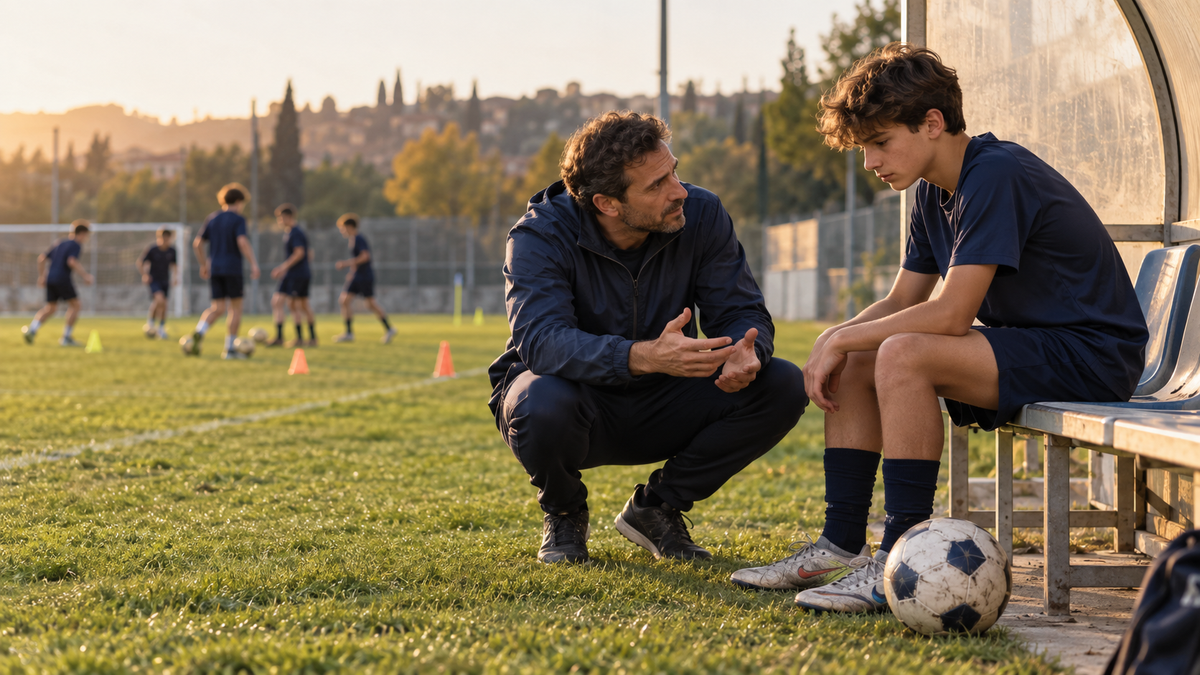
10 October 2026What decides whether a young player stays isn't only the result: how their coach treats them matters too.
by Fabio Zarra
01 THE DATA
A rift that starts early
Youth teams started up again just a few weeks ago. It's the right moment to look at a figure that clubs know but rarely confront: at some point, many kids quit. Youth dropout is therefore more topical than ever. According to figures compiled by TEHA Group from Istat data and presented in June at the Sport Business Forum in Treviso by the Osservatorio Valore Sport, in 2024 75% of kids aged 11 to 14 played sport, 66% of those aged 15 to 17, and 56% of those aged 18 to 19. In the same age bands, the share of those who used to play and then stopped rises from 9% to 16% to 28%.
The Istat report “Sports participation in Italy” (2024 data, published in June 2025) points to a clear gender difference in dropout among young people aged 10–24: 21.6% of girls versus 15.1% of boys, with an average age of stopping of 14 for the former and 15 for the latter. According to Istat data reported in the press, the young people in this age group who have quit number over 1.5 million.
The Observatory's researchers identify five areas that shape teenagers' perceptions: family, school, coach, sports facility and neighbourhood. The coach is therefore one factor, not the sole culprit. And the shortage of facilities, which often dominates the debate, doesn't emerge as the main reason.
02 ONE CAUSE AMONG MANY
Why look at the coach in particular
If the causes are many, why focus on the coach? Because, among those that depend on the people who work with the kids every day, it is among the most modifiable. And the literature points in the same direction. A systematic review by Balish and colleagues examined 141 correlates of youth sport dropout: among those with the highest-quality evidence are autonomy, perceived competence, relatedness to others and a task-oriented climate, and the conclusions speak of factors that are largely social. [1]
A systematic review with meta-analysis of prospective studies on dropout from team sports in adolescence (6,304 players in total across the selected studies) found the strongest relationships with drop-out in constructs related to motivation and sporting experience, and recommends that clubs cultivate a high-quality motivational climate. [2]
Autonomy, competence and relatedness aren't slogans. They are the three basic psychological needs of self-determination theory, and they are exactly what a coach can nurture or frustrate through their everyday way of being on the pitch.
The opposite of autonomy support isn't structure: it's control.
03 A USEFUL DISTINCTION
Controlling isn't directing
Mageau and Vallerand's motivational model of the coach-athlete relationship identifies three coach behaviours that foster satisfaction of the needs for autonomy, competence and relatedness: autonomy support, structure and involvement. [3] Structure is a distinct dimension of the model, alongside autonomy support: giving clear rules, goals and explanations is not the problem. In this framework, supporting autonomy doesn't mean giving up structure.
The problem is control. The Controlling Coach Behaviors Scale by Bartholomew, Ntoumanis and Thøgersen-Ntoumani, validated across several samples, distinguishes four components of a controlling style: controlling use of rewards, negative conditional regard, intimidation and excessive personal control. [4]
Rewards used to control. Prizes, and also praise, used as leverage to get kids to behave a certain way. The signal is that recognition serves to make them train harder, not to acknowledge their progress.
Negative conditional regard. The coach appears cold, distant or indifferent toward those who don't conform to their way of seeing things, or who aren't performing. Affection and attention become bargaining chips.
Intimidation. Verbally humiliating a kid, even in front of others, or evaluating their performance non-constructively to obtain a behaviour.
Excessive personal control. Interfering in aspects of the kid's private life, or demanding that sport be the centre of their life.
A practical rule, consistent with the distinction the literature makes between practices that target the person (negative conditional regard, intimidation, personal control) and practices that concern behaviour (use of rewards): tone of voice isn't the dividing line, what is targeted is — the technical action, or the person. [9]
04 WHAT HAPPENS INSIDE THE KID
From control to need frustration, and on to ill-being
In two cross-sectional studies of athletes and in a diary study, Bartholomew and colleagues found that perceived coach control was associated with frustration of psychological needs, and that this was associated more consistently than need satisfaction with negative outcomes: burnout, depression, negative affect and physical symptoms. Need frustration was also associated with altered physiological arousal before training, and the diary study found the same relationships at the daily level. [5]
In youth football the picture is similar. In a longitudinal study of young male footballers (about 12–13 years old, 725 participants at the first assessment and 597 at the second, within the same season), changes in perceived control were associated with changes in need frustration, which corresponded to increases in burnout. [6] In a study of 433 male footballers aged 12 to 15 from 24 football schools in the province of Valencia, the model explained 47% of the variance in burnout, as well as negative affect and symptoms of physical and psychological ill-being. [7]
Some caveats are in order. The 2017 study is cross-sectional, based on self-reported questionnaires and includes only boys: girls are missing, that is, the group in which dropout in Italy is more frequent and earlier. In the sample, players described their coaches on average as slightly or moderately controlling, so the association emerges even in a sample not dominated by extreme cases.
Closer to the intention to stay, a study of 658 Spanish water polo players aged 13 to 18 measured commitment to continuing in sport (among the items, determination to continue the following season). The group that perceived its coaches as poorly supportive and highly controlling showed the lowest values, while the other four groups did not differ significantly from each other. [9] This study too is cross-sectional and concerns a single sport. Burnout, ill-being and declared commitment don't coincide with actual dropout, and the authors of the football studies themselves point to dropout as the variable to study in this framework.
05 IT CAN BE CHANGED
A teachable behaviour, a measurable effect
The most direct evidence that coach behaviour can shift the dropout rate comes from a field experiment by Barnett, Smoll and Smith. Eight Little League baseball coaches took part in a pre-season workshop, Coach Effectiveness Training, while a control group consisted of ten coaches. [8] At the end of the season the children coached by the trained coaches rated their coach, teammates and sport more positively. At the start of the following season, 26% of the kids in the control group had quit, versus 5% of the experimental group. There was no difference in the teams' average win-loss percentages between those who had quit and those who had stayed, which indicates that dropout didn't depend on the team's lack of success.
The limits must be stated: few coaches, a single sport, a study from 1992. It should be read as a strong but not definitive indication. Its value lies in showing that a set of teachable behaviours, in particular praising effort and desirable performance and reacting to mistakes with encouragement and instruction, can change a figure like dropout.
06 PRACTICAL IMPLICATIONS
What to do starting from the next session
The suggestions that follow are practical applications of the cited findings, not the result of a single study.
After a mistake, recognition first, then correction. A signal that acknowledges intention or effort, followed by technical instruction, in the same sentence if possible.
Explain why and give real but limited choices. Not “you decide what to do”, but “choose in which order to do these drills”. Technical control stays with the coach, the perception of autonomy passes in part to the kids.
Don't turn attention and affection into currency. Ask yourself who you give attention to after a poor performance, and with what expression. For a week, note who you talk to and how.
Align the whole staff. Fitness coach, assistant, match analyst: if a single figure uses only correction and no recognition, that remains the kid's experience.
| How do you train a staff that knows how to create a climate of growth? Autonomy support, feedback after mistakes, attention management: these are observable and trainable behaviours, also for coaches and managers in youth sport. Let's talk about it. www.sportpsychologycenter.com |
07 IN CLOSING
A question for the start of the season
No coach, on their own, can bring dropout down to zero: family, school, club and neighbourhood all matter. But among all the levers, everyday behaviour on the pitch is the one that can change as early as tomorrow, with no tenders and no budget. The question for every staff, at the start of the season, isn't only how many matches we will win, but how many of these kids will still want to be here in June.
SCIENTIFIC REFERENCES
[1] Balish, S. M., McLaren, C., Rainham, D., & Blanchard, C. (2014). Correlates of youth sport attrition: A review and future directions. Psychology of Sport and Exercise, 15(4), 429–439. DOI: 10.1016/j.psychsport.2014.04.003 https://www.sciencedirect.com/science/article/abs/pii/S1469029214000508
[2] Back, J., Johnson, U., Svedberg, P., McCall, A., & Ivarsson, A. (2022). Drop-out from team sport among adolescents: A systematic review and meta-analysis of prospective studies. Psychology of Sport and Exercise, 61, 102205. DOI: 10.1016/j.psychsport.2022.102205
[3] Mageau, G. A., & Vallerand, R. J. (2003). The coach–athlete relationship: A motivational model. Journal of Sports Sciences, 21(11), 883–904.
[4] Bartholomew, K. J., Ntoumanis, N., & Thøgersen-Ntoumani, C. (2010). The controlling interpersonal style in a coaching context: Development and initial validation of a psychometric scale. Journal of Sport and Exercise Psychology, 32(2), 193–216. DOI: 10.1123/jsep.32.2.193
[5] Bartholomew, K. J., Ntoumanis, N., Ryan, R. M., Bosch, J. A., & Thøgersen-Ntoumani, C. (2011). Self-determination theory and diminished functioning: The role of interpersonal control and psychological need thwarting. Personality and Social Psychology Bulletin, 37(11), 1459–1473. DOI: 10.1177/0146167211413125
[6] Balaguer, I., González, L., Fabra, P., Castillo, I., Mercé, J., & Duda, J. L. (2012). Coaches' interpersonal style, basic psychological needs and the well- and ill-being of young soccer players: A longitudinal analysis. Journal of Sports Sciences, 30, 1619–1629. DOI: 10.1080/02640414.2012.731517
[7] Mars, L., Castillo, I., López-Walle, J., & Balaguer, I. (2017). Estilo controlador del entrenador, frustración de las necesidades y malestar en futbolistas. Revista de Psicología del Deporte, 26(Suppl 2), 119–124.
[8] Barnett, N. P., Smoll, F. L., & Smith, R. E. (1992). Effects of enhancing coach-athlete relationships on youth sport attrition. The Sport Psychologist, 6(2), 111–127.
[9] Abós, Á., Murillo, M., Sevil-Serrano, J., & García-González, L. (2023). How coaches' need-supportive and controlling behaviors are related to different (mal)adaptive outcomes in water polo players: A person-centered approach. Current Psychology, 42(10), 8085–8096. DOI: 10.1007/s12144-021-02101-y
JOURNALISTIC SOURCES
Istat, “La pratica sportiva in Italia” (2024 data, June 2025), istat.it.
Quotidiano.net / Luce (05/06/2026), “I giovani abbandonano lo sport proprio quando dovrebbero ‘insistere’: l'allarme dell'Osservatorio Valore Sport” [“Young people drop out of sport just when they should ‘persist’: the alarm from the Osservatorio Valore Sport”] (TEHA Group data based on Istat).
Sky TG24 (07/11/2025), “Il progetto di Vero Volley per combattere l'abbandono sportivo in Italia” [“Vero Volley's project to fight sport dropout in Italy”] (data from the Istat report on sports participation).

Fabio Zarra