
Youth dropout: how many kids will still want to be here in June?
6 October 2026They earn millions: do they really have the right to be tired?
17 October 2026An 84-point lead, a teammate stopped by a failure and a team principal who has to defend the fairness of the garage: what psychology says.
by Virginia Marino
01 THE PICTURE
The youngest leader ever and a weekend that doesn't start as planned
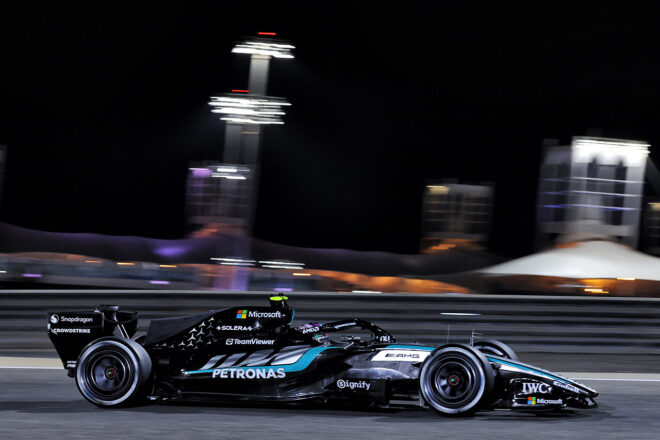
Kimi Antonelli arrives in Singapore with an 84-point lead over George Russell, his Mercedes teammate, with seven races still on the calendar. He turned twenty on 25 August. This season he has won in China and Japan, scored a Grand Slam at Monte Carlo and become the youngest championship leader in Formula 1 history. At Silverstone he took the first pole for an Italian at that circuit since 1953, the year of Alberto Ascari, the last Italian world champion.
The Singapore weekend, however, didn't begin as expected. In Friday's Sprint qualifying Antonelli was seventh, 573 thousandths behind Russell, who was second with the car's previous configuration, and 693 off Verstappen's pole. Russell, who retired at Sepang with a power unit problem (his third retirement of the season), will start Sunday from the back of the grid because of the unit replacement.
02 WOLFF'S WORDS
“Brainless”: the answer to suspicions of favouritism
On Friday, at the FIA press conference, Toto Wolff was asked what he would say to those who claim Mercedes favours Antonelli, especially after the failure that penalised Russell at Sepang. The answer was very harsh: according to international news agencies, Wolff called anyone who thinks that “brainless”, and according to the Italian press he suggested they watch the Teletubbies or Mickey Mouse instead of Formula 1. [5]
Beyond the tone, in substance Wolff did three things. He reiterated that the team's philosophy, since his arrival in 2013, is to give both drivers the same equipment. He presented the decision to run two different specifications in Singapore, with Antonelli on the update introduced in Malaysia and Russell on the configuration used in Baku, as a way of finding out which is faster and therefore as an example of equal treatment. Finally, he recalled his personal relationship with both: Mercedes has followed Antonelli since he was 11, and Wolff shares a city of residence with Russell, Monaco. Already after Japan he had presented them as the product of the same work by the Mercedes junior programme, of which they are both products.
A note on method. These are statements from a party to the dispute, and from the outside it isn't possible to establish how decisions are made inside the garage: this article takes no position on the merits. What we can do is ask why a leader feels the need to intervene so publicly, and what this means for a team and for a twenty-year-old driver.
03 WHY FAIRNESS MATTERS
Perceived fairness isn't a detail: it's psychological infrastructure
Research on organisational justice has shown this for decades. A meta-analysis of 183 studies (Colquitt and colleagues, 2001) distinguishes four dimensions: distributive justice (resources are fairly distributed), procedural justice (the decision-making process is fair), interpersonal justice (people are treated with respect) and informational justice (decisions are explained). The four dimensions are associated, with differing strengths, with outcomes such as satisfaction, commitment, evaluation of authority, cooperative behaviour, withdrawal from the group and performance. [1]
Wolff's three moves read well through this grid: the same equipment concerns the distributive dimension, explaining why two specifications are being tried concerns the procedural and informational ones, the relationship with Russell the interpersonal one. With one caution: the research concerns work organisations in general, not Formula 1 teams, and proves neither that fairness is real at Mercedes nor that it isn't. It's reasonable to assume, but remains a hypothesis, that in a garage with two drivers in contention and hundreds of people around, a statement of principle also serves to set a behavioural norm, and not only to answer critics.
A lead in the standings isn't a psychological advantage: it has to be defended twice, on track and in the perception of those watching.
04 DEFENDING A LEAD
Two ways of being in front: protecting or building
Tory Higgins' regulatory focus theory distinguishes two ways of self-regulating: promotion focus, oriented to goals, aspirations and gains, and prevention focus, oriented to safety, responsibility and losses to be avoided. [2] In laboratory experiments, Crowe and Higgins observed that promotion focus leads to more “eager” strategies and prevention focus to more conservative ones. Faced with a difficult task or after a failure, those in promotion did better, while those in prevention tended to give up more easily. [3]
Indirect evidence comes from golf. Pope and Schweitzer analysed over 2.5 million putts on the PGA Tour and found that even the best players, Tiger Woods included, show loss aversion: every hole has a reference point, par: players seem to experience a score worse than par as a loss and one better as a gain. Putts for birdie, the gain, turn out to be less accurate than those to save par. [4]
Applying these results to a Formula 1 driver is a leap that has to be declared: none of these studies concerns racing. But the hypothesis is interesting. A leader with an 84-point lead has a natural reference point, the title, and every point lost risks weighing more than a point gained. Caution, in itself, isn't a flaw: in a championship where a retirement costs enormously, settling for second place can be rational. The psychological risk is another: that caution becomes a way of being in the car and not a race choice, extending also to the moments when attacking is needed.
05 A CROOKED WEEKEND
Seventh in Sprint qualifying isn't a crisis: it's information
Commenting on qualifying, Antonelli spoke in technical and process terms: there's still a lot to understand about the package, the car is unpredictable and doing a clean lap is hard, he told ANSA. It's a language that separates the result of the session from judgement of oneself. And it's consistent with a relationship to criticism already seen in the past: a year ago, after the 2025 Italian Grand Prix, Wolff had called his driver's race disappointing, and Antonelli had replied that he understood the comment and that with Toto they always talk openly, also admitting a mistake of his own at the start. [6]
We don't know how Antonelli really experiences this phase, and we can't deduce it from two sentences to the press. We can, however, say what, in line with the cited studies, tends to protect those in front: reading a difficult weekend as a question to answer, not as a signal to defend. Crowe and Higgins suggest that after a setback the promotion stance, the one that asks “what can I build”, is more productive than the one that asks “what do I risk losing”.
06 PRACTICAL IMPLICATIONS
What coaches can take home: four pointers
The pointers that follow are practical applications of the cited findings, not the result of a study on Formula 1.
Explain the criteria, especially when you treat two athletes differently. Playing time, roles, equipment: if choices differ, the why must be said before others say it. This is the informational dimension of justice.
Step in early and with a few consistent messages. A rumour that circulates for days without an orderly reply risks looking like a confirmation. Better a clear position, repeated with the same content by the whole staff.
Distinguish caution from passivity when a team or an athlete is ahead. Define in advance which behaviours remain offensive even with the lead, that is, the process goals that don't change with the score.
After a bad session, technical analysis first, judgement second. Ask what there is to understand before asking what went wrong: it shifts attention from what is being lost to what is being built.
| How do you prepare an athlete to manage a lead, or a suspicion? Expectation management, staff communication and regulation after a difficult weekend are trainable skills, not natural gifts. Let's talk about it. www.sportpsychologycenter.com |
07 IN CLOSING
The title isn't decided, and the piece is worth it anyway
The Singapore race and the six that follow will say a lot, and this article is written before knowing them. But regardless of the outcome, the Antonelli case and Wolff's words show something simple and often underestimated: being in front isn't a state, it's a task. It's defended with the car, with the head and with the trust of those around. And when the points are many, this last part is the least visible and not the least important.
SCIENTIFIC REFERENCES
[1] Colquitt, J. A., Conlon, D. E., Wesson, M. J., Porter, C. O. L. H., & Ng, K. Y. (2001). Justice at the millennium: A meta-analytic review of 25 years of organizational justice research. Journal of Applied Psychology, 86(3), 425–445. DOI: 10.1037/0021-9010.86.3.425 https://www.researchgate.net/publication/11920237_Justice_at_the_Millennium_A_Meta-Analytic_Review_of_25_Years_of_Organizational_Justice_Research
[2] Higgins, E. T. (1997). Beyond pleasure and pain. American Psychologist, 52(12), 1280–1300. DOI: 10.1037/0003-066X.52.12.1280
[3] Crowe, E., & Higgins, E. T. (1997). Regulatory focus and strategic inclinations: Promotion and prevention in decision-making. Organizational Behavior and Human Decision Processes, 69(2), 117–132.
[4] Pope, D. G., & Schweitzer, M. E. (2011). Is Tiger Woods loss averse? Persistent bias in the face of experience, competition, and high stakes. American Economic Review, 101(1), 129–157. DOI: 10.1257/aer.101.1.129
JOURNALISTIC SOURCES
[5] The Washington Post / AP (09/10/2026), “Mercedes boss Wolff slams ‘brainless’ claims team would favor Antonelli over Russell”; Formula1.com (October 2026), “‘Brainless’: Wolff fires back at ‘lunatics’ over Antonelli/Russell treatment rumours”; Formula1.it and Fanpage.it (October 2026), reports of the Singapore FIA press conference; Crash.net (late March 2026), Wolff interview with Sky Sports after the Japanese GP.
[6] SI.com (September 2025), “Kimi Antonelli reacts to harsh Toto Wolff criticism”.
ANSA (09/10/2026), “A Singapore Verstappen in pole per la Sprint, Antonelli fatica” [“In Singapore Verstappen on Sprint pole, Antonelli struggles”]; Motorsport.com Italia (October 2026), Singapore GP Sprint qualifying.
Sky Sport (October 2026), drivers' standings and the state of the 2026 F1 World Championship; AGI (29/03/2026) and Open (25/08/2026), Antonelli's records; Automoto.it (04/07/2026), Silverstone pole.
