
«Non siamo perfetti»: Sylla, la sua psicologa e la scienza dietro l’imagery mentale
5 September 2026Winning and getting sacked on the same day: the psychology behind sport's most precarious job
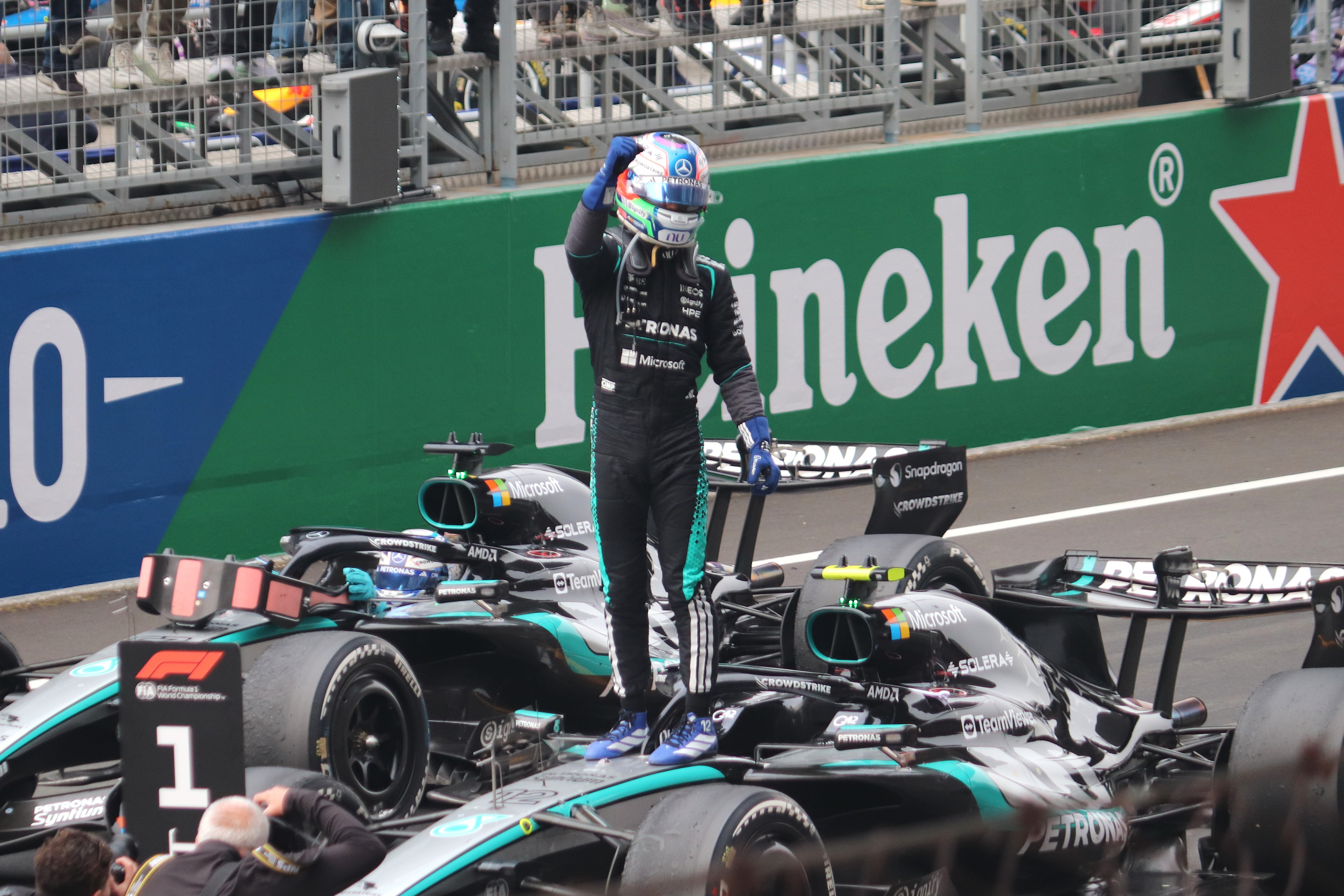
8 September 2026Sixty years after the last Italian win at the Italian Grand Prix, Andrea Kimi Antonelli rewrote Monza's history by climbing from nineteenth on the grid to the top step of the podium, in front of his home crowd. It's the kind of feat that, in the heat of the moment, gets read almost purely in technical terms: tyre strategy, safety car, engine power. But a comeback of this scale, achieved in a single afternoon, under the eyes of an entire country that had waited six decades, is above all a textbook case of applied sport psychology. Inside those fifty-three laps lies a precise set of mental processes — resilience, attentional regulation and pressure management — that sport psychology can help us read and, above all, train in athletes at every level, not just in Formula 1 paddocks.
Author Fabio Zarra
01 — RESETTING AFTER THE MISTAKE: RESILIENCE AS A PROCESS, NOT A TRAIT
Starting nineteenth on home soil, in front of hundreds of thousands of fans who had come specifically to see him win, is exactly the kind of event scientific literature calls an acute performance stressor: a single, intense episode carrying a very high evaluative load, capable of triggering frustration, doubt and a dangerous narrowing of focus onto an already-compromised result. It's the moment when many athletes, even elite ones, start racing "against" the standings instead of "inside" the race, spending cognitive resources ruminating on the mistake instead of building the response.
Sarkar and Fletcher's (2014) systematic review of the protective factors behind sporting resilience describes exactly this mechanism: it isn't the absence of difficulty that sets elite athletes apart, but the ability to activate psychological resources — dispositional optimism, perceived control, emotional regulation and solid social support — that allow performance to stay stable right after an adverse event, instead of letting the negative episode spiral into further mistakes. The authors describe a genuine biopsychosocial "protective filter": the sturdier it is, the smaller the disruption a single negative event can produce on subsequent performance.
In Antonelli's case, the most interesting signal isn't the comeback itself, but its speed: the ability to treat a disastrous qualifying session as a closed, settled matter, and then immediately redirect attention to the next task — one overtake at a time — rather than to the overall gap to close. Clinically, it's the difference between reading the mistake as a "specific and temporary" event (I got this qualifying session wrong) versus a "global and permanent" one (I'm not up to this weekend): the first opens the door to a comeback, the second makes it psychologically almost impossible before the lights even go out.
It's also useful to compare this with the concept of post-error emotional reactivity, studied especially in sports with immediate margins for correction, such as tennis or golf: athletes who recover their optimal state of arousal fastest after a setback aren't the ones who feel no frustration, but the ones with well-established routines for quickly putting that frustration back to work for the task at hand. A bad starting grid position, in this sense, is no different from a double fault at 15-40: what matters is how much time passes between the mistake and the return to clean execution.
02 — ONE OVERTAKE AFTER ANOTHER: WHY EXTERNAL FOCUS HOLDS UP UNDER PRESSURE
Climbing eighteen positions in a single race requires dozens of rapid decisions, any one of which could be compromised by one evaluative thought too many ("am I recovering fast enough? what if I get this overtake wrong too?"). The more the stakes grow lap by lap — and at Monza, in front of the home crowd, they grow with every corner — the greater the risk that attention shifts from the motor task to one's own internal state: an apparently small change that research on motor attention has nonetheless shown to be decisive for performance outcomes.
Mullen, Faull, Jones and Kingston's (2012) study, conducted on a simulated driving task under competitive pressure, compared a group instructed to maintain an external attentional focus — that is, oriented on a reference point outside the body, such as the racing line or the braking point — with a group instructed to use an internal focus, centred on their own movements or physical state. The first group produced superior performance and a lower investment of mental effort, measured through heart rate variability: an indicator that looking "outside oneself" relies on more automatic, cognitively cheaper control processes. When additional competitive pressure was introduced during the race phase, the external-focus group kept improving its performance, while the internal-focus group showed more marked signs of deterioration.
Translated into the Monza comeback: staying anchored to the immediate task — the next braking point, the slipstream to exploit, the gap to seize on the car ahead — is what makes a whole race's worth of overtaking sustainable, without the weight of the final result interfering with technical execution. Every time a driver's attention slips onto "what would happen if I won" instead of "where do I brake now", the risk of error rises measurably: it's the same dynamic that, in youth sport, makes a talented kid miss the last free throw precisely when he starts thinking about how great it would be to score it.
For coaches, the practical point is that external focus isn't a generic mental attitude to suggest ("stay focused"), but a skill trained through concrete, checkable cues: a precise visual reference, an audio signal, a point on the track or field to bring attention back to whenever a drift toward evaluative thoughts is noticed.
03 — HOME-CROWD PRESSURE: RISK OR FUEL?
Winning in front of your home crowd is never psychologically neutral, and research has documented this for decades. Baumeister and Steinhilber's (1984) classic study on the so-called "home choke" showed how, in decisive situations, the support of a home crowd can paradoxically increase self-consciousness and fear of letting people down, worsening performance precisely when support is most intense. The mechanism the authors propose is as simple as it is insidious: the more the crowd expects victory, the more the athlete stops executing the action automatically and starts consciously monitoring it — a bit like someone who trips on the stairs precisely when they realise someone is watching. The effect has been replicated in other contexts — from free throws in basketball to biathlon in front of a home crowd — always with the same pattern: technical performance worsens as the emotional stakes of the context rise.
| The difference between those who are overwhelmed by pressure and those who turn it into performance isn't the absence of arousal, but the ability to keep it within a functional range. |
Yet not all elite athletes respond the same way, and this is where the picture gets interestingly complicated. A recent study published in Frontiers in Psychology (2026) on Formula 1 and Formula 2 drivers found that F1 drivers show significantly higher levels of concentration and confidence than their counterparts in the feeder category, at the same age — a finding the authors interpret as evidence that attentional control under pressure is a psychological skill selected for and trained along the path to the top, rather than a simple effect of age-related maturation or accumulated experience. In an environment like motorsport, where an attentional error can cost not just the race but physical safety, this ability seems to function as a genuine evolutionary filter toward the elite.
This is the point where Antonelli's story departs from the "home choke" script: the heat of Monza didn't erode his clarity, but seems to have been absorbed into an attentional profile already trained to stay stable regardless of the emotional stakes of the context. The way he managed the early laps — without forcing his way back, without attempting risky overtakes in phases where the risk outweighed the benefit — tells us more than a team strategy: it tells of arousal kept within a functional range, neither so low that it slowed his reading of the race, nor so high that it dangerously narrowed his attentional field, as typically happens in moments of choking under pressure.
It's also worth noting the role of the team context in this balance: a pit wall that communicates in an essential way, without amplifying the enormity of the moment over the radio, itself acts as an external regulator of the driver's arousal — a form of social support that the same resilience literature identifies as a protective factor in its own right, distinct from the athlete's individual abilities alone.
04 — WHAT REMAINS, FOR THOSE WHO COACH ATHLETES AND YOUNG TALENT
Beyond the excitement of the moment, the Monza story offers some insights that transfer to any sporting context, from youth sport to high-level individual sport.
- Resilience is trained upstream: normalizing a qualifying mistake (or a bad start, a lost first set, a slow first lap) as a closed, specific fact, not as an identity threat, is work done during the week, through targeted cognitive work, not on the starting grid.
- External focus must be built with concrete, observable cues (a point, a line, an opponent, a signal), not with generic invitations to "stay focused", which by themselves provide no reference for attention to actually anchor to.
- The home crowd, and external expectation more broadly, should be neither avoided nor idealized: it needs to be prepared for, through realistic pressure simulations in training, so that the first encounter with that level of arousal doesn't happen on the day of the race that matters most.
- Communication from the entourage — technical staff, coach, family — is itself a tool for regulating the athlete's arousal, and as such should be designed deliberately, not left to the instinct of the moment.
The Monza comeback will be remembered as a sporting feat, and rightly so. But for those who work every day with athletes and sporting elites, it remains above all a valuable case study in how resilience, attention and pressure management can be read, understood and — above all — trained intentionally, even in the most exposed, expectation-laden moments of a career.
| SPORT PSYCHOLOGY CENTER Want to train the same mental clarity as a driver or elite athlete under pressure? Discover SPC Academy's programmes and the MAT mental trainer to build resilience, focus and arousal management in competition. |
REFERENCES
- Sarkar, M., & Fletcher, D. (2014). Psychological resilience in sport performers: a review of stressors and protective factors. Journal of Sports Sciences, 32(15), 1419–1434. DOI: 10.1080/02640414.2014.901551
- Mullen, R., Faull, A., Jones, E. S., & Kingston, K. (2012). Attentional focus and performance anxiety: effects on simulated race-driving performance and heart rate variability. Frontiers in Psychology, 3:426. DOI: 10.3389/fpsyg.2012.00426
- Baumeister, R. F., & Steinhilber, A. (1984). Paradoxical effects of supportive audiences on performance under pressure: The home field disadvantage in sports championships. Journal of Personality and Social Psychology, 47(1), 85–93. DOI: 10.1037/0022-3514.47.1.85
- McKnight, K., et al. (2026). Formula 1 drivers demonstrate superior concentration and confidence compared to Formula 2 drivers. Frontiers in Psychology. DOI: 10.3389/fpsyg.2026.1697498

Fabio Zarra