Sara Curtis and the record of the record
14 August 202689 minutes, 130 points: what happens to the mind when the pressure never ends
27 August 2026From 10 to 16 August 2026 in Birmingham, Italian athletics wins 8 golds, tops the European medal table, and delivers stories that go well beyond the sporting result. Nadia Battocletti wins the 5000-10000 double for the second consecutive time after a bout of flu that had stopped her in late May. Tentoglou takes his gold medal off and gives it to his rival. Skrzyszowska loses by a thousandth of a second and hugs the woman who beat her. Sport psychology tries to explain all of this.
Author Fabio Zarra www.sportpsychologycenter.com
There are editions of the European Athletics Championships that leave a mark — not only in the medal table, but in memory too. Birmingham 2026, which closes today, 16 August, at the Alexander Stadium, is already one of those. Italy tops the medal table with eight golds and nineteen medals in total, the largest delegation in its history at the European Athletics Championships with 130 athletes. Nadia Battocletti won the 5000m and 10000m double title for the second consecutive edition, becoming the first athlete — man or woman — to do so in two Europeans in a row. Gianmarco Tamberi reclaimed the high jump title on his daughter Camilla's birthday. Andy Diaz carried the Italian flag on the triple jump runway, flanked by Giovanni Dallavalle taking bronze.
But what Birmingham 2026 gave to world athletics isn't only Italian. It's a catalogue of gestures that remind us why sport exists, beyond the medal table: Tentoglou sharing his own gold medal with Ehammer in a gesture of camaraderie — and then forgetting it in the changing room, running back to retrieve it live on TV. Skrzyszowska losing the 100m hurdles by a thousandth of a second and immediately embracing the winner. Battocletti looking almost happier about a friend's bronze than about her own gold. Palmisano and Maria Pérez embracing after the race the way only people who truly respect each other can.
This article has two stories to tell. The first is Italian, and it's about a sporting movement that has found itself. The second is universal, and it's about what makes sport something more than mere competition.
01 — THE RESULTS
Eight golds and a table worth framing
Numbers first, because the numbers tell the depth of what happened in Birmingham. Italy won eight European titles in seven days, spread across different disciplines — sprints, jumps, throws, race walking, middle distance — and different categories — senior men and women. This isn't specialisation in a niche: it's broad dominance. A delegation of 130 athletes, the largest in Italian history at this event. And first place in the medal table ahead of Great Britain — on home soil for the British.
| ITALY'S 8 GOLDS · EUROPEAN ATHLETICS CHAMPIONSHIPS BIRMINGHAM 2026 | |
| Leonardo Fabbri | Men's shot put |
| Nadia Battocletti | Women's 5000m |
| Nadia Battocletti | Women's 10,000m |
| Dariya Derkach | Women's triple jump |
| Gianmarco Tamberi | Men's high jump |
| Massimo Stano | Race walk — men's 20km |
| Sofia Fiorini | Race walk — women's 35km |
| Andy Diaz | Men's triple jump |
Alongside the golds, a wealth of silvers and bronzes tells the story of the movement's depth: Matteo Sioli bronze in the high jump, where Tamberi takes gold — two Italians on the same podium. Dallavalle bronze in the triple jump, where Diaz triumphs. Micol Majori bronze in the 5000m, where Battocletti dominates. Pietro Riva silver in the marathon. The 4×400m relay teams in the final with new Italian records. All this happened while Marcell Jacobs — still dealing with a muscle problem — finished seventh in the 100m, and while Mattia Furlani couldn't find the mark for the podium. The final tally is the kind that gets remembered.
02 — BATTOCLETTI
«I feel more like an eagle»: the psychology of the double gold
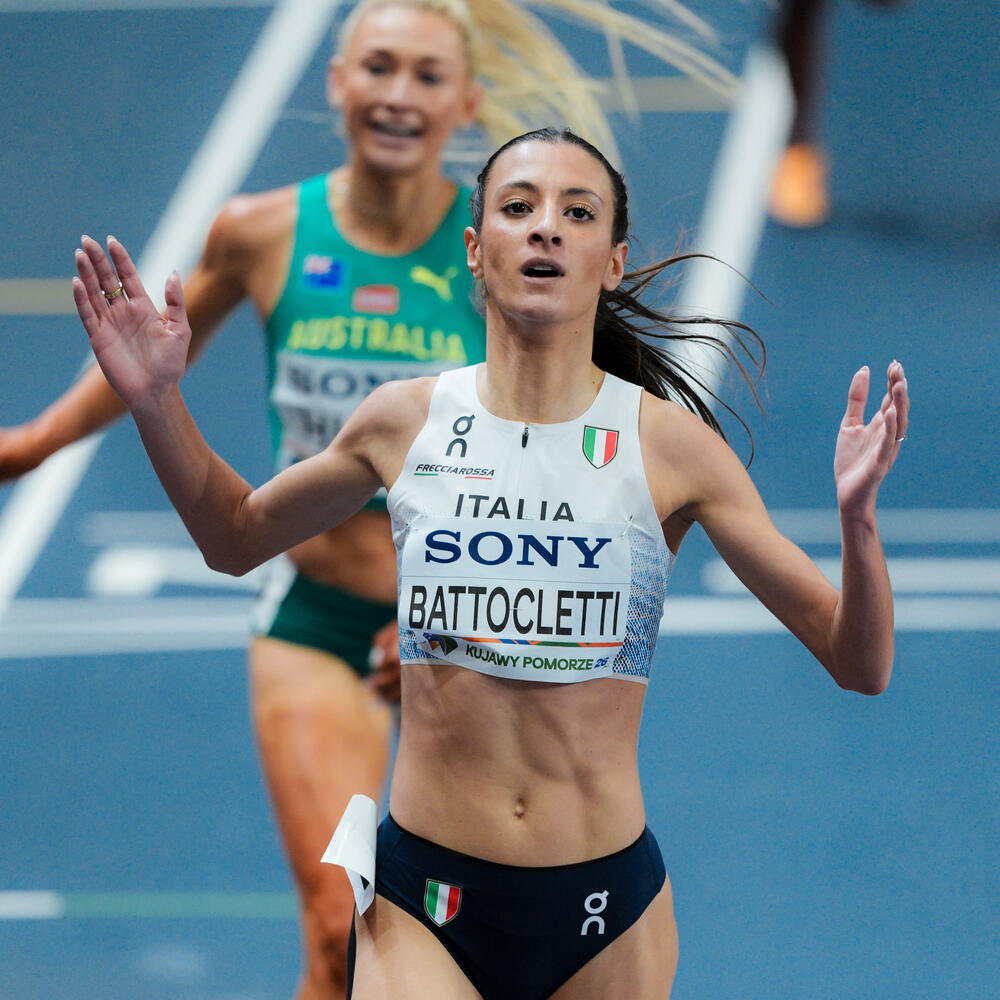
The biggest story of these Europeans has a precise name: Nadia Battocletti. Twenty-five years old, from Trento, coached by her father Giuliano, an architecture student a step away from her degree thesis. She won the 5000m on Monday 11 August in 15:37.84, with the crown carried by her mother Jawhara on the victory lap — «I would never have allowed myself to do that, but she's visionary. I feel more like an eagle» — then the 10,000m on 14 August, with the same surgical tactic: controlled pace for three-quarters of the race, then the acceleration at 250 metres that no rival could match.
What makes this double even more significant is the context that precedes it. In late May 2026, Battocletti had come down with flu that forced her to stop for weeks — in the most important season, just months before the Europeans. She could have arrived in Birmingham in reduced form, with a ready-made excuse. Instead she arrived as a dominant force, winning the same races she had already won in Rome in 2024 — the first athlete of either gender to do so in two consecutive Europeans.
| «Maybe I still don't realise the level I'm at. I should be a bit less indulgent with myself and tell myself I'm really strong.» NADIA BATTOCLETTI · AFTER WINNING THE 10,000M, BIRMINGHAM, 14 AUGUST 2026 |
The psychology of resilience, in the model developed by Fletcher and Sarkar through interviews with British Olympic champions, describes the ability to turn adversity into a resource — not to ignore it, but to use it as material for growth. Battocletti didn't pretend the flu hadn't happened: she went through it, adapted her preparation, kept her trajectory intact. The result is a champion who arrives at the European Championships with the awareness of having already overcome something difficult.
There's also a motivational dimension to her story worth attention. Deci and Ryan, in Self-Determination Theory, describe how athletes driven by intrinsic motivation — who run because they love running, because they find satisfaction in the challenge itself — develop greater consistency and resilience in performance over the long term. Battocletti puts it in words that are almost a spontaneous case study: «It was a beautiful day, I had so much fun». Not «I'm satisfied with the result» or «I executed the race plan»: I had fun. In the middle of a European competition, in a race a continental title depends on, her dominant experience is enjoyment. This is the psychological profile of an athlete who runs for no other reason than love of what she does.
03 — THE MODEL
Coached by her father: the psychology of a unique relationship
There's an aspect of Battocletti's story that coaching psychology can't ignore: she's coached by her father. Giuliano Battocletti isn't just her coach — he's her parent. He's the person who watched her grow up, who knows every one of her emotional nuances, who manages the same relationship on two completely different planes: the family relationship and the technical one. It's one of the most complex roles that exist in sports coaching.
Sophia Jowett's 3+1Cs model of the coach-athlete relationship describes four dimensions that determine its quality: closeness (emotional proximity and mutual trust), commitment (dedication to maintaining the relationship), complementarity (cooperative and responsive behaviours), and co-orientation (shared perception of the relationship). In Battocletti's case, closeness is structural — not built over time through work, but pre-existing within the family dimension. This can be an enormous advantage (maximum trust, immediate communication, deep knowledge of the athlete) or a risk (difficulty distinguishing roles, conflicts that spill beyond the technical environment).
Battocletti's words after the 10,000m say something precise about how this relationship works: «I'm at this level thanks to him too, since he built my entire staff. I'm really happy that he's the one coaching me, he understands me instantly». There's no ambiguity in how the relationship is perceived: the father-coach is a resource, not a burden. Co-orientation — Jowett's term for the shared perception of how the relationship works — is high. And that translates into performance.
04 — THE SPIRIT OF BIRMINGHAM
The psychology of fair play: why champions embrace the people who beat them
There were more medals at these Europeans than appear in the official table. There were invisible ones: a hug at the finish line, a medal handed over with open hands to the athlete who didn't win it, a smile in the hardest moment. Sky Sport, which covered the event, collected them one by one as if they were part of the official programme — and in a sense, they were.
Tentoglou, winner of the long jump with 8.44 metres, shares his own gold medal with runner-up Ehammer in a spontaneous gesture of respect — and then, in the post-race stress, leaves it on a bench in the changing room and has to interrupt a live interview to run and retrieve it. «If it had been heavier I'd have appreciated it more», he'll joke, returning in front of the cameras with the medal around his neck. Saraboyukov overtakes Baldé on the final jump, and Baldé applauds him instantly, without hesitation. Skrzyszowska loses the women's 100m hurdles by a thousandth of a second — not a hundredth, not a tenth: a thousandth — and the first thing she does is open her arms to the winner. Battocletti wins her third European gold on the track and seems almost happier about Micol Majori's bronze — who had raced without even packing her official tracksuit, not believing it possible — than about her own title.
| «It was unthinkable — of course I dreamed of it, but I didn't even pack the official tracksuit for a possible medal ceremony.» MICOL MAJORI · AFTER BRONZE IN THE WOMEN'S 5000M, BIRMINGHAM, 2026 |
Research by Vallerand and colleagues developed a multidimensional definition of sportspersonship, identifying five dimensions: full commitment to participation, respect for the social conventions of sport, respect for the rules and officials, respect and care for opponents, and the absence of a «win at all costs» orientation. What Birmingham 2026 offered — in the gestures of Tentoglou, Skrzyszowska, Battocletti, and Palmisano — is a concrete manifestation of all five of these dimensions, in the most visible and most moving form possible.
But there's a deeper psychological question behind these gestures: why? Why can an athlete who has just lost the most important race of the year by a thousandth of a second find within herself the generosity to embrace the woman who beat her? The answer — partly counterintuitive — is that this generosity isn't in spite of the competition. It's the product of competition experienced the right way: with an athletic identity solid enough not to depend on a single result to find its own worth. Those who lose with grace don't do it because they didn't care. They do it because they cared about the right thing.
05 — ITALY
The psychology of a sporting movement that found itself
There's a bigger question Birmingham 2026 raises, and it's worth addressing: how is this possible? How did Italian athletics — which hadn't won an Olympic gold in years before Tokyo 2020 — become, within a few years, one of the athletically dominant nations in Europe?
The answer isn't in a single decision or a single talented coach. It lies in what psychology calls collective efficacy: a group's shared belief in its own ability to achieve ambitious goals. When Marcell Jacobs and Gianmarco Tamberi win gold in Tokyo in 2021 on the same afternoon — the 100m and the high jump within a few hours — something changes, not only in Italian athletics, but in how Italian athletes perceive themselves and what's possible. Bandura showed that collective efficacy is built through shared experiences of success: every gold becomes proof that the next one is possible too. Jacobs opens the door. Tamberi throws it wide open. Battocletti, Fabbri, Diaz, Derkach, Stano — each with their own story — walk through it.
It's no coincidence that the Italian delegation at the 2026 European Athletics Championships numbers 130 athletes — the highest figure in its history. It isn't just an effect of the results: it's the cause of the results that follow. When a movement believes in itself, young athletes are drawn to it, investment arrives, talent finds a system that welcomes it. Italian athletics is living through a virtuous circle whose psychological engine is collective efficacy — and Birmingham is its most concrete demonstration in the last twenty years.
06 — CLOSING THOUGHTS
What remains after the last race
Today the Alexander Stadium closes, Birmingham's lights go out, and the athletes head home with their medals and their stories. Italy goes home with a haul that was unimaginable ten years ago. Battocletti goes home with two golds and a degree thesis still to defend. Tamberi goes home with a European title to dedicate to Camilla. Majori goes home with a bronze medal she didn't even have the clothes to collect.
But something remains beyond the medals, and this edition showed it with unusual clarity: sport, when it truly works, produces not just results but behaviour. Tentoglou's generosity, Skrzyszowska's grace, Battocletti and Majori's shared joy aren't accidents. They're the product of years of sporting development that didn't stop at technique, but also built a way of being in competition — with oneself, with opponents, with the idea of winning and losing.
This is the sport we want to tell you about. Not just who wins, but how. Not just the result, but the person who achieves it. Birmingham 2026 gave Italy many reasons to celebrate. And it gave sport psychology many stories to be proud of.
| Do you want your competition to look like Battocletti's? Competing with joy, managing adversity, finding grace in defeat and generosity in victory: these are skills that are built, not left to chance. Working with a sport psychologist is exactly about this. → BOOK A FIRST CONSULTATION Sport Psychology Center · Professional consultancy, VR training and mental training |
SCIENTIFIC REFERENCES
- Vallerand, R. J., Deshaies, P., Cuerrier, J.-P., Brière, N. M., & Pelletier, L. G. (1996). Toward a multidimensional definition of sportsmanship. Journal of Applied Sport Psychology, 8(1), 89–101. DOI: 10.1080/10413209608406310 https://www.tandfonline.com/doi/abs/10.1080/10413209608406310
- Fletcher, D., & Sarkar, M. (2012). A grounded theory of psychological resilience in Olympic champions. Psychology of Sport and Exercise, 13(5), 669–678. DOI: 10.1016/j.psychsport.2012.04.007
- Jowett, S. (2007). Interdependence analysis and the 3+1Cs in the coach-athlete relationship. In S. Jowett & D. Lavallee (Eds.), Social psychology in sport (pp. 15–27). Champaign, IL: Human Kinetics.
- Deci, E. L., & Ryan, R. M. (2000). The “what” and “why” of goal pursuits: Human needs and the self-determination of behavior. Psychological Inquiry, 11(4), 227–268. DOI: 10.1207/S15327965PLI1104_01
- Bandura, A. (1997). Self-efficacy: The exercise of control. New York, NY: W. H. Freeman. [Collective efficacy as the engine of success for sporting movements]
News sources: Eurosport.it, FIDAL.it, Fanpage.it, Sky Sport, La Presse.it, Adnkronos, Sportface.it, Podisti.net, Notizie.it (August 2026). Alexander Stadium, Birmingham, 10-16 August 2026. Battocletti's statements: Eurosport and Sportface (14 August 2026). Majori's statement: FIDAL.it. Sportsmanship gestures: Sky Sport liveblog, 14-15 August. First athlete to win the 5000+10000 double in two consecutive Europeans (Eurosport). Italian delegation of 130 athletes: Olympics.com.

Fabio Zarra