«I don't want the pressure to destroy me»: Antonelli and the psychology of a champion learning to win
22 July 2026«Love for Italy doesn't depend on a role»: Pirlo, Maldini, Leonardo, the FIGC, and the psychology of reputation under attack
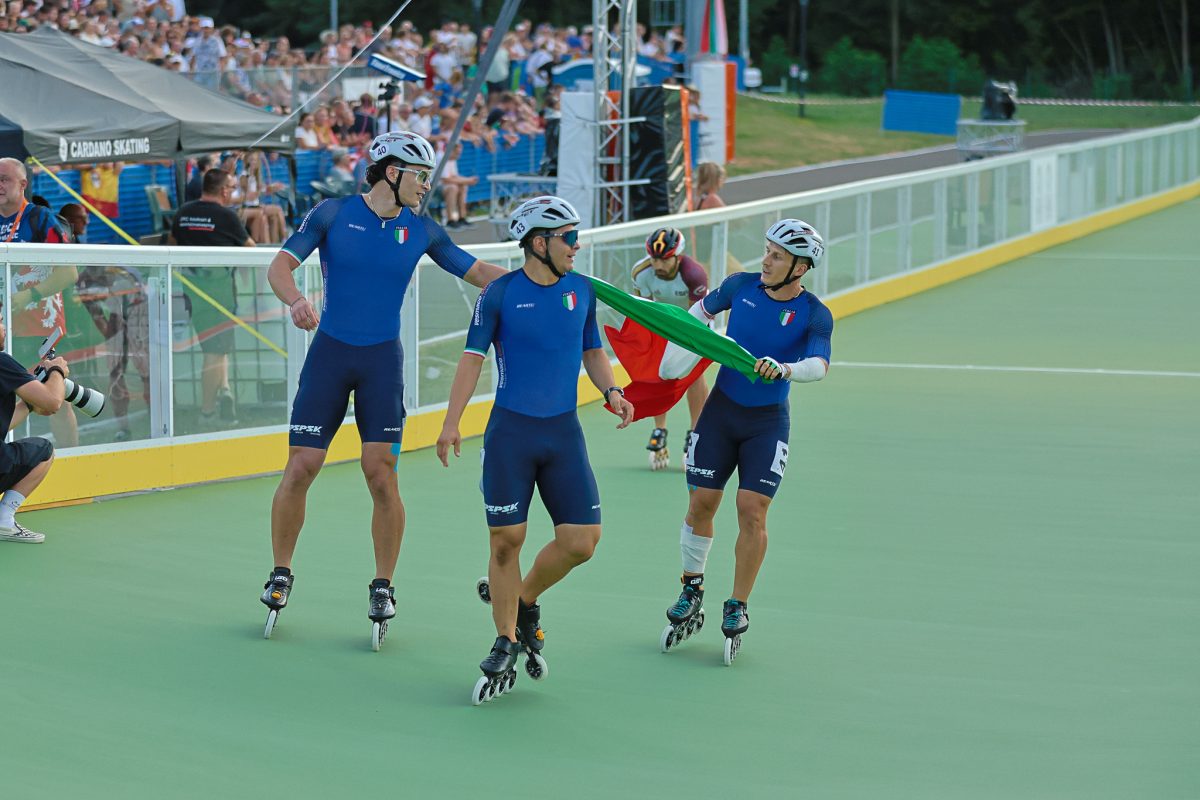
28 July 2026From 20 to 26 July 2026, the Karol Wojtyla Sports Centre in Cardano al Campo (Varese) hosts the European Inline Speed Skating Championships. Italy dominates: doubles, triples, and a cascade of medals across every category. Psychology explains why competing at home changes everything — even in an individual sport — and what it means to manage the pressure of a race that lasts less than forty seconds.
Author Fabio Zarra https://www.sportpsychologycenter.com
There's a sport that has been practiced in Italy for decades with an almost underground dedication — far from the big television stages, far from the mainstream spotlight — and that produces European and world champions with a regularity few other sports of comparable visibility can boast. Inline speed skating, in its road-racing specialty, is one of these. And this week in July, in Cardano al Campo, in the province of Varese, it's celebrating one of its most spectacular European editions — with the Italian national team in excellent form across the board.
The 2026 European Inline Speed Skating Championships take place from 20 to 26 July at the Karol Wojtyla Sports Centre on Via Carreggia, a facility renovated for the occasion, with its 200-metre banked track and its 500-metre road circuit. Over 400 athletes from 18 nations, 66 races to award titles in the Youth, Junior, and Senior categories on track, road, and marathon. And Italy, led by head coach Massimiliano Presti, is dominating.
This article isn't a sports report. It's a psychological analysis of what's happening in Cardano al Campo — and of three phenomena that make it interesting for those who study athletes' minds: home advantage, the psychology of pure sprinting, and the power of collective team spirit in a structurally individual sport.
01 — SPEED SKATING: THE RESULTS
Italy dominating across every category
The track phase — held from 20 to 22 July — handed Italy a medal haul that speaks to the depth and continuity of a solid sporting movement. It isn't just one champion winning: it's different generations winning together, from seniors to juniors, across different disciplines.
| ATHLETE | CATEGORY | RACE | MEDAL |
| Asia Negri | Senior Women | 200m sprint | GOLD 🥇 |
| Vincenzo Maiorca | Senior Men | 500m sprint | GOLD 🥇 |
| Alice Sorcionovo | Senior Women | 500m sprint | GOLD 🥇 |
| Sofia Paola Chiumiento | Junior Women | 500m sprint | GOLD 🥇 |
| Sofia Paola Chiumiento | Junior Women | 200m sprint | GOLD 🥇 |
| Giorgio Ghisio Erba | Junior Men | 5000m points race | GOLD 🥇 |
| Agnese Dominoni | Junior Women | Long-distance race | GOLD 🥇 |
| Vincenzo Maiorca | Senior Men | Time trial (head-to-head) | SILVER 🥈 |
| Duccio Marsili | Senior Men | 500m sprint | SILVER 🥈 |
| Valentina Buccolini | Senior Women | 500m sprint | SILVER 🥈 |
| Agnese Dominoni | Junior Women | First day | SILVER 🥈 |
| Francesco Onesti | Junior Men | 500m sprint | SILVER 🥈 |
| Matteo Ponziani | Junior Men | Long-distance race | BRONZE 🥉 |
The road races — 24 and 25 July — and the 42km city marathon on 26 July will add more titles to the medal table. The October World Championships in Asunción (Paraguay) are already on the horizon: these Europeans also serve as a dress rehearsal for the season's big appointment.
02 — HOME ADVANTAGE
Why competing at home really does change something
In the history of endurance and sprint skating, Italy has always performed at its best on home soil. At the 2022 European Championships, hosted in L'Aquila, the Italian national team topped the medal table with 50 medals. Today, once again in Italy — in Cardano al Campo — the pattern repeats. It isn't a coincidence, and sport psychology has precise explanations for this phenomenon.
Home advantage is one of the most documented and studied phenomena in the sport literature. Nevill and Holder's review, published in Sports Medicine, analysed decades of data from different sports, identifying four main factors that explain the advantage of competing in one's own country or arena: the crowd, familiarity with the environment, travel (the benefits of not having to travel), and rule-related factors. Of these, the crowd is the strongest and most consistent factor across all the sports analysed. Courneya and Carron, in an earlier and equally influential review, had already shown that home athletes' performance improves systematically in the presence of their own crowd — not just in subjective perception, but in objective performance data.
How does this translate into speed skating? The Cardano al Campo facility is a world reference point for the discipline — Italian skaters know it, have trained there, feel it as familiar territory. The crowd present is largely Italian, cheering for the Azzurri, and this pressure «in a positive sense» — home crowd support — generates a psychophysiological state of functional activation that tends to boost performance. The crowd isn't decoration: it's an active ingredient of the performance.
| The crowd is the most powerful factor in home advantage. The audience doesn't just witness the performance: it's part of it. |
It should be said that home advantage in individual sports — like speed skating — is less automatic than in team sports. In a sport with no referee who could be swayed by crowd chants, with no teammates whose morale could be lifted by the cheering, home advantage works mainly through two channels: the familiar physical environment and the psychophysiological response to the crowd's energy. Both channels are present in Cardano al Campo, and the track-phase results suggest they've been effective.
03 — PURE SPRINT
The psychology of forty seconds with no room for error
The 500 metres — the pure sprint event in inline speed skating — is among the most psychologically demanding athletic tests that exist. Not because of its duration: it lasts about 35-40 seconds for an elite athlete. Precisely because of that. In forty seconds there's no room for tactical adjustments, no recovering from a technical error, no chance to make up a lost position. There's only the start, the acceleration, holding top speed, and the finish line. Every tenth of a second is decisive.
Managing such a short race psychologically requires specific work on activation — on arousal. Yuri Hanin's IZOF (Individual Zones of Optimal Functioning) model has shown that every athlete has their own zone of optimal activation, outside of which performance drops. Every athlete has their own optimal emotional configuration — which can be high-activation or surprisingly calm. The point the model stresses is that there's no universal zone: the same level of agitation that fuels one athlete paralyses another. For a speed skating sprinter, the work is to identify one's own zone and learn to reach it systematically before the starting line — not to assume maximum agitation is the right answer.
Mental preparation work for the 500 metres is therefore a job of precise calibration. Pre-race routines — sequences of actions, thoughts, and visualisations repeated before every competition — serve exactly this purpose: bringing the athlete to their optimal activation level at the moment they reach the starting line. Orlick and Partington, in their foundational study of 235 Canadian Olympic athletes, identified precisely the quality and consistency of pre-race routines as one of the most robust predictors of optimal performance under high-pressure conditions. For a speed skating sprinter who has to compress everything into forty seconds, this routine is literally the only mental preparation available: there's no time to adjust during the race.
| In forty seconds there's no room to adjust. Mental preparation has to already be complete by the time you reach the starting line. |
04 — THE INVISIBLE TEAM
Collective efficacy in an individual sport
Speed skating is, in its individual competitive form, a sport where every athlete competes for themselves. There are no passes, no team patterns, no substitutions. And yet — as these European Championships' results show — something exists that functions like a team, even in this context. You see it in the cascading effect of the medals: Maiorca wins the 500m, Marsili takes silver in the same race — an Italian one-two that isn't born of luck, but of shared work. Sorcionovo gold, Buccolini silver: same story. Chiumiento dominates the junior women's category in both sprint distances.
Psychology has a precise name for this phenomenon: collective efficacy. The construct developed by Albert Bandura describes a group's shared belief in its ability to achieve common goals. In national teams of individual sports, this collective efficacy shows up indirectly but powerfully: a teammate's success raises everyone else's confidence. When Maiorca wins gold, Marsili steps up to the start line of the same race with the certainty that Italy can dominate. When Sorcionovo wins, Buccolini goes onto the track with a psychological confirmation of the group's level.
Head coach Massimiliano Presti, leading a national team that had already dominated last year's Europeans winning a huge medal haul on track and confirming itself as European leader on the road, is working on exactly this: not just the individual technical preparation of each athlete, but building a team environment where collective confidence becomes an amplifier of individual confidence. That structure — visible in Cardano's results — is one of the most powerful psychological assets a national team can have.
05 — THE GENERATION
Veterans and youngsters: a growth model that works
There's a fact emerging from the track-phase results that goes beyond the simple medal count: Italy wins across every category. Not just the seniors — who confirm an already well-known excellence. But also the juniors, with Sofia Paola Chiumiento winning two golds in two sprint races, Giorgio Ghisio Erba dominating the 5000m points race, Agnese Dominoni first collecting a silver and then the title in the long-distance race. And there's already talk of interesting new talent among the youth category — the youngest age group.
This is one of the most important signals for the psychology of a sports team in the long run. It isn't enough to have champions right now: you need a system that produces champions over time. The coexistence of high-level senior athletes and fast-growing juniors within the same national structure creates an environment where models of excellence are visible and imitable. The young athletes train alongside the champions, watch them, hear them talk about preparation and mindset. This is learning by osmosis — the most powerful and lasting kind.
The October World Championships in Asunción will be the ultimate test. But what these Cardano Europeans are already saying is that Italian speed skating has a depth of talent — spread across generations and disciplines — that's the best guarantee for the movement's future.
| THREE PSYCHOLOGICAL FACTORS BEHIND ITALY'S DOMINANCE IN CARDANO Home advantage (Nevill & Holder, 1999). Competing in one's own country, in front of one's own crowd, in a familiar venue activates an optimal psychophysiological state of arousal. The crowd is the strongest factor — not decoration for the race but an active ingredient of performance.Pre-race routines and IZOF (Hanin, 2000; Orlick & Partington, 1988). In the 500 metres — forty seconds with no room for error — mental preparation is entirely contained in the pre-start routine. Reaching one's optimal activation level before the gun is the most critical psychological skill for a sprinter.Collective efficacy (Bandura, 1997). A teammate's success raises everyone else's confidence. The Italian medal doubles — Maiorca and Marsili, Sorcionovo and Buccolini — aren't luck: they're the product of a team environment where confidence multiplies. |
06 — CLOSING THOUGHTS
What Cardano al Campo tells us
Inline speed skating is a sport Italy has never stopped cultivating — even when the spotlight was pointed elsewhere. It does so with clubs spread across the whole country, with families bringing their kids to races on weekends, with coaches working quietly, and with a federation — the FISR, the Italian Roller Sports Federation — that has built a quality technical system over time. The result of all this is visible this week in Cardano al Campo.
From a sport psychology perspective, these European Championships offer a rare case study: a sporting movement that manages to combine present excellence — the seniors winning today — with investment in the future — the juniors standing alongside them on the podium. This balance between immediate performance and long-term building isn't automatic: it requires a sporting culture that values both dimensions, and a psychological environment — team, national, institutional — that supports both.
The road races and the big Sunday marathon are still to come. Italy is already in the lead. And the psychology of home advantage, of optimal sprinting, and of collective confidence says the odds of finishing the tournament as it started — at the top — are far higher than chance.
| Does it make a difference for you to compete at home or away? Home advantage and managing pre-competition activation are specific areas of work in sport psychology. Building the right routines to perform at your best — in any environment — is part of the process. → BOOK A FIRST CONSULTATION Sport Psychology Center · Professional consultancy, VR training and mental training |
SCIENTIFIC REFERENCES
- Nevill, A. M., & Holder, R. L. (1999). Home advantage in sport: An overview of studies on the advantage of playing at home. Sports Medicine, 28(4), 221–236. DOI: 10.2165/00007256-199928040-00001 https://pubmed.ncbi.nlm.nih.gov/10565549/
- Courneya, K. S., & Carron, A. V. (1992). The home advantage in sport competitions: A literature review. Journal of Sport and Exercise Psychology, 14(1), 13–27. DOI: 10.1123/jsep.14.1.13
- Hanin, Y. L. (2000). Emotions in sport. Champaign, IL: Human Kinetics. [IZOF model — Individual Zones of Optimal Functioning]
- Orlick, T., & Partington, J. (1988). Mental links to excellence. The Sport Psychologist, 2(2), 105–130. DOI: 10.1123/tsp.2.2.105
- Bandura, A. (1997). Self-efficacy: The exercise of control. New York, NY: W. H. Freeman. [Collective efficacy and team performance]
News sources: Italian Roller Sports Federation — FISR (fisr.it), Tuttosport (24 July 2026), Siracusa News, Giornale L'Ora, Pattinaggio Artistico Alusìa, Corriere dello Sport (19 July 2026), Siracusapress.it, Webmarte.tv, Siracusa Post. Event: 2026 European Inline Speed Skating Championships, Cardano al Campo (VA), Karol Wojtyla Sports Centre, 20-26 July 2026. Organiser: Cardano Skating S.R.L. SSD. National head coach: Massimiliano Presti. Track results (20-22 July) confirmed by FISR and accredited press. Road races: 24-25 July. Marathon (42km): 26 July. Next event: World Championships, Asunción (Paraguay), October 2026. Note: road race and marathon results are not included in this article as they had not yet taken place at the time of publication.

Fabio Zarra