
The number of destiny: two goalkeepers, a 23, and the psychology of lucky numbers in sport
20 July 2026Speed Skating: Italy Wins At Home — Home Advantage And The Psychology Of Sprinting
25 July 2026Spa-Francorchamps, 19 July 2026. Andrea Kimi Antonelli wins the Belgian Grand Prix, his sixth win of the season in Formula 1 at 19. He is the youngest championship leader in the category's history. And yet he talks about pressure, about the fear of destroying himself, about thinking one race at a time. Psychology explains why this awareness is, in itself, already an elite skill.
Author Fabio Zarra www.sportpsychologycenter.com
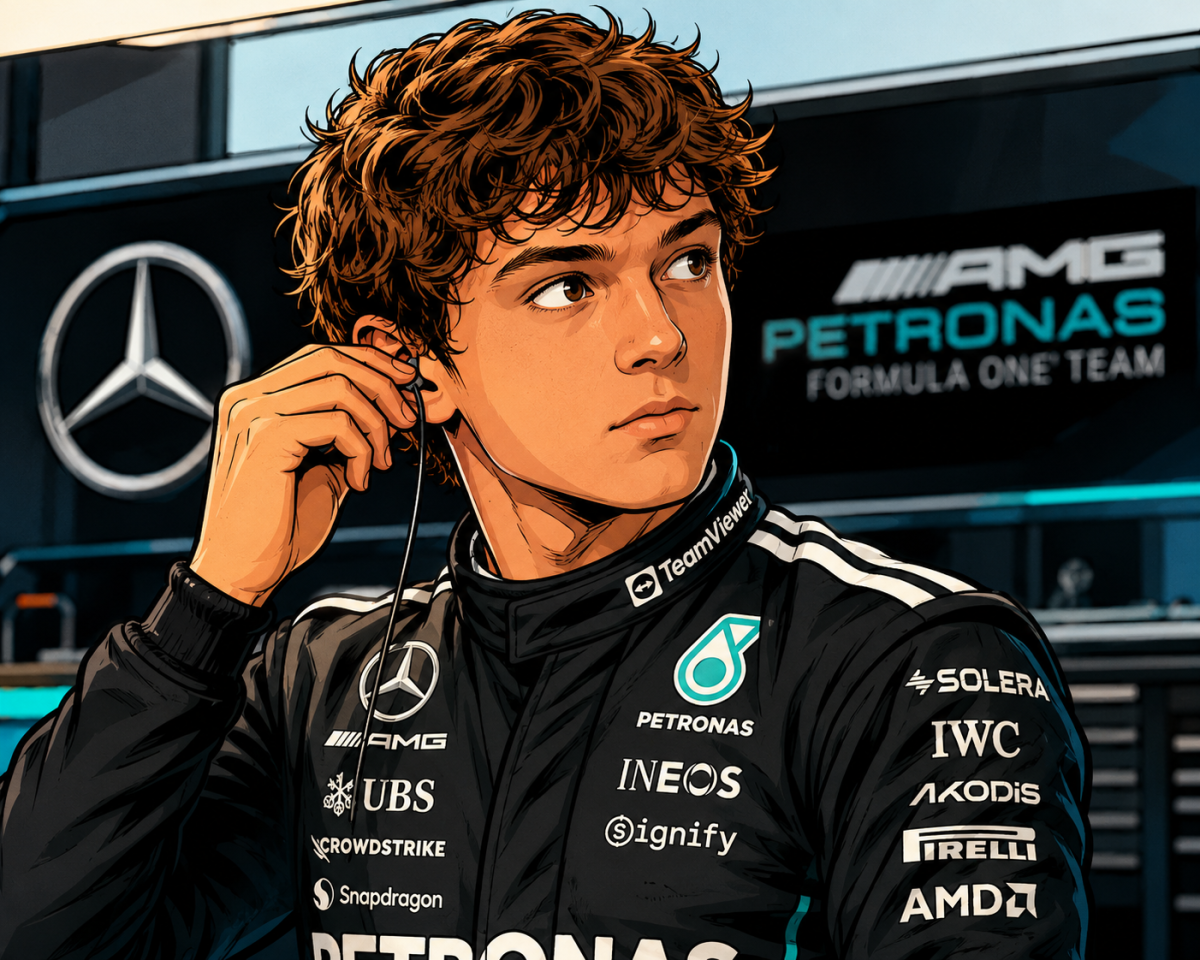
Fisichella put it with disarming simplicity: «Kimi has the face of a child, but when he lowers his visor he changes completely. He becomes another person». It may be the most precise description of what's happening in this Formula 1 World Championship. Andrea Kimi Antonelli, 19, from Casalecchio di Reno, Bologna, is leading the championship with a 45-point lead over Lewis Hamilton — a seven-time world champion — and 50 over teammate George Russell. He has won six of the ten Grands Prix held. He has six pole positions. He is the youngest championship leader in Formula 1 history.
At Spa-Francorchamps, on 19 July, he won a race that seemed lost: the Virtual Safety Car had handed the lead to Charles Leclerc during the pit-stop sequence. Antonelli tucked in behind the Monégasque driver exiting Eau Rouge, waited for the right moment, and completed the overtake along the Kemmel straight with the calm brutality of someone who knows exactly what to do. He became the first Italian to win at Spa since Alberto Ascari's victory in 1953 — seventy-three years ago.
But what makes Antonelli interesting for sport psychology isn't just the numbers. It's the words. Because a 19-year-old dominating motorsport's most important championship talks about pressure that could destroy him, about the fear of getting carried away by the moment, about thinking one race at a time as Federer teaches. It's the vocabulary of someone learning, in real time, how to manage their own greatness.
01 — ANTONELLI'S SEASON
How we got here
Antonelli's 2026 season started like a freight train. Five consecutive wins between March and June — Melbourne, Bahrain, Suzuka, Miami, Monaco — matched by as many pole positions. Numbers not seen in Formula 1 since Lewis Hamilton's dominant 2020 season. Then, as in every real season, the hard stretches arrived: a retirement in Barcelona due to a technical issue, a difficult race at Silverstone, three races without a win that let Hamilton and Russell close in on the standings.
Belgium was the answer. Starting from pole — his sixth — Antonelli endured a chaotic start marked by violent fluctuations in the new 2026 power units' electrical delivery and by the collision between Russell and Hamilton on the first lap, which eliminated his teammate and left Antonelli as the only Mercedes driver in the points. He managed the race, lost the lead to the VSC, and reclaimed it with a veteran's overtake. On the podium, in front of the Italian flag, he said: «It's a privilege to represent Italy and carry the Tricolore to the top step of the podium».
| Antonelli's 2026 season NUMBERS AFTER 10 RACES 6 wins, 6 pole positions. Youngest championship leader in F1 history. 2nd most successful Italian driver ever after Ascari. +45 over Hamilton, +50 over Russell. First Italian to win at Spa since 1953. | The difficult stretches THE PATH ISN'T LINEAR Retirement in Barcelona, a difficult race at Silverstone, three Grands Prix without a win. «For various reasons I haven't brought home results in the last few races. I've always had the momentum.» |
02 — THE WORDS
What Antonelli says — and what it tells us
In press conferences, Antonelli has a way of speaking that sets him apart from standard sporting rhetoric. He doesn't say «we have to win the championship». He doesn't say «we're the strongest». He says things like this, said before the Belgian Grand Prix in a press conference: «About the title? We think about one race at a time, like Federer said». And this, said in Barcelona in spring: «I remember last year's pressure and I don't want it to destroy me».
| «I remember last year's pressure and I don't want it to destroy me. With the team we're doing incredible work: what we're really doing well is putting things into practice without letting ourselves get carried away by the moment.» ANDREA KIMI ANTONELLI · SPANISH GP PRESS CONFERENCE, BARCELONA, JUNE 2026 |
These are statements that reveal a rare psychological awareness for a 19-year-old. Antonelli isn't reciting a motivational script: he is precisely describing the mechanisms he's trying to manage. The pressure is real. The risk of being overwhelmed is real. And he knows it. This awareness — not the certainty of winning, but the awareness of the risk — is already, in itself, an elite skill.
In the post-race interview in Belgium, the tone is the same: «I've always had the right momentum, but for various reasons I haven't brought home results in the last few races. Today things went well for the championship, but that's exactly why we have to seize every opportunity, because the situation can easily swing one way or the other». This isn't arrogance disguised as humility. It's the clarity of someone who knows that a 45-point lead in Formula 1 is never final.
03 — EXPERTISE
How you become a champion at 19
The first question sport psychology raises when faced with a talent like Antonelli is: how is this possible? How do you develop the skill to drive a Formula 1 car at the highest level in the world before you can even legally drink in many countries?
The most solid answer comes from the deliberate practice framework. Krampe and Ericsson, in a study on expert pianists of different ages, showed that specific expertise doesn't simply accumulate with the passing of time, but with the quality of structured practice. What matters isn't how many years you have: it's how many hours of intentional practice, with quality feedback, under conditions that progressively push your own limits, you've accumulated. Antonelli started karting at age eight. He won the Italian and German F4 championships in 2022. He racked up more than twenty wins in the feeder formulas. He joined Mercedes' junior programme and had access to one of the most advanced simulators in motorsport. His deliberate-practice portfolio, at 19, is already that of a driver with decades of specific experience.
Alonso, who knows a thing or two about young champions, framed the phenomenon precisely: «We're in a different era. Technology, simulators, the tools: everything prepares you better». It isn't a diminishment of Antonelli's talent — it's an acknowledgement that expertise today is built differently, more intensively, earlier, with tools that didn't exist a generation ago.
04 — THE PRESSURE
«I don't want it to destroy me»: managing excellence
The most important sentence Antonelli has said this season isn't about wins. It's about fear. «I remember last year's pressure and I don't want it to destroy me». It's the statement of a young man who knows where the risk lies. Not the technical risk — he already manages that well. The psychological risk: the pressure that turns performance into a burden, that shifts attention from execution to outcome, that turns every race into an exam instead of an opportunity.
Sport psychology has a precise model for describing this risk: the challenge vs. threat model by Blascovich and Tomaka. Faced with a high-stakes situation — such as being the youngest championship leader in history — the body can respond in two ways. The challenge response activates when perceived resources match the demand: the heart speeds up, the mind focuses, performance improves. The threat response activates when the demand exceeds perceived resources: vasoconstriction, attentional dispersion, a tendency to avoid. Leading the championship by 45 points doesn't automatically trigger a challenge response — if anything, the risk is that awareness of having a lot to lose pushes toward a threat response. Antonelli knows this. That's why he talks about pressure. That's why he says he doesn't want to be overwhelmed.
His main tool is what Locke and Latham identified as the most powerful mechanism for sustaining performance under pressure: focusing on process rather than outcome. «We think about one race at a time», as Federer said. Not «I want to win the championship» — which is a distant outcome goal, dependent on uncontrollable variables. But «what do I need to do this weekend, this session, this corner». The specificity of the near-term goal replaces the weight of the distant one. It's one of the most validated techniques in the goal-setting literature, and it's also the natural response of a driver who has understood — at 19 — that greatness is built one Grand Prix at a time.
| «You have to seize every opportunity, because the situation can easily swing one way or the other. We have to keep performing and getting results, then we'll see what happens.» KIMI ANTONELLI · POST-RACE, BELGIAN GP, SPA-FRANCORCHAMPS, 19 JULY 2026 |
05 — RESILIENCE
The difficult stretches and the comeback
Between his fifth consecutive win (Monaco) and his return to victory (Spa), Antonelli went through three difficult races: a retirement in Barcelona, a tough race at Silverstone, a result below expectations. For a 19-year-old leading the championship, with the whole world watching, with all of Italy's expectations, with the constant comparison to teammates Hamilton and Russell: that's no small thing.
Fletcher and Sarkar's research on resilience in Olympic athletes showed that champions don't deny difficulties — they appraise them positively, using them as learning opportunities. Antonelli did exactly that. «For various reasons I haven't brought home results in the last few races», he said at Spa. Not «the car wasn't working» or «everyone was against me». A neutral, non-defensive assessment that leaves room to learn. And then: «I've always had the right momentum» — a form of self-efficacy maintained through difficulty, that underlying confidence in one's own resources that Bandura identified as the most robust predictor of resilient performance.
06 — IDENTITY
Who Antonelli is when he lowers his visor
There's a subtle but fundamental question sport psychology raises about a young talent: who are they, outside the car? Because athletic identity — the way an athlete defines themselves through their sport — is double-edged. When it's strong and well-integrated, it produces focus, motivation, resilience. When it's exclusive — when the athlete is only the driver, only the tennis player, only the striker — it becomes fragile: every defeat is a threat to identity, not just to the result.
Antonelli seems to have found a rare balance. Inside the car, visor down, he's entirely a driver. Outside the car, in press conferences, in interviews, when he talks about the father who always follows him to races, he's also a nineteen-year-old who knows he still has everything to learn. The ability to separate these two states — to be fully a driver on track and fully a young man off it — is one of the most sophisticated forms of emotional regulation that exists in elite sport. It isn't improvised: it's built over time, with support, with awareness.
Deci and Ryan's Self-Determination Theory describes three fundamental psychological needs that, when satisfied, produce well-being and lasting motivation: autonomy, competence, and relatedness. Antonelli seems to have all three. Autonomy — the sense that his choices are truly his own, that his career is built on his own will and not just others' expectations. Competence — which every race confirms and reinforces. And relatedness — his father always present, the Mercedes team that believes in him, the team of engineers who accompany him. It's no accident that, on the podium at Spa, he spoke of the «privilege of representing Italy» rather than talking about himself.
| FOUR PSYCHOLOGICAL SKILLS ANTONELLI HAS AT 19 Risk awareness. He knows pressure can destroy him. Naming it — not ignoring it — is already the first step to managing it. Metacognition is rare at any age.Process focus. «One race at a time, like Federer said.» The near-term goal replaces the weight of the distant one. Locke & Latham in the daily practice of a 19-year-old driver.Non-defensive resilience. The difficult stretches are assessed without alibis: «I haven't brought home results for various reasons». No external blame, no minimising. Just an honest account of a non-linear path.Integrated identity. Driver inside the car, young man outside it. Separating the two roles is a sophisticated form of emotional regulation — and a rare one among precocious champions. |
07 — IN CLOSING
The child learning to be great
«He has the face of a child, but when he lowers his visor he becomes another person». Fisichella's line is beautiful because it contains a precise psychological truth: Antonelli isn't finished yet. He's still forming. And this formation is happening, in real time, on the biggest stage that exists in motorsport — with a championship to defend, with Hamilton and Russell behind him, with all of Italy watching.
What makes him extraordinary isn't just speed. It's the awareness of still having everything to learn — and the will not to destroy himself in the process. At 19, with six wins this season and the championship lead, Antonelli has already learned the hardest thing that exists in elite sport: that greatness isn't managed by pretending not to feel it, but by recognising it, naming it, and putting it back in its place — one race at a time.
Formula 1 will return to the Hungaroring for the Hungarian Grand Prix. Antonelli will start with a 45-point lead. And with something rarer: the awareness that this lead isn't a finish line, but a starting point. That the work continues. That the pressure is there, and that ignoring it would be the fastest way to be destroyed by it.
| How are you handling the pressure of your role? Performance psychology works on exactly this: recognising pressure, naming it, and building the tools to turn it into a resource instead of a burden. At any age, at any level. → BOOK A FIRST CONSULTATION Sport Psychology Center · Professional consultancy, VR training and mental training |
SCIENTIFIC REFERENCES
- Krampe, R. T., & Ericsson, K. A. (1996). Maintaining excellence: Deliberate practice and elite performance in young and older pianists. Journal of Experimental Psychology: General, 125(4), 331–359. DOI: 10.1037/0096-3445.125.4.331 https://psycnet.apa.org/record/1996-06578-001
- Blascovich, J., & Tomaka, J. (1996). The biopsychosocial model of arousal regulation. In M. P. Zanna (Ed.), Advances in Experimental Social Psychology (Vol. 28, pp. 1–51). San Diego, CA: Academic Press. DOI: 10.1016/S0065-2601(08)60235-X
- Locke, E. A., & Latham, G. P. (2002). Building a practically useful theory of goal setting and task motivation: A 35-year odyssey. American Psychologist, 57(9), 705–717. DOI: 10.1037/0003-066X.57.9.705
- Deci, E. L., & Ryan, R. M. (2000). The “what” and “why” of goal pursuits: Human needs and the self-determination of behavior. Psychological Inquiry, 11(4), 227–268. DOI: 10.1207/S15327965PLI1104_01
- Fletcher, D., & Sarkar, M. (2012). A grounded theory of psychological resilience in Olympic champions. Psychology of Sport and Exercise, 13(5), 669–678. DOI: 10.1016/j.psychsport.2012.04.007
News sources: Sky TG24, Autosprint, Corriere dello Sport, Tuttosport, OASport, BolognaToday, Il Giornale Digitale, f1grandprix.motorionline.com, Virgilio.it (July 2026). 2026 Belgian GP result: 1st Antonelli (Mercedes), 2nd Leclerc (Ferrari), 3rd Verstappen (Red Bull), 4th Hamilton (Ferrari, +5 sec penalty). Russell (Mercedes) retired on the first lap after contact with Hamilton. Championship standings after Belgium (round 10/2026): Antonelli 224 points, Hamilton 179, Russell 174. «I remember last year's pressure» statement: Spanish GP press conference, Barcelona, June 2026 (source: OASport). «We think about one race at a time, like Federer said» statement: Thursday press conference, Belgian GP, 16 July 2026 (source: BolognaToday). Post-race statement, Belgium: Autosprint, Sky TG24, Corriere dello Sport, 19 July 2026. Fisichella's statement on Antonelli: f1grandprix.motorionline.com, July 2026. Alonso's statement on Antonelli: formula1.it, June 2026. First Italian win at Spa: Alberto Ascari, 1953 (source: SKY TG24, Cavalidieri Garage).

Fabio Zarra