
Sport Psychology Center at WMF 2026
15 June 2026Barefoot on the field before the World Cup: the psychology of pre-game rituals.
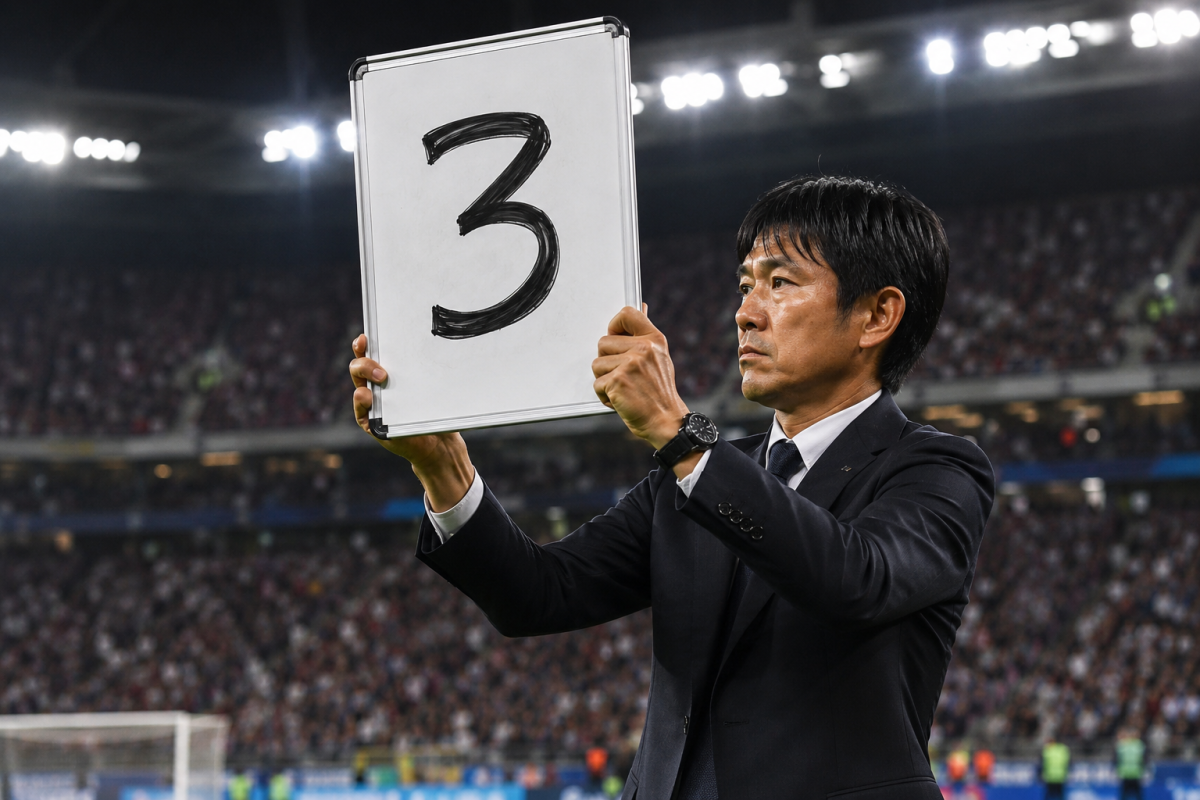
17 June 2026At the 2026 World Cup, Japan coach Hajime Moriyasu made headlines not for his lineups or his statements, but for a blackboard. On that blackboard, numbers appeared in large letters. Science explains why this communication system is much more sophisticated than it seems—and what it teaches us about the psychology of coaching in extreme conditions.
Author Fabio Zarra Event World Cup 2026 Category Performance psychology
Dallas Stadium, June 14, 2026. The Netherlands and Japan face off in the first matchday of Group F of the 2026 World Cup. On the pitch, the match is exciting and intense: the Dutch take the lead through Van Dijk, the Japanese equalize through Nakamura, the Netherlands regain the lead through Summerville, and Japan equalizes with Kamada in the 89th minute. But what ends up on social media and the front pages of sports websites around the world isn't the comeback, nor the last-minute goal. It's a chalkboard.
Several times during the game, Hajime Moriyasu's assistant coach approached the sideline with a board on which the numbers 45, 3, 2, 1 were written in large letters in marker. Each number appeared at specific moments during the game. The cameras caught them, social media amplified them, and the debate immediately ignited: were those numbers pre-coded tactical instructions? A coded communication system to transmit instructions to the players without the opponents being able to decipher the message? Or, more simply, was the coach signaling to his players the minutes remaining in the half?
There has been no official response so far: the Japan Football Association has not commented on the system. Some credible sources—including Eurosport and Adnkronos—identified the board primarily as a time management tool: the number 45 signaled the start of first-half stoppage time, while the numbers 3-2-1 counted down the minutes remaining in the second half. Other sources—Fanpage, Corriere dello Sport, Il Fatto Quotidiano, and Sportmediaset—claim that those numbers concealed a tactical code pre-agreed with the players. It's likely that both functions coexisted, as often happens in well-designed communication systems.
Whatever the technical truth, there's a psychological question worth asking—and it's the question this article aims to answer. Why is such a simple system also, potentially, so effective? What does it tell us about communication in coaching? And why did a Japanese coach, of all people, adopt it?
01 — THE MAN AND THE METHOD
Who is Hajime Moriyasu
Before discussing the system, it's worth getting to know the man who conceived it. Hajime Moriyasu, 57, has been Japan's national coach since the summer of 2018—a rare managerial continuity in international football, even rarer in Asian football. As a player, he represented the national team 35 times. As a coach, he won three Japanese championships with Sanfrecce Hiroshima (2012, 2013, and 2015) before embarking on his adventure with the national team. With the Olympic team, he reached fourth place at the 2021 Tokyo Games. And with the senior national team, he is the first Japanese coach in history to lead the team at two consecutive World Cups—Russia 2018 and, now, North America 2026—having surpassed the 100th coaching milestone.
The portrait that emerges from the news is that of a methodical, discreet coach, capable of building a solid and disciplined team culture. He's not a media personality. He's not looking for a dramatic turn of events. His tears during the national anthem before the match against the Netherlands—caught on camera and also going viral—wasn't a calculated gesture: it was the emotion of a man carrying the weight of a nation and who, for that moment, couldn't contain it. Then he turned to the pitch and got to work.
| "I'm disappointed because we couldn't win, but even though we went behind twice, the players never gave up and fought with determination, united as a team." HAJIME MORIYASU · POST-MATCH STATEMENT, SOURCE OFFICIAL FIFA.COM |
02 — THE PROBLEM
Communicating in a stadium of 90,000 people
The case of the Uruguayan Real Madrid midfielder is cited by the FIFPRO report as emblematic. "Back-to-back" matches refer to matches played within five days of each other: 58 such episodes in a single season. Five days is the minimum biological recovery window for a muscle subjected to intense eccentric stress. Below that threshold, the return to the field occurs on a neuromuscular system still in the repair phase. The psychological consequence is that the athlete quickly develops a chronic perception of fatigue—what the literature calls chronic perceived fatigue—which in turn reduces motivation, sleep quality, and decision-making ability on the field.
Coaches have always developed systems to circumvent this problem. Hand signals, conventional gestures, tactical cards brought by fourth officials during substitutions. But in the heat of a match—the final minutes of injury time, when the team must manage a lead or overturn a deficit—communication becomes particularly critical and difficult. This is precisely when Moriyasu used the whiteboard.
Eccles and Tenenbaum's research on coordination and communication in sports teams has shown that expert teams don't rely exclusively on explicit, real-time communication—which is cognitively costly and often impractical under high-intensity conditions. High-level teams instead develop shared mental models: shared knowledge structures that allow group members to anticipate each other's actions and coordinate implicitly, even without exchanging direct verbal instructions. Moriyasu's code, in its most efficient form, is exactly that: a shared model built in training and activated by a single visual stimulus during competition.
03 — THE SOLUTION
Why a number works better than a sentence
Imagine the alternative. An assistant coach approaches the opposing bench—because the board was visible to everyone, including the Dutch staff—and shouts detailed tactical instructions over the din of 90,000 people. It wouldn't work for two reasons: the ambient noise would impede reception, and any attentive opponent could grasp the content of the message. A number written in large letters bypasses both problems in one fell swoop: it's visible from a distance, it's semantically indecipherable to anyone who doesn't know the code, and—here's the crucial point—it imposes minimal cognitive load on the player receiving it.
This last aspect is the most relevant from a psychological perspective. The cognitive load theory, developed by John Sweller, describes how human working memory has a limited capacity: when the number of information to be processed simultaneously exceeds that capacity, performance deteriorates. A player in conditions of high physical and psychological intensity—in the final minutes of a world cup match, under pressure, out of breath—has a working memory that is already partially saturated. Sending him a complex message at that moment means competing with the cognitive resources already engaged in managing the game.
A single number, pre-trained to a specific pattern, requires no processing: it is recognized, not decoded. It's the difference between reading a word in a language you know thoroughly—automatic, almost effortless—and deciphering text in a foreign language—slow, laborious, and error-prone. The numerical code transforms the latter scenario into the former.
| A single number, pre-associated in training with a precise pattern, requires no processing: it is recognized, not decoded. |
There's a second, even more classic, cognitive foundation supporting this choice. In 1956, George Miller published one of the most cited papers in the history of psychology, known as "the magic number seven plus or minus two": human working memory can effectively handle between five and nine chunks of information simultaneously, where a chunk is a consolidated unit of information. A single number—3, 45, 2—is the smallest and most stable chunk in existence. It leaves no room for ambiguity, requiring no residual processing capacity. It arrives, it's recognized, and the associated schema is activated. The end.
04 — THE SYSTEM
The Collective Mind: How the Team Code Works
Moriyasu's board would be nothing without what precedes it: a mental preparation that transforms arbitrary numbers into shared meanings. This is the point that media hype tends to overlook. The code is not the board. The code is the weeks—or months—of shared work that have built, in each player's mind, the same association between a stimulus and a response.
Weick and Roberts, in a study that profoundly influenced the literature on the psychology of high-risk organizations, described a phenomenon they called collective mind: a group's ability to act coherently and precisely in highly complex situations, not because each individual explicitly coordinates with others in real time, but because it has internalized a shared action system that makes coordination automatic. Their classic case studies were teams on military aircraft carriers—contexts where explicit communication is often impossible, risk is extremely high, and mistakes are fatal. Their central point: the collective mind does not emerge from the sum of individual minds, but from the quality of relationships—from the level of heedful interrelating, that is, mutual attention built up over time.
Moriyasu's system requires exactly this. Players must have developed, during training, an automatic, non-deliberate, attention to the bench's instructions. They must have memorized the codes to the point of activating them without conscious processing. And they must have mutual trust that, when one of them responds to the number, the others will respond in the same direction. It's not a simple communication trick: it's a system of collective trust encoded in numerical form.
| Verbal communication in competition HIGH COMPLEXITY, HIGH VULNERABILITY Subject to environmental noise. Interceptable by opponents. Requires active cognitive processing at a time when cognitive resources are already engaged. Slow. | Pre-shared numeric code LOW COMPLEXITY, HIGH EFFICIENCY Visible from a distance. Semantically undetectable without the key. Requires recognition only, not processing. Instantaneous. Presupposes and reinforces team trust. |
05 — THE CULTURAL CONTEXT
Because a Japanese coach did it
There's a question worth asking: why haven't we seen this system, simple and elegant in its logic, before? And why did it emerge in a Japanese team, with a Japanese coach?
The answer is not trivial and has deep cultural roots. Markus and Kitayama, in a seminal study in cultural psychology, described the distinction between independent self cultures—typically Western, where the individual defines himself as autonomous from others—and interdependent self cultures—typically East Asian, including Japan, where the individual defines himself primarily through relationships with the group he belongs to. In a self-interdependent culture, the collective response to a shared signal is not a constraint: it is a natural form of coordination that reflects the way these people construct their own identities and relationships.
In more practical terms: a system of numerical codes only works if each member of the group has the discipline and willingness to memorize those codes, keep them updated, and rely on them in times of maximum pressure rather than relying on their own individual interpretation of the situation. This is an easier disposition to develop in a cultural context where the subordination of the self to the group is a deeply rooted value, not an imposed sacrifice.
There is also a specific element mentioned by some sources: the Japanese familiarity with abstract numbering and coding systems, resulting, among other things, from the use of the soroban—the Japanese abacus—as a teaching tool. This is not a matter of cultural determinism, but of compatibility: a system that requires the memorization of numerical associations finds more fertile ground in a culture that has trained this form of abstraction since childhood.
06 — THE IMPLICATIONS
What does modern coaching teach?
Moriyasu's whiteboard has sparked controversy due to its apparent bizarreness. But it dispels a misconception still circulating in sports coaching: that effective communication requires complexity. This isn't the case. In extreme conditions—noise, pressure, limited time, high cognitive load—the most effective communication is one that reduces complexity to the minimum compatible with the intended message.
This doesn't mean impoverishing tactical work. It means that deep tactical work—understanding the system, memorizing patterns, creating a shared vocabulary—is done earlier, in training, under conditions where cognitive resources are available. In competition, the task of communication isn't to explain: it's to activate. A single number can activate a complex pattern, if that pattern has been carefully constructed.
It's worth asking how many teams, at any level, have seriously invested in this preparatory work. How many have a truly internalized shared vocabulary—not written on a tactics board that no one reads, but encoded in each player's procedural memory to the point of being effortlessly recalled at the most difficult moment of the game. That's Weick's collective mind. That's Eccles's expert team. That's, in its most basic and powerful form, Moriyasu's tactics board.
| THREE PRINCIPLES OF THE MORIYASU SYSTEM APPLIED TO COACHING Build first, activate during. Tactical complexity is worked on in training, when cognitive resources are available. In competition, the communication system activates already consolidated patterns—it does not build them from scratch. The simplicity of the signal is proportional to the depth of preparation. Reduce the cognitive load at the critical moment. A simple, recognizable, and unambiguous message preserves the players' cognitive resources for performance. The clearer the signal, the less the brain has to work to decode it, and the more resources remain available for execution. Build trust in the shared code. A coded communication system only works if every member of the group has full trust in the system and in each other. This is not built in a match: it is built in the daily relationship between the coach and the group. |
07 — IN CLOSING
Simplicity as a strategy
Ultimately, the most interesting question the Moriyasu case raises isn't "were those numbers tactical or not?" It's a deeper question: to what extent can a coach design his team's communication system like a technical system? With the same care, with the same attention to constraints—noise, time, cognitive load—and with the same awareness that effectiveness depends not on the complexity of the message, but on the quality of the preparation that precedes it?
Moriyasu didn't invent anything radically new. The secret code has existed in sports for decades—in the bases of baseball, in rugby lineouts, in point guard signals in basketball. What he did was apply a well-known principle in an unusual context, with a level of media visibility that transformed a practical tool into an inadvertent case study. And he demonstrated, in front of 90,000 people and millions of television viewers, that the most powerful communication is sometimes the one that takes up the least space.
Japan earned a draw against the Netherlands, coming back from behind twice in the final seconds. We can't know how much the chalkboard contributed. But we do know that a team capable of coordinating with the precision and discipline displayed by the Samurai Blue—even under maximum pressure—doesn't do it by chance. It does so because it has built, over time, a communication system that works. With or without giant numbers on a chalkboard.
| Do you have an important competition coming up? Managing the lead-up to a competition and pre-competitive anxiety is one of the key areas of working with a sports psychologist. You can't improvise the night before: you build ahead. Let's talk about it. → BOOK AN INITIAL CONSULTATION Sport Psychology Center · Professional counseling, VR training, and mental training www.sportpsychologycenter.com |
SCIENTIFIC REFERENCES
- Eccles, D. W., & Tenenbaum, G. (2004). Why an expert team is more than a team of experts: A social-cognitive conceptualization of team coordination and communication in sport. Journal of Sport and Exercise Psychology, 26(4), 542–560. DOI: 10.1123/jsep.26.4.542 https://www.researchgate.net/publication/285838030_Why_an_Expert_Team_Is_More_than_a_Team_of_Experts_A_Social-Cognitive_Conceptualization_of_Team_Coordination_and_Communication_in_Sport
- Sweller, J. (1988). Cognitive load during problem solving: Effects on learning. Cognitive Science, 12(2), 257–285. DOI: 10.1207/s15516709cog1202_4
- Weick, K. E., & Roberts, K. H. (1993). Collective mind in organizations: Heedful interrelating on flight decks. Administrative Science Quarterly, 38(3), 357–381. DOI: 10.2307/2393372
- Markus, H. R., & Kitayama, S. (1991). Culture and the self: Implications for cognition, emotion, and motivation. Psychological Review, 98(2), 224–253. DOI: 10.1037/0033-295X.98.2.224
- Miller, G. A. (1956). The magical number seven, plus or minus two: Some limits on our capacity for processing information. Psychological Review, 63(2), 81–97. DOI: 10.1037/h0043158
Sources of the reported facts: FIFA.com (official source, match page and highlights Netherlands-Japan), LaPresse, Tuttosport, Virgilio Sport, Eurosport, Fanpage.it, Corriere dello Sport, Il Fatto Quotidiano, Sportmediaset, Adnkronos, Derbyderbyderby.it (June 14-15, 2026). Official result: Netherlands-Japan 2-2 — Dallas Stadium, Dallas (Texas), June 14, 2026. Goalscorers: Van Dijk (50′), Nakamura (57′), Summerville (64′), Kamada (89′). Japan coach: Hajime Moriyasu, in charge since 2018. Note: The encoded tactical function of the numbers on the board has not been officially confirmed by the Japan Football Association at the time of publication of this article. The function of indicating the remaining time is confirmed by accredited sources (Eurosport, Adnkronos). The tactical code hypothesis is reported by other equally reliable sources (Fanpage, Corriere dello Sport, Il Fatto Quotidiano, Sportmediaset) and represented as such in the text.

Fabio Zarra