
Ancelotti's wristlock: The hidden psychology behind set pieces
13 June 2026Sport Psychology Center at WMF 2026
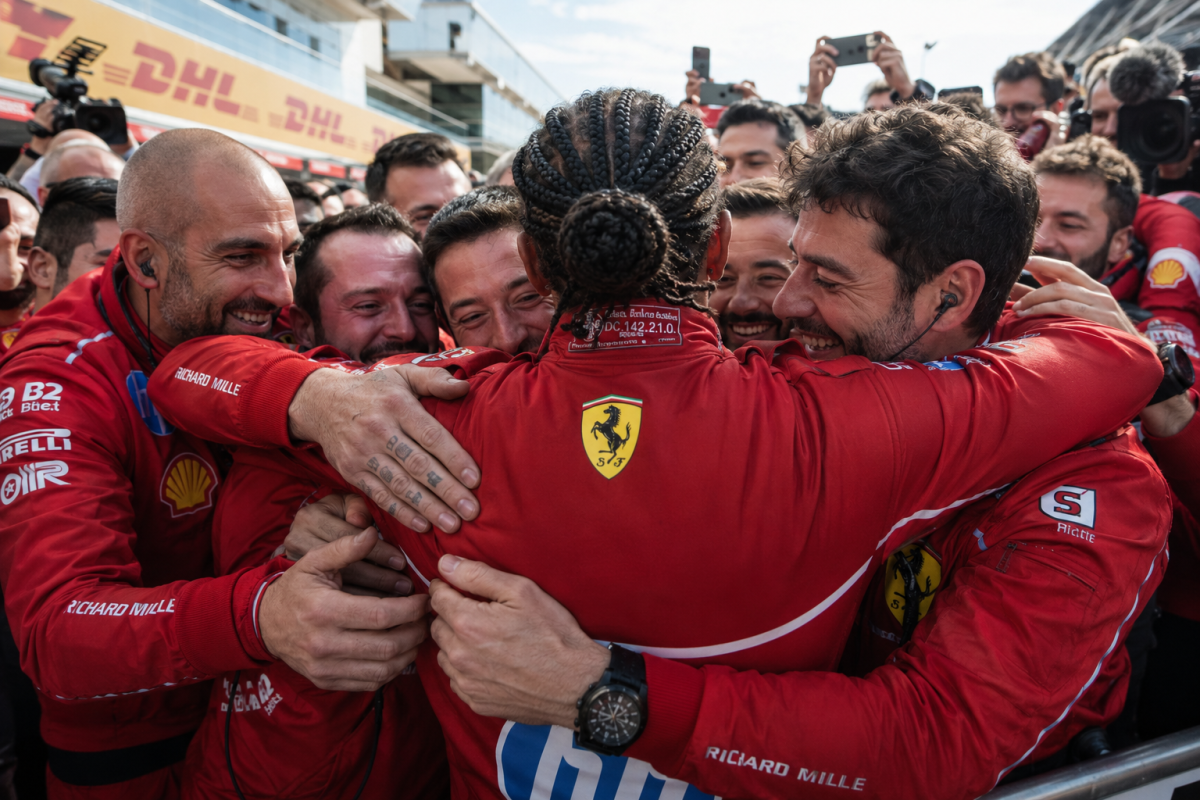
15 June 2026Barcelona, June 14, 2026. Lewis Hamilton wins his first Grand Prix with Ferrari, his 31st appearance in red: his 106th career victory, 686 days without a win, tears of joy, and a childhood dream finally fulfilled. Psychology explains why this victory is worth more than all the others.
Author Fabio Zarra Event GP Barcelona-Catalunya, F1 2026 · 14 June 2026 Category Performance Psychology
There's a phrase Lewis Hamilton uttered upon arrival, his voice still cracking with emotion, as a sea of red surrounded him on the Barcelona podium: "I watched Ferrari win so many races when I was little. I followed it on TV as a kid, and then, when I started racing in Formula 1, I saw it whizzing by on the screens on the track and I often wondered what it really meant to win with that car." Then a pause. "Finally, this moment has arrived."
On June 14, 2026, at the Barcelona-Catalunya Grand Prix, Lewis Hamilton won his 106th Formula 1 Grand Prix—his first with Ferrari. He had waited 686 days since his last victory (the 2024 Belgian GP with Mercedes) and 31 races since the beginning of his adventure in red. He won at 41 years old. And he cried. Not from exhaustion, not from relief—but because what happened on the Montmeló circuit wasn't simply one more victory: it was the closing of a circle he had begun as a child.
This article isn't a race analysis—you can find that on motorsports websites. It's an analysis of what goes on in the mind of a champion when he realizes a lifelong dream. And of the psychology that makes it possible, at 41 years old and after nearly two years without a win, to still do the most difficult thing in the world.
01 — THE FACTS
Barcelona, Tour 65: History is being made
The race started with Russell on pole, Hamilton second, and Antonelli third. Ferrari's strategy proved perfect: red tires at the start, a well-timed pit stop, and a decisive stroke of luck when the Virtual Safety Car—deployed for Fernando Alonso's retirement with a problem with his Aston Martin—gave Hamilton a nearly free tire change, propelling him into the lead ahead of Russell. From there, the pace was impeccable. With three laps to go, Antonelli—who was climbing back to the championship lead—retired with a technical issue. Leclerc, also recovering from tenth place, retired almost simultaneously. The final podium: Hamilton (Ferrari), Russell (Mercedes), Norris (McLaren).
The numbers speak for themselves. Ferrari hadn't won a Grand Prix since the 2024 Mexican GP, when Carlos Sainz triumphed. Hamilton hadn't won in 686 days. It was his 31st race with the Scuderia, after a 2025 season that Ferrari itself had defined as one of "adaptation" and "transition," effectively sacrificing the championship to focus on the new 2026 regulations. Hamilton is now second in the world championship standings, 41 points behind Antonelli. "I'm in for the championship too," he said with a smile.
There's a historical coincidence that added a special flavor to the victory: just like Michael Schumacher thirty years ago, Hamilton scored his first victory with Ferrari on the Barcelona circuit. This coincidence wasn't planned—but the psychology of symbols knows well that unplanned coincidences become, in the narrative of a feat, the detail that transforms it into legend.
02 — 686 DAYS
The longest fast of his career
To understand the weight of this victory, one must understand the weight of the anticipation that preceded it. Seven hundred and fifty-two days without a career win was a possibility no one would have ever imagined for Lewis Hamilton, the most successful driver in Formula 1 history. Yet that's what happened: from the summer of 2024 to the summer of 2026, Hamilton remained without a win. First, the end of the Mercedes season—which had already begun with the announcement of his move to Maranello—then an entire 2025 season in which Ferrari had chosen to focus resources on the new regulations, leaving the championship to its rivals.
Hamilton never publicly complained about this decision. He said: "It was a difficult decision, but I understand it. We're building something bigger." The 2025 season ended with zero race wins, one podium in China (third), and the feeling, for many, that the move to Ferrari had been a misjudgment. Then, in 2026, with the new technical regulations, the Ferrari SF-26 made a qualitative leap. And Hamilton was Hamilton again.
| "I'm speechless, guys." LEWIS HAMILTON · RADIO WITH THE FERRARI TEAM, BARCELONA 14 JUNE 2026 |
03 — THE DREAM
Why Hamilton Went to Ferrari: The Psychology of Intrinsic Motivation
When Hamilton's move to Ferrari was announced in January 2024, the question on everyone's mind was: why? Hamilton was already the most successful driver in history, having won six of his seven world titles with Mercedes, and earning more than anyone else in the paddock. The logical answer—more money, greater bargaining power—didn't hold up under the facts.
The most precise explanation comes from the psychology of motivation. Deci and Ryan's Self-Determination Theory distinguishes between extrinsic motivation—driven by external rewards such as money, fame, and social approval—and intrinsic motivation—driven by the pleasure of the activity itself, curiosity, the desire for growth, and authentic challenge. Decades of research have shown that intrinsic motivation produces more stable long-term performance, greater satisfaction, and a resilience in the face of adversity that extrinsic motivation cannot replicate.
Hamilton already had everything extrinsic motivation could offer. Going to Ferrari had almost no extrinsic justification—in fact, it entailed real risks (an uncompetitive car, a year of adaptation, the comparison with Leclerc). It was an intrinsically motivated choice: the child who watched Ferrari on television and wondered what it would be like to win with that car. That question—never resolved, despite 105 victories in other colors—remained unanswered. And Hamilton pursued it to the very end.
His words into Nico Rosberg's microphone, still in his overalls and with a cracked voice, are the most precise confirmation of this: "I watched Ferrari win, and when I was racing, I wondered what it meant to win with this car. I will be forever grateful to the entire team. I hope this is the first of many. Forza Ferrari." It's not the language of someone who has achieved a professional goal. It's the language of someone who has closed a chapter of their life.
| "It's a truly special moment. Winning my first race with Ferrari is something I've dreamed of since I was a child and achieving it gives me an incredible feeling." LEWIS HAMILTON · FERRARI.COM, OFFICIAL POST-RACE STATEMENT |
04 — NARRATIVE IDENTITY
The boy who watched Ferrari on TV
There's a concept in personality psychology that illuminates this victory with particular precision: narrative identity. The model developed by Dan McAdams holds that people construct their sense of self through internally coherent life stories—narratives that integrate past, present, and future into a narrative that gives meaning to experience. We are not just what we do: we are the stories we tell about ourselves and our lives.
In Lewis Hamilton's narrative identity, Ferrari occupies a nontrivial place. It's not just another manufacturer: it's the symbol of childhood, the dream that preceded every success, the open question that none of his previous 105 victories could answer because they were victories in another color, in another chapter of history. Every elite athlete carries with them a narrative of the "as a child I dreamed of..." variety—and that narrative, when it meets reality, generates an emotion qualitatively different from any other success. Not greater in absolute terms: more charged with personal meaning.
That's why Hamilton cried. Not because it was the most difficult victory—there have been more difficult ones. Not because it was the most important in terms of points—at this point in the season, the championship is still wide open. But because it was the victory that closed a story that had been ongoing since he was a child. And closed stories, in the psychology of self-narration, produce an emotion that "ordinary" victories cannot generate.
| Extrinsic Motivation MONEY, FAME, STATUS Hamilton already had it all. 7 world titles, 105 victories, the richest contract in F1 history. Ferrari didn't add anything to this—in fact, it entailed risks. | Intrinsic motivation THE DREAM, THE IDENTITY, THE AUTHENTIC CHALLENGE "I wondered what it meant to win with that car." An open question as a child. No victory with other colors could answer it. |
05 — RESILIENCE
How to survive 686 days without winning
Resilience is not the absence of adversity: it is the ability to transform difficulties into resources. The model developed by Fletcher and Sarkar—based on in-depth interviews with British Olympic champions—describes resilience as a dynamic process that includes a positive assessment of adversity, confidence in one's ability to cope with it, and the presence of a supportive environment that supports the athlete in times of greatest pressure.
Hamilton went through exactly this process in the 2025 season. Locke and Latham's goal-setting theory showed that difficult and specific goals—like winning with Ferrari—produce higher levels of persistence and commitment, provided the athlete maintains the confidence that they can be achieved. Hamilton never lost that confidence. He chose Ferrari knowing that 2025 would be a year of development. He accepted the risk that entailed. And when the car wasn't competitive, he didn't abandon his vision: "I don't regret coming to this team," he said in November, as the season ended winlessly. "When you drive for a team like this, the only thing that really matters is winning"—and he was right. He was waiting for 2026 to arrive.
His behavior during the fast is the embodiment of what psychology calls mastery orientation: the focus remains on the process, on learning, on building, rather than on the immediate outcome. "Through hard work, we've rediscovered our connection. I have to thank those who worked behind the scenes, believing and trusting in the decisions; we began this journey together," he said today. This isn't the language of a frustrated athlete: it's that of an athlete who has stayed the course.
06 — 41 YEARS OLD
Expertise has no expiration date
There's one final element to this story that sports psychology cannot ignore: age. Lewis Hamilton won his first Grand Prix with Ferrari at 41. This isn't just a biographical fact: it's an elegant yet precise slap in the face to all the narratives about athletic decline inevitable with advancing age.
Krampe and Ericsson studied precisely this phenomenon in expert pianists of different ages: older masters who continued to practice in a deliberate and structured manner showed a much smaller decline in domain-specific abilities than amateurs of the same age—despite identical declines in general measures of cognitive speed. Specific expertise, maintained through continuous practice, resists aging in a qualitatively different way than general ability. What is lost in terms of reaction speed or general processing is compensated for by a refined decision-making system, an automatic reading of situations built over decades, and an emotional management that grows with experience. Hamilton didn't win despite being 41 years old: he won also thanks to what 41 years of deliberate practice at the highest level had built within him.
Today's victory is the most concrete demonstration of this: it was a victory of strategy, of tyre management, of reading the race in real time. All skills that grow with experience, not diminish. "A perfect race, built on experience, management, and impeccable pace," wrote AGI in its race report. This is no coincidence: it is the result of expertise accumulated over decades and which, at 41, is at its qualitative peak—even if no longer at its physical peak.
| FOUR PSYCHOLOGICAL ELEMENTS OF HAMILTON'S VICTORY Intrinsic motivation (Deci & Ryan). Ferrari was a childhood dream, not a contract. Intrinsic motivation produces longer-lasting performance and greater resilience in the face of adversity than extrinsic motivation. Narrative identity (McAdams). This victory closes a chapter opened as a child. Narrative life stories determine which successes produce authentic emotion and which remain simple sporting achievements. Resilience as a process (Fletcher & Sarkar). 686 days without a win, a season sacrificed, a year of adaptation. Hamilton maintained a process-oriented and long-term focus instead of giving in to the pressure of immediate results. Expertise and longevity (Krampe & Ericsson). At 41, you win not despite your age, but thanks to what age brings. Masters who maintain deliberate practice preserve domain-specific skills much better than those who stop training with the same intensity. |
07 — IN CLOSING
What this story tells us
Hamilton's victory in Barcelona is many things at once. It's a sporting achievement—25 points, second place in the world standings, the championship back underway. It's a historic event—Hamilton's first Ferrari victory, an echo of Schumacher's thirty years ago on the same circuit, the most successful champion in history continuing to win at 41. But it's also, for those who look at things from the perspective of sports psychology, something more precise: it's proof that intrinsic motivation, when genuine, stands the test of time, failure, and doubt.
Hamilton left a position of absolute comfort—Mercedes, six world titles, the most successful car of the decade—to pursue a question he'd asked himself as a child. He endured nearly two years without a win. He listened to everyone's doubts. And then, when the car gave him the chance, he did what he'd trained his mind and body for for thirty years. "I love what I do," he said post-race. "There's no better feeling."
This phrase—spoken by the most successful athlete in the history of Formula 1, with 106 career victories, at 41 years old—is perhaps the most eloquent way the psychology of intrinsic motivation manifests itself in reality. He wasn't talking about Ferrari. He wasn't talking about the world title. He was talking about the fact that, even today, even now, after all he's won, the thing that drives him is the love for what he does. And that never gets old.
| Pressure is trained. Resilience is built. Even in your sport, in your most difficult moments, there is a method. Let's talk about it with the tools of performance psychology. → BOOK AN INITIAL CONSULTATION Sport Psychology Center · Professional counseling, VR training, and mental training Sport Psychology Center |
SCIENTIFIC REFERENCES
- Deci, E. L., & Ryan, R. M. (2000). The “what” and “why” of goal pursuits: Human needs and the self-determination of behavior. Psychological Inquiry, 11(4), 227–268. DOI: 10.1207/S15327965PLI1104_01 https://it.scribd.com/document/512660587/Deci-Ryan-2000-the-What-and-Why-of-Goal-Pursuits-Human-Needs-and-Self-Determination-of-Behavior
- McAdams, D. P. (2001). The psychology of life stories. Review of General Psychology, 5(2), 100–122. DOI: 10.1037/1089-2680.5.2.100
- Fletcher, D., & Sarkar, M. (2012). A grounded theory of psychological resilience in Olympic champions. Psychology of Sport and Exercise, 13(5), 669–678. DOI: 10.1016/j.psychsport.2012.04.007
- Krampe, R. T., & Ericsson, K. A. (1996). Maintaining excellence: Deliberate practice and elite performance in young and older pianists. Journal of Experimental Psychology: General, 125(4), 331–359. DOI: 10.1037/0096-3445.125.4.331
- Locke, E. A., & Latham, G. P. (2002). Building a practically useful theory of goal setting and task motivation: A 35-year odyssey. American Psychologist, 57(9), 705–717. DOI: 10.1037/0003-066X.57.9.705
Sources of the reported facts: ferrari.com (official post-race press release), AGI, ANSA, Fanpage.it, Formulacritica.it, Motorsport.com Italia, Sportmediaset, p300.it, Virgilio Sport (June 14, 2026). 2026 Barcelona-Catalunya GP result: 1st Hamilton (Ferrari), 2nd Russell (Mercedes), 3rd Norris (McLaren), 4th Verstappen (Red Bull), 5th Piastri (McLaren). Antonelli (Mercedes) and Leclerc (Ferrari) retired. Hamilton's last win before today: 2024 Belgian GP, July 28, 2024 (Mercedes) — 686-day drought. First Ferrari win with Hamilton in his 31st appearance for Ferrari, the 106th of his career. Driver standings after Barcelona: Antonelli 156 points, Hamilton 115 points. All Hamilton quotes are taken from official post-race statements (ferrari.com, Sky Sport, Nico Rosberg podium interview, press conference).

Fabio Zarra