
Rejected at the World Cup, chosen for the Super Cup: the psychology of inclusion in sport
13 June 2026"This is something unique": Hamilton, 41, Ferrari, and the psychology of a dream come true
15 June 2026From American football to Brazil's World Cup training camp, a small quarterback sleeve speaks to a great truth of sports psychology: the mind that wins is the one we take weight off.
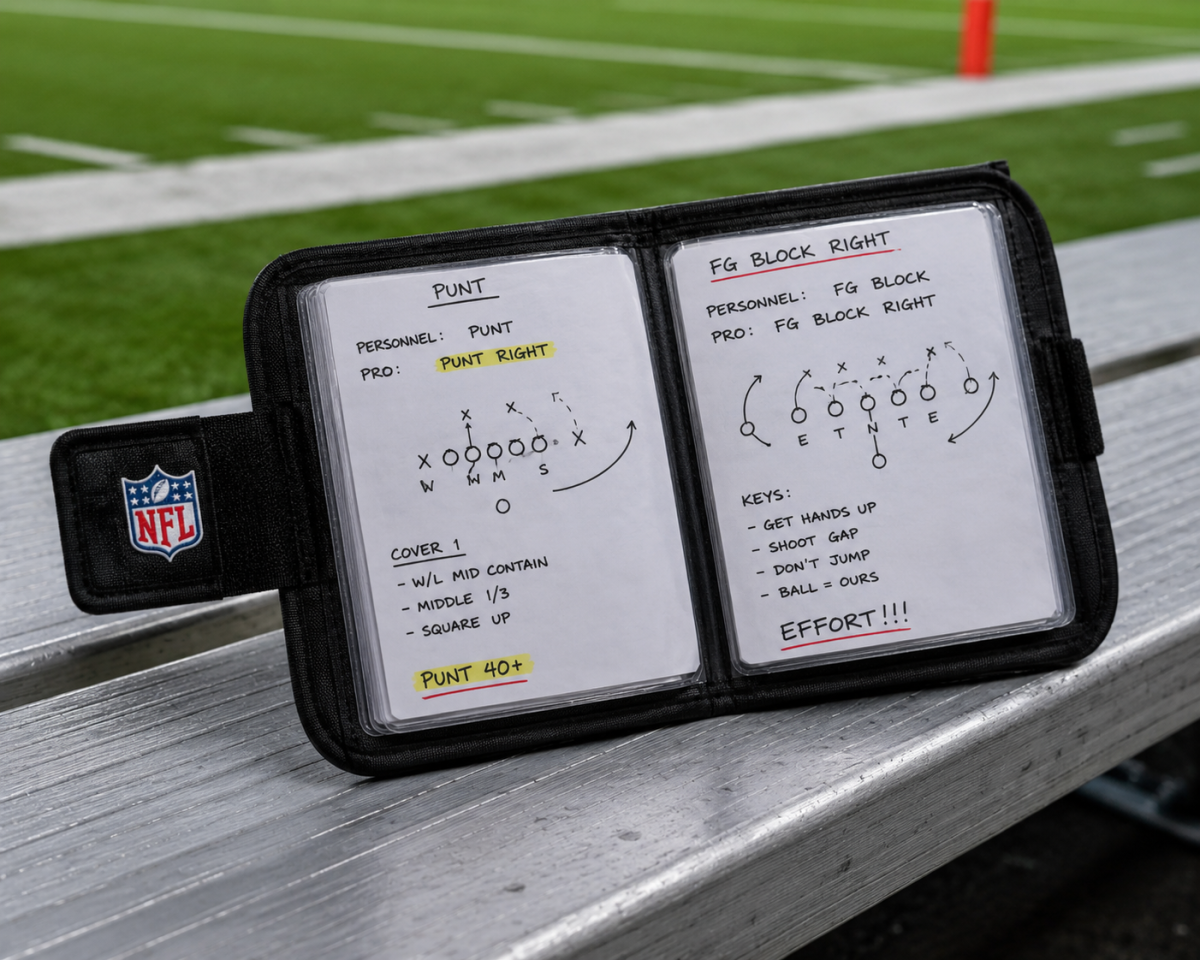
On June 13, 2026, a controversial image emerged from the Brazilian national team's training camp: Carlo Ancelotti wearing a typical American football quarterback's wristband and using it to help his defenders memorize set-piece moves (Sky Sport, 2026). A "gimmick", they called it. In reality, it's much more: it's a textbook case of how cognitive psychology applied to sport can transform a seemingly trivial detail into a measurable competitive advantage.
It's not an isolated idea: when football learns from the NFL
Ancelotti's move didn't come out of nowhere. For several seasons, major European football has been turning to American football for set pieces. Arsenal manager Mikel Arteta regularly meets with Los Angeles Rams head coach Sean McVay—the two clubs share ownership—exchanging ideas and tactical solutions. Clubs like Arsenal and Tottenham were among the first to introduce dedicated set-piece coaches (Nicolas Jover and Gianni Vio, respectively), and today almost every Premier League team has one (ESPN, 2025).
The parallel is clear: in American football, the quarterback calls out seemingly incomprehensible sequences of numbers, and each player sprints in a specific direction, following a shared pattern. Ancelotti takes this logic a step further: not just the pattern, but the physical support to remember it at the precise moment it's needed. This is where tactics meet psychology.
Why it works: the mind “unloads” the weight
The key concept is called cognitive offloading. Risko and Gilbert (2016) define it as using a physical action to modify the processing requirements of a task, thus reducing its cognitive demand. Setting an alarm, writing a list, tilting your head to read a rotated image: every time we outsource some of our mental work to the environment, we free up internal resources.
Why is it important on the pitch? Because our working memory—the "mental space" in which we maintain information while we act—has surprisingly limited capacity. While Miller (1956) spoke of about seven elements, subsequent research has scaled it down to about four "chunks" of information that can be maintained simultaneously (Cowan, 2001). And under pressure—anxiety, fatigue, the public, stakes—that margin shrinks even further.
The idea in one sentence
A defender who has to memorize six different corner and free kick plays consumes precious mental resources. Transferring those plays to the wrist gives the mind the space to focus on what matters: reading the opponent, marking, and attacking the ball at the right time.
The wristband, in other words, doesn't replace preparation: it protects it. It reduces the risk that, in the few seconds of a crucial corner kick, mental energy will be spent retrieving information instead of executing it.
A shared language: the team's mental models
Set pieces are not an individual gesture, but a collective and synchronized action. And this is where a second pillar of sports psychology comes into play: shared mental models. Eccles and Tenenbaum (2004) showed why a team of experts is more than the sum of its talents: what makes the difference is the ability to coordinate. With training, communication shifts from explicit (spoken, shouted) to implicit: teammates anticipate each other's movements without needing to speak.
Organizational research confirms the principle: when group members share the same task representation, team processes and performance improve (Mathieu et al., 2000). The NFL playbook code—and the wristband that summarizes it—functions exactly like a common language: it anchors the shared mental model and allows eleven minds to move as one, even in the chaos of a crowded penalty area.
Set pieces as a “closed skill”: the value of routine
There's one final reason why this approach makes sense. Unlike open, unpredictable, and continuous play, dead-ball play is a plannable situation: you start from a dead ball, with time to organize. Technically speaking, it's a closed skill, the ideal framework for building pre-executive routines.
Cotterill (2010), in a landmark review, highlights how pre-executive routines help athletes manage activation, focus attention on relevant cues, and increase their sense of control before a critical move. Consulting the wristband, aligning oneself with the designated pattern, and taking position becomes a collective routine: a ritual that reduces uncertainty precisely at the moment of maximum tension. Less uncertainty means less anxiety; less anxiety means cleaner execution.
What can we learn (from professionals to youth sector)
For coaches:Outsourcing complexity is a strategy, not a shortcut. Codifying a common language, reducing the memorization burden, and transforming patterns into repeatable routines makes the team more focused under pressure.
For athletes:The mind has a limited attention budget. Freeing it from tasks that can be delegated to external support means having more resources to read the game and make better, faster decisions.
For youth: The same principle helps younger children, whose working memory is still developing, learn complex patterns without overload, building confidence one step at a time.
This is precisely the philosophy that guides our work at the Sport Psychology Center: training attention, decision-making, and pressure management with concrete tools—from virtual reality mental training programs to individual psychological support—to best equip the mind to express talent.
"It's the details that win you a World Cup," commented Sky Sport. Sports psychology adds a nuance: the truly winning details are those that free the mind. Ancelotti's wristband isn't a gadget: it's the wearable version of a solid scientific principle. And it reminds us that, increasingly, innovation in sport isn't just about the body or tactics, but how we train and protect our minds.
Scientific references
Statements and journalistic sources
Sky Sport (2026, 13 giugno). Ancelotti… QB: l’ultima trovata dal ritiro del Brasile. sport.sky.it
ESPN (2025, 12 novembre). How Premier League teams are borrowing NFL plays for set piece success. espn.com
Peer-reviewed scientific literature
Cotterill, S. T. (2010). Pre-performance routines in sport: current understanding and future directions. International Review of Sport and Exercise Psychology, 3(2), 132–153. https://doi.org/10.1080/1750984X.2010.488269
Cowan, N. (2001). The magical number 4 in short-term memory: A reconsideration of mental storage capacity. Behavioral and Brain Sciences, 24(1), 87–114. https://doi.org/10.1017/S0140525X01003922
Eccles, D. W., & Tenenbaum, G. (2004). Why an expert team is more than a team of experts: A social-cognitive conceptualization of team coordination and communication in sport. Journal of Sport & Exercise Psychology, 26(4), 542–560. https://doi.org/10.1123/jsep.26.4.542
Mathieu, J. E., Heffner, T. S., Goodwin, G. F., Salas, E., & Cannon-Bowers, J. A. (2000). The influence of shared mental models on team process and performance. Journal of Applied Psychology, 85(2), 273–283. https://doi.org/10.1037/0021-9010.85.2.273
Miller, G. A. (1956). The magical number seven, plus or minus two: Some limits on our capacity for processing information. Psychological Review, 63(2), 81–97. https://doi.org/10.1037/h0043158
Risko, E. F., & Gilbert, S. J. (2016). Cognitive offloading. Trends in Cognitive Sciences, 20(9), 676–688. https://doi.org/10.1016/j.tics.2016.07.002
