
«È già fatta?» La psicologia dell’ultimo passo, tra Antonelli e Marquez
2 November 2026Mancini calls up the young players: is the future now?
12 November 2026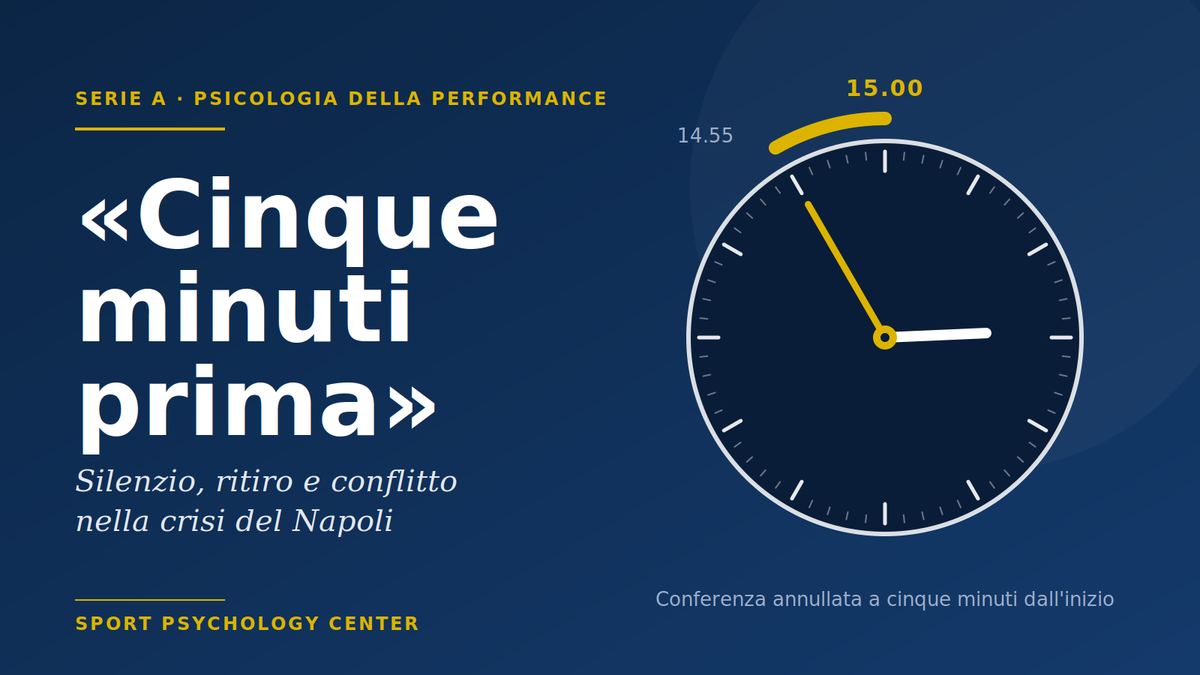
A cancelled press conference, a team retreat, a row on the pitch: what research can (and cannot) say about cohesion, conflict and communication in a team in crisis. by Fabio Zarra
01 THE EPISODE
A packed press room and an announcement at 2.55pm
On Saturday 7 November, at 3pm, at Castel Volturno, Massimiliano Allegri was due to preview SSC Napoli-Lazio, a match against the league leaders scheduled for Sunday at 12.30. The press conference had been announced the day before at 2.30pm and no cancellation notice had arrived in the morning. At 2.55pm, with about twenty journalists already in the room, the head of communications announced that “the club has cancelled the press conference, because Napoli are in a training camp retreat”. According to Adnkronos, the press office then asked those present to leave the room. [8]
The club then issued a statement confirming that there would be no press conference because the team was on a retreat. According to Sky Sport the decision came from chairman De Laurentiis: keep a low profile, focus the group on the pitch and limit words on the eve of the match, in the hope that the team responds with deeds. Again according to Sky, it wouldn't be a true press blackout but a line dictated by the moment, and Allegri was reportedly ready to speak. It is the first press conference missed since the start of his time at Napoli, in July. [9]
Press criticism concerned the method more than the decision: one specialist site wrote that you don't cancel an event with a few minutes to go, another spoke of a lack of respect for those who had organised themselves to be there.
02 HOW WE GOT HERE
Seven defeats in 14 games, a row on the pitch, a retreat announced in stages
Napoli arrive at the eve of the match with seven defeats in 14 official matches this season, nine injured players and Marianucci's suspension, leaving Allegri with thirteen outfield players. On 1 November they had lost 2-0 at Torino to Juventus. On 4 November they lost 4-1 at Porto, their third defeat in four Champions League games, remaining on 3 points and in 27th place in the league phase table. [10]
At Porto, late in the game, there was also a heated exchange of insults between De Bruyne and Lucca: according to Goal's reconstruction, it started from a request by De Bruyne, made with broad gestures, for a different movement from the teammate who had just come on. After the match Politano told Sky he would have liked to see other teammates, not always the Italians, speak in front of the microphones, then clarifying it wasn't an attack on anyone. Hojlund, asked about Allegri's positive assessment of the performance, replied that he didn't agree and asked everyone, the club included, to look in the mirror. [10]
In the post-match, Allegri, according to Goal, had ruled out a retreat (“we've been away for six days”); other outlets instead report he postponed any decision to Friday. On Friday 6 November De Laurentiis brought forward his arrival in Naples and met the squad, Allegri and staff for several hours at Castel Volturno; immediately afterwards the team moved to a hotel in the Phlegraean area for a retreat lasting until the morning of the match. Il Mattino, as reported by an industry site, described the retreat as “punitive”, attributed the decision to Allegri and wrote that after Porto he wouldn't have spoken to anyone: this is a journalistic reading that the club has not confirmed, and the sources don't clarify with certainty who decided on the retreat. [11]
03 WHAT A SILENCE COMMUNICATES
Protecting or avoiding? Two readings of the same silence
The stated reason, a low profile to protect the group, is plausible: a team under pressure can benefit from less outside noise on the eve of a decisive match. But the same gesture can be read another way. The coping literature distinguishes two ways of dealing with a threat: orienting toward it (approach) or moving away from it (avoidance). They are, write Roth and Cohen, metaphors for cognitive and emotional activity directed toward the threat or away from it. [1]
It must be said clearly that this model concerns individuals, not clubs, and that we have no studies on cancelling press conferences. It's an analogy, not a direct application. Read through this grid, Napoli's choice can be protection (reducing noise) or avoidance (not facing questions about Porto, the row, the coach's future). From the outside we can't establish which of the two it is. We can, however, observe that the way it was done, with five minutes' notice and a minimal explanation, may give more weight to the second reading.
A silence can protect a group or tell how serious the situation seems. It depends on how and when it is communicated.
04 THE RETREAT
Cohesion or signal? What research says
The retreat comes from an intuitive idea: being together strengthens the group, and a stronger group performs better. Mullen and Copper's meta-analysis on the relationship between cohesion and performance shows a more nuanced picture. The effect is significant but small, depends mainly on commitment to the task and not on interpersonal attraction or group pride, and a cross-lagged analysis suggested that the more direct effect might run from performance to cohesion and not vice versa. [2] In other words, spending days together doesn't equal increasing commitment to the task, and results seem to feed cohesion at least as much as cohesion feeds results.
The same goes for team building. Salas and colleagues' meta-analysis found no significant effect on performance: on objective measures there was a non-significant tendency to get worse, on subjective ones a small improvement, and interventions focused on role clarity were more likely to increase performance. [3] An update by Klein and colleagues, on a larger database, found a moderate positive effect across outcomes overall, stronger on affective and process outcomes. [4] None of these studies concerns retreats in football: they do indicate, however, that being together works better when it has content (roles, goals, process) than as shared time.
Then there is the way the retreat is experienced. If it's perceived as punishment, it falls within the family of controlling coach behaviours, which in Bartholomew and colleagues' studies on athletes are associated with frustration of psychological needs and negative outcomes such as burnout and negative affect. [7] These are studies on athletes, largely cross-sectional, and not on retreats. But the point holds: the same retreat can be read as support or as control, depending on how it's communicated and justified.
05 THE CONFLICT
The row on the pitch and the contradictory accounts
De Dreu and Weingart's meta-analysis distinguishes task conflict from relationship conflict. The latter, made of personal antagonism, was strongly and negatively associated with team performance and satisfaction. The more interesting result concerns the former: contrary to popular belief, task conflict too was negatively associated with performance, and less negatively when it was weakly correlated with relationship conflict. [5]
Applied to Porto, without judging anyone: if Goal's reconstruction is correct, the episode started from a request about the task (a different movement) and then degenerated into insults, that is, from task conflict to relationship conflict. The public disagreement over the assessment of the match, on the other hand, concerns the task, but is expressed in front of everyone. In a team in crisis the two tend to overlap: it's precisely when criticism of the play turns into criticism of people that conflict becomes most costly. One caution remains: the research concerns mainly work teams and not sports teams, so it's a useful reference, not a measure of what is happening at Napoli.
06 PRACTICAL IMPLICATIONS
What coaches can take home: four pointers
The pointers that follow are practical applications of the cited findings, not the result of a study on Napoli or on press conferences.
Decide the communication line beforehand, and say so in time. Informational justice, that is, explaining decisions, is one of the four dimensions of perceived fairness (Colquitt and colleagues, 2001). A choice that arrives without notice and without explanation weighs as much as the choice itself. [6]
Distinguish protection from avoidance. If you lower your profile, say why, for how long and what will be said afterwards. Silence without a frame leaves it to others to provide one.
Give the retreat content. Roles, process goals and clear tasks: the evidence on team building suggests it's this, and not shared time in itself, that makes the difference.
Keep task and person separate. Criticism of the play should be voiced, but in a controlled setting and without turning it into personal attacks: it's the shift from task conflict to relationship conflict that makes the conflict costlier.
| How do you manage communication for a team in crisis? Communication lines, internal conflict and the meaning of a retreat are observable, trainable processes, also for coaching staff and executives. Let's talk about it. |
07 IN CLOSING
Tomorrow's result doesn't change the question
This article is written the day before Napoli-Lazio, and we don't know how it will end. But whatever the outcome, the question remains: in a moment of crisis, are silence, retreat and internal conflict tools or symptoms? Research doesn't answer case by case. It does suggest, though, that the choices themselves matter less than the way they're explained, the content given to them and the ability to keep conflict on the task and away from the people.
www.sportpsychologycenter.com
SCIENTIFIC REFERENCES
[1] Roth, S., & Cohen, L. J. (1986). Approach, avoidance, and coping with stress. American Psychologist, 41(7), 813–819. DOI: 10.1037/0003-066X.41.7.813 https://psycnet.apa.org/record/1986-27206-001
[2] Mullen, B., & Copper, C. (1994). The relation between group cohesiveness and performance: An integration. Psychological Bulletin, 115(2), 210–227. DOI: 10.1037/0033-2909.115.2.210
[3] Salas, E., Rozell, D., Mullen, B., & Driskell, J. E. (1999). The effect of team building on performance: An integration. Small Group Research, 30(3), 309–329.
[4] Klein, C., DiazGranados, D., Salas, E., Le, H., Burke, C. S., Lyons, R., & Goodwin, G. F. (2009). Does team building work? Small Group Research, 40(2), 181–222. DOI: 10.1177/1046496408328821
[5] De Dreu, C. K. W., & Weingart, L. R. (2003). Task versus relationship conflict, team performance, and team member satisfaction: A meta-analysis. Journal of Applied Psychology, 88(4), 741–749. DOI: 10.1037/0021-9010.88.4.741
[6] Colquitt, J. A., Conlon, D. E., Wesson, M. J., Porter, C. O. L. H., & Ng, K. Y. (2001). Justice at the millennium: A meta-analytic review of 25 years of organizational justice research. Journal of Applied Psychology, 86(3), 425–445. DOI: 10.1037/0021-9010.86.3.425
[7] Bartholomew, K. J., Ntoumanis, N., Ryan, R. M., Bosch, J. A., & Thøgersen-Ntoumani, C. (2011). Self-determination theory and diminished functioning: The role of interpersonal control and psychological need thwarting. Personality and Social Psychology Bulletin, 37(11), 1459–1473. DOI: 10.1177/0146167211413125
JOURNALISTIC SOURCES
[8] Gazzetta del Sud (07/11/2026), “Napoli è una polveriera, conferenza stampa di Allegri annullata” [“Napoli is a powder keg, Allegri's press conference cancelled”]; Adnkronos (07/11/2026), “Napoli, annullata la conferenza stampa di Allegri”; Il Fatto Quotidiano (07/11/2026).
[9] Sky Sport (07/11/2026), “Napoli, la squadra è già in ritiro: niente conferenza stampa per Allegri” [“Napoli, the team is already on retreat: no press conference for Allegri”]; NapoliToday (07/11/2026); IamNaples.it (07/11/2026), club statement; FirenzeViola.it (07/11/2026), citing Sky; Il Napolista and Calcio Napoli 1926 (07/11/2026), commentary.
[10] AGI (04/11/2026), “La crisi del Napoli continua con il Porto in Champions” [“Napoli's crisis continues with Porto in the Champions League”]; Il Napolista (04/11/2026), for the league table position; Goal.com (05/11/2026), for the statements by Allegri, Politano and Hojlund and for the De Bruyne-Lucca episode; Gazzetta del Sud (07/11/2026) for injuries and the season's record.
[11] ANSA (06/11/2026), “Calcio: crisi Napoli, De Laurentiis a Castel Volturno incontra Allegri e la squadra” [“Football: Napoli crisis, De Laurentiis meets Allegri and the team at Castel Volturno”]; Juorno.it / Il Giorno (07/11/2026); Calcionapoli24.it (05/11/2026), citing Il Mattino; Il Bello del Calcio and Pazzi di Fanta (04/11/2026), on Allegri's post-match statements.

Fabio Zarra