
“Five minutes before”: silence, retreat and conflict in SSC Napoli's crisis
7 November 2026Four first call-ups on the eve of Italy-France: what research says about early talent and what young players need to cope with the “now”.
by Fabio Zarra
01 THE MOVE
Mancini's answer to those who wanted more young players
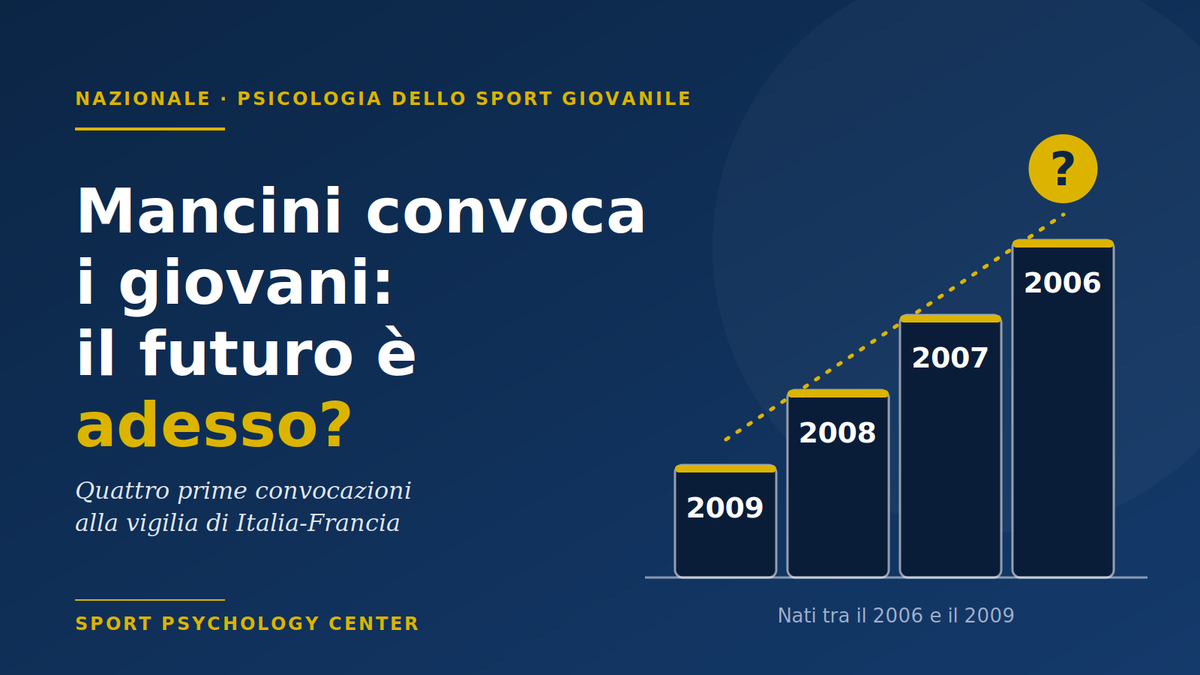
On the eve of Italy-France, Roberto Mancini said that everyone wanted young players in the national team and that now they are there, adding: “let's hope we pick the right ones”. [8] For the last two matches of the Nations League group he called up 31 players, with four first call-ups in the Azzurri shirt: Riccardo Cassano (Como, born 2009), Simone Lontani (Parma, 2008), Alphadjo Cisse (Milan, 2006) and Mattia Liberali (Como, 2007). The squad has an average age of 24 years and 171 days, the lowest of Mancini's tenure, not counting Cassano (17) and Lontani (18). [7]
The context is demanding. This evening at 8.45pm, at a sold-out San Siro, Italy face France: the Bleus are on 10 points, the Azzurri on 7, Belgium on 6 and Turkey on 0, and a place in the quarter-finals is at stake. On Sunday the group ends in Brussels against Belgium. [6]
02 WHAT “NOW” MEANS
Two kids visiting, three in camp, a qualification to play for
The word “now” in the title doesn't apply to everyone in the same way. Cassano and Lontani are called up to be observed up close: they won't stay in camp for its whole duration and in the coming days will join the Under 18 and Under 19 national teams. Cisse, Liberali and Palma, by contrast, stay aggregated to the squad for the entire camp. [6] For two of the boys, then, “now” is a visit of a few days.
Mancini is holding together two objectives: qualification and the growth of the young players. “now the objective is to make the young players grow”, he said, adding that there are already reference points on the performance of the more experienced ones. [9] The reason for the choice is to get to know them directly, because watching them only in matches isn't enough. [10] It's a bet declared as such, not a verdict on their worth.
03 THE FUTURE ISN'T READ IN A CALL-UP
What research says about precocity
A meta-analysis by Barth, Güllich, Macnamara and Hambrick compared higher- and lower-performing athletes, across different ages and sports. The central result: the predictors of junior and of senior performance are often opposite. The best juniors had started their main sport earlier, had accumulated more specific practice and had progressed faster, while among seniors the best had reached milestones later and world-class ones had practised more sports other than their main one. [1]
A later synthesis by the same authors reaches the same conclusion regarding pathways: few elite juniors went on to reach an equivalent level as seniors, and few elite seniors had reached it as juniors. [2] A cautious reading follows: early success is information, not a verdict.
Two cautions. These studies concern athletes in many sports and at many levels, not national-team call-ups in football, and they say nothing about the individual players called up by Mancini. But they make coherent the coach's formula, which speaks of a bet and of direct knowledge, not of certainties.
The future doesn't become now because a call-up says so: it becomes so if the player has the tools to cope with it.
04 04 WHAT IT TAKES TO COPE WITH “NOW”
The psychological skills that can be built early
If early performance predicts little, what can be built right away? MacNamara, Button and Collins interviewed seven elite athletes and one parent of each about their development. The analysis identified psychological factors as key determinants of who emerges as a talent and maintains excellence, and the authors suggest that development programmes should value psychological skills and behaviours early. [3]
It's a qualitative study on a small sample, to be read as an indication and not as a measure. But it points to a concrete path for those who work with young players entering elite groups: preparing them for the leap not only technically, but also in how to face a new context.
05 THE CONTEXT OF “NOW”
San Siro and role: two variables that weigh
In 1965 Robert Zajonc proposed an explanation that remains a basic reference: the presence of other people increases arousal, and this facilitates well-learned responses and hinders those not yet learned. [4] For those playing at a high level, technical actions are largely learned. What is new is the context: the international pace, little-known teammates, a sold-out stadium where Italy have lost the last three matches and haven't beaten France at home since 1962. [6] The hypothesis is that the risk lies in responses that in the new context are not yet automatic, such as quick decisions and communication with teammates. The theory has not been tested on these players, and some may not take the field: for Cassano and Lontani the issue is, if anything, the camp environment.
Then there is the role. Salas and colleagues' meta-analysis on team building found that interventions focused on role clarity were more likely to increase performance. [5] The context is different, because it concerns work groups and not a call-up of a few days, but the idea is transferable: a player who arrives to be observed and leaves after a few days needs to know why they are there, for how long and what will be looked at. If the role isn't clear, the same call-up can be experienced as an exam or as a promotion, and the media narrative (“the youngest”, “the chosen one”) risks deciding in place of those directly involved.
06 PRACTICAL IMPLICATIONS
What those who accompany a young talent can take home
The pointers that follow are practical applications of the cited findings, not the result of a study on these call-ups.
Explain the purpose of the call-up. Observing isn't selecting: say it to the player, the family and the club, in simple words, before the outside narrative does.
Separate the label from the task. “The youngest ever” is a headline, not a goal. Ask the player what he has to do in today's training session, not what the record is worth.
Don't break the path. The return to the youth national teams, as for Cassano and Lontani, should be presented as continuity and not as a downgrade.
Train psychological skills before the leap, not after. Facing a new context, an unknown teammate, a mistake in front of everyone: these are situations that can be rehearsed in advance.
| How do you accompany a young talent in the leap to a higher level? Role communication, label management and psychological skills can be trained, also in youth sectors and training camps. Let's talk about it. |
07 IN CLOSING
Now is the beginning, not the arrival
This article is written before the kick-off of Italy-France, and we don't know how it will end or who will take the field. The question in the title can be answered like this: if “now” means exposure, that is, letting the players get to know the head coach and the group get to know the players, yes, the future is now. If it means arrival, no: a call-up is a bet, not a promise. For it to become something more, precocity matters less, and what matters more is how the experience is explained, the role given to the player and the skills with which he faces it.
www.sportpsychologycenter.com
SCIENTIFIC REFERENCES
[1] Barth, M., Güllich, A., Macnamara, B. N., & Hambrick, D. Z. (2022). Predictors of junior versus senior elite performance are opposite: A systematic review and meta-analysis of participation patterns. Sports Medicine, 52(6), 1399–1416. DOI: 10.1007/s40279-021-01625-4 (PDF) Predictors of Junior Versus Senior Elite Performance are Opposite: A Systematic Review and Meta-Analysis of Participation Patterns
[2] Güllich, A., Barth, M., Macnamara, B. N., & Hambrick, D. Z. (2023). Quantifying the extent to which successful juniors and successful seniors are two disparate populations: A systematic review and synthesis of findings. Sports Medicine, 53(6), 1201–1217. DOI: 10.1007/s40279-023-01840-1
[3] MacNamara, Á., Button, A., & Collins, D. (2010). The role of psychological characteristics in facilitating the pathway to elite performance. Part 1: Identifying mental skills and behaviors. The Sport Psychologist, 24(1), 52–73. DOI: 10.1123/tsp.24.1.52
[4] Zajonc, R. B. (1965). Social facilitation. Science, 149(3681), 269–274. DOI: 10.1126/science.149.3681.269
[5] Salas, E., Rozell, D., Mullen, B., & Driskell, J. E. (1999). The effect of team building on performance: An integration. Small Group Research, 30(3), 309–329.
JOURNALISTIC SOURCES
[6] FIGC.it (05/11/2026), “L'Italia a caccia del pass per i quarti di Nations League: 31 convocati per i match con Francia e Belgio” [“Italy chasing a Nations League quarter-final pass: 31 called up for the matches against France and Belgium”]; LaPresse (05/11/2026 and 11/11/2026), for the call-ups, the sell-out and the previous matches at San Siro; Sportal.it (05/11/2026); Sky Sport (November 2026), squad and kick-off times.
[7] Quotidiano Sportivo (10/11/2026), on Mancini's press conference and the average age; Il Fogliettone (10/11/2026), on the Coverciano camp.
[8] askanews, picked up by Il Quotidiano del Sud (11/11/2026), Mancini's statements on the eve of Italy-France.
[9] LaPresse (11/11/2026), “Nations League, San Siro esaurito per Italia-Francia” [“Nations League, San Siro sold out for Italy-France”]; Adnkronos (11/11/2026), Mancini's press conference.
[10] Lazionews24.com (11/11/2026), Mancini's press conference on the eve of Italy-France.

Fabio Zarra