
«Love for Italy doesn't depend on a role»: Pirlo, Maldini, Leonardo, the FIGC, and the psychology of reputation under attack
28 July 2026The training camp that trains the mind: what Deportivo Riestra's preseason camp teaches us about the psychology of preseason training
6 August 2026On 28 July 2026, Malagò announces to the Federal Council the return of Roberto Mancini to the Azzurri bench. Three years after his departure for Saudi Arabia, after repeatedly stated regret, and after a formal apology to the Federation. The psychology of the second chance explains what really drives this return — and why the road to rebuilding trust is longer than it seems.
Autore Fabio Zarra
There's a sentence Roberto Mancini has repeated many times over the past three years, in interviews, in leaked private conversations, in the silences made eloquent by the time spent in Saudi Arabia: «I regret it». He has said that choosing to leave the Italian national team in August 2023 — just appointed coordinator of the youth national teams, then immediately resigning to sign with Saudi Arabia — was a mistake. He said it to the press. He said it to friends. He evidently said it, too, to Giovanni Malagò, who on 28 July 2026 announced to the Federal Council his return as head coach of the Azzurri.
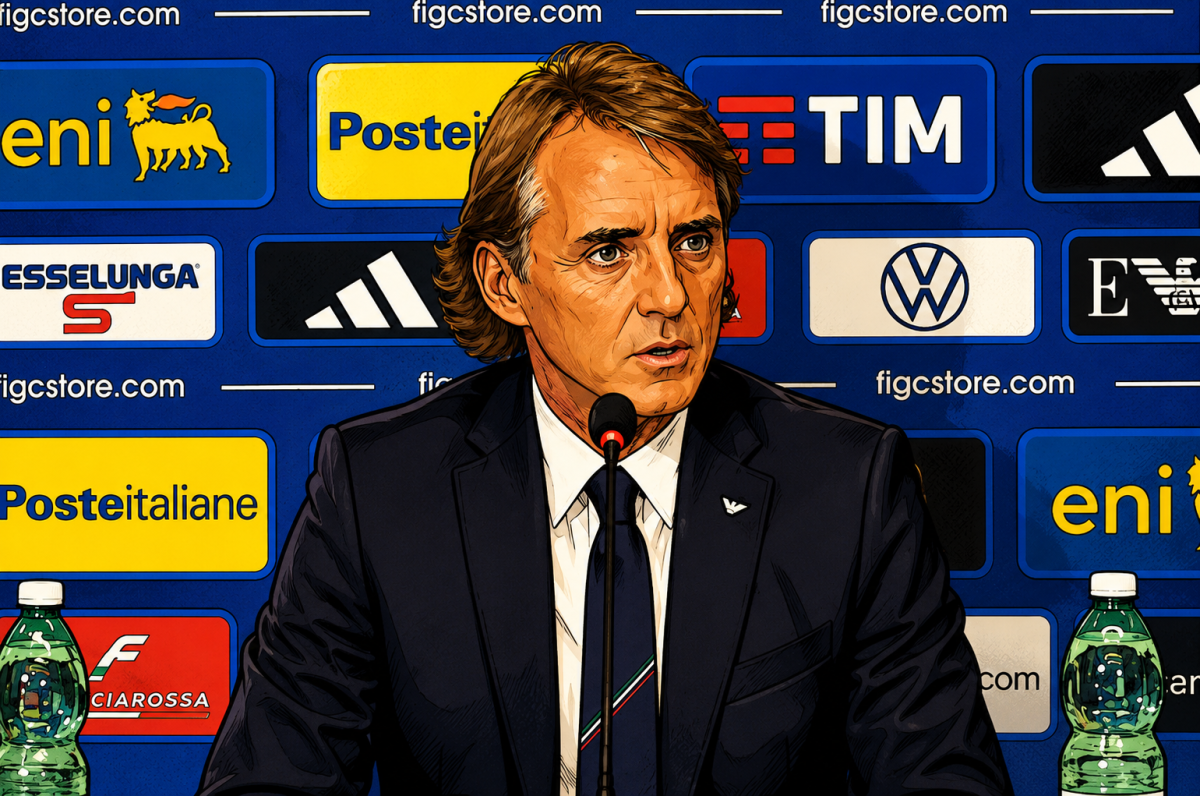
«It's important that he apologised, and that's the premise for the coach's presentation», Malagò said ahead of the official press conference on 29 July. At Mancini's side, as technical director, Claudio Ranieri — who had already turned down the head coach role after Spalletti's sacking and now accepts a different, more structural role. Together, they form a pairing that the football system chose as a response to the chaos produced by the Pirlo-Maldini-Leonardo affair: experience against uncertainty, known names against the risk of the untested.
For sport psychology, Mancini's return is one of the richest cases in recent years. Not because it's unusual for a coach to return to a bench — that happens often. But because this return comes after a departure many experienced as a betrayal, after openly stated regret, after a formal apology, and with the weight of having to prove something that, the first time around, needed no proving. It's a second chance with all the baggage second chances carry.
01 — THE STORY
From Wembley to Palermo, from Jeddah to Rome
Mancini's tenure on the Italian bench had begun in 2018, inheriting Ventura's catastrophe — the failure to qualify for the Russia World Cup — and turned into one of the finest chapters in the recent history of the Azzurri. The 2021 European Championship, won at Wembley against England on penalties, was the peak: a national team reinvented in style, mindset, and narrative, with Gianluca Vialli — who passed away in January 2023 — as a symbolic and human figure alongside the coach. Thirty-seven matches unbeaten: an absolute record.
Then the cracks. The night in Palermo against North Macedonia, March 2022: Italy eliminated in the play-offs for the second consecutive World Cup, even more painful than 2018 because it came after being reigning European champions. Mancini was kept on — a choice supporters read as continuity, detractors as inertia — and was also appointed coordinator of the youth national teams. It lasted a few days. On 13 August 2023, the FIGC announced it had «taken note of his resignation». A few hours later it became known: he had signed with Saudi Arabia. The contract was stratospheric. So was the controversy.
| The first tenure (2018-2023) LIGHT AND SHADOW Euro 2021 won at Wembley. Record of 37 matches unbeaten. Failure to qualify for the 2022 World Cup (North Macedonia). Then the sudden resignation for Saudi Arabia. | The return (2026) SECOND CHANCE Regret stated repeatedly. Formal apology to the Federation before the appointment. Ranieri as technical director. Goal: qualification for Euro 2028 and the 2030 World Cup. |
02 — THE REGRET
«I regret it»: the psychology of regret as the engine of the return
Mancini's regret isn't diplomatic rhetoric. Less than two months after his Saudi adventure ended, interviewed on Tg1, he had already said: «I wouldn't do it again, for technical and footballing reasons. I think coaching the national team is the most beautiful thing there is». A sentence worth far more than any statement: it's an assessment made when no job offer was yet on the table. Regret has a precise psychology, and it's worth applying it to this case.
Zeelenberg and Pieters, in their theory of regret regulation, describe regret as an action-oriented emotion: it isn't experienced passively, but as a drive to correct a choice perceived as wrong. Regret differs from disappointment — which is felt over what happened — because it's rooted in the awareness that we could have chosen otherwise. And this awareness, when intense and lasting enough, becomes the most powerful motivation for a course correction.
Mancini has had three years to feel this regret. Three years in Saudi Arabia, far from Italy, far from European football, far from the Azzurri. Three consecutive World Cups without Italy — the third, in 2026, has just ended without her. Regret, in this case, had all the time and all the material it needed to become irresistible. And when the FIGC chaos of the past few days created a sudden vacuum, it was already there: ready to become a return.
| Regret isn't passive. It's an action-oriented emotion: it tells us we could have chosen otherwise — and that we still can. |
There's also a deep motivational dimension to this story, which Deci and Ryan's Self-Determination Theory illuminates with precision. In 2023, Mancini chose an extrinsic motivation — the Saudi pay, the stratospheric contract — abandoning an intrinsic one — leading the Italian national team, the project he had built over five years. Research has shown for decades that extrinsic motivation produces short-term satisfaction but rarely holds up over time: when the external incentive isn't accompanied by an authentic sense of meaning, the emptiness that remains is exactly what Mancini has described over these three years. The regret wasn't for the money he'd earned. It was for the story he'd abandoned.
03 — TRUST
Is an apology enough? The science of repairing betrayal
Malagò said Mancini's apology is «important» — the necessary premise for his return. Capello, in the Gazzetta dello Sport, said something very different: «He did something serious, he didn't deserve to come back. How can you abandon the national team to go collect money in Saudi Arabia? It's an act of missing love». Who's right? The answer, as often happens, is in the research.
Kim, Ferrin, Cooper, and Dirks conducted two studies on trust repair after a perceived violation, distinguishing between violations of competence — «he wasn't good enough» — and violations of integrity — «he broke a commitment». Mancini's departure for Saudi Arabia is, in the perception of many, an integrity violation: not a technical issue, but one of loyalty to a project, a country, a mandate. Kim and colleagues' research found that integrity violations are significantly harder to repair than competence violations — and that an apology alone isn't enough to restore the previous level of trust.
This doesn't mean Mancini can't make up the lost ground. It means the apology — however necessary and however sincere — is only the first step of a process measured in months and years, not in press conferences. Research suggests that what repairs an integrity violation isn't words, but subsequent actions: consistency between what one says and what one does, the ability to show — match after match — that one's priorities have changed. Capello senses this: for him, certain chapters don't close with a signature or a statement. He's right that the process is long. He's not right — and the research contradicts him — if he means the process is impossible.
| «It's important that he apologised, and that's the premise for the coach's presentation.» GIOVANNI MALAGÒ · FIGC FEDERAL COUNCIL, 28 JULY 2026 |
There's an attributional dimension to this affair worth spelling out. Weiner's attribution theory describes how people explain the causes of events affecting them. Mancini's 2023 departure is attributed by most fans and insiders to causes that are internal (it was his choice), stable (that's who he is, he's done it before) and controllable (he could have chosen not to). This attributional pattern is the most damaging for trust repair: it says the cause lies in the man, not the circumstances, and that it could have been avoided. To repair it, Mancini must convince the public that at least one of these dimensions has changed — that he's a different man, that his priorities have shifted, that what he learned in Saudi Arabia transformed him. Saying it isn't enough: he has to prove it.
04 — IDENTITY
The return as an act of narrative redemption
There's a third level of analysis in this story, the most personal one: identity. Dan McAdams described how people build their sense of self through internally coherent life stories. Within those stories, McAdams identified a recurring pattern in the life narratives of people facing hardship: the redemption sequence. A moment of fall — the wrong choice, the perceived betrayal, the loss — followed by a redemption that turns that experience into something meaningful.
Mancini's return has the narrative structure of what McAdams, in his work on narrative identity, describes as redemption sequences: experiences of falling that turn into rising through a recognition of one's own mistake and an act of correction. The champion who wins the Euros, who leaves for the money, who repents, who returns to close the circle. It's a story the Italian public knows well — culturally, we're trained to recognise it and, often, to love it. It's no coincidence that Malagò — described by ANSA as Mancini's «personal friend» — chose him precisely in this moment of institutional vacuum: the right narrative was there too, ready to be used.
The question psychology raises, though, isn't whether the narrative is beautiful. It's whether it's authentic. The risk with returns driven by regret is that the dominant emotion — «I want to make up for what I did» — can become a burden rather than a resource: if Mancini returns mainly to exorcise 2023, his gaze will be mostly on the past rather than the future. The second chance really works when the athlete or coach manages to use regret as initial fuel and, over time, turn it into something new — genuine motivation toward what comes next, not a constant comparison with what came before.
05 — MANCINI AS HEAD COACH: THE RISK
The weight of measuring up against himself
The most insidious problem for Mancini won't be a critical press, nor fans' resistance, nor the Federation's expectations. It will be measuring up against himself. The 2021 Euros are still fresh in the collective memory — the 37 unbeaten results, Wembley, Vialli — and the Mancini of 2026 begins his tenure not as the builder of something new, but as someone who has to get back to that level. Many will use 2021 as the yardstick for everything he does from now on.
This kind of pressure — having to prove you're worth what you were worth in an unrepeatable moment, under different conditions, without some of the ingredients that made it possible (Vialli, that specific generation of players, that particular emotional context) — is among the hardest to manage in performance psychology. You can't go back to 2021 because 2021 no longer exists. You can only build something different and hope it's just as meaningful.
Then there's Capello's voice, embodying a significant part of Italian football public opinion. The former coach is blunt: «It seems incredible to me that Mancini could return to the Azzurri bench after leaving it that way». It's a position that shouldn't be dismissed: it's precise and grounded in real facts. But it's simply incomplete. Chapters can remain open without the story staying unchanged. A story can add new pages that change how the old ones are read. But that takes time — and wins.
06 — CLOSING THOUGHTS
The second chance as the ultimate test
Roberto Mancini will return to the Italy bench with a résumé very few Italian coaches can boast, with a regret that has chased him for three years and that he has now turned into motivation, and with trust to rebuild brick by brick, result by result. It isn't the most comfortable position to start from. It's perhaps the most psychologically honest one: a man who knows exactly why he was wrong, who has reckoned with himself in public, and who now has to prove that reckoning was real.
The psychology of the second chance tells us these situations can produce performances of a higher quality than the first time around — not despite the weight of the past, but because of it. Someone who returns after losing something important carries an awareness that someone who has never lost doesn't have: they know how much what they've found again is worth, and how much it can cost to let it go a second time. If Mancini can use this awareness — instead of being overwhelmed by comparison with 2021 or by anxiety over having to fix 2023 — he could build something unexpected. Not better or worse than the Euros. Simply different, and his own.
Football will tell. Psychology has already anticipated it.
| THREE QUESTIONS PSYCHOLOGY ASKS OF MANCINI'S RETURN Has regret become motivation or a burden? Regret over 2023 can be extremely powerful fuel — or a prison. If Mancini looks forward and builds something new, regret works in his favour. If he keeps looking back trying to erase 2023, it becomes an obstacle.Can trust be repaired? Yes — but not with an apology. Integrity violations are repaired through consistency over time. The process is long and requires actions to be consistently louder than words.Is the comparison with 2021 manageable? Only if Mancini manages to build something new instead of trying to replicate the unrepeatable. The 2021 Euros had specific ingredients — Vialli, that generation, that moment — that can't be recreated. What can be built is a new story. |
| Are you returning to a path you've already walked? Managing comparison with the past, turning regret into motivation, rebuilding trust: these are all skills that can be built — with the right time and the right tools. → BOOK A FIRST CONSULTATION www.sportpsychologycenter.com · Professional consultancy, VR training and mental training |
SCIENTIFIC REFERENCES
- Zeelenberg, M., & Pieters, R. (2007). A theory of regret regulation 1.0. Journal of Consumer Psychology, 17(1), 3–18. DOI: 10.1207/s15327663jcp1701_3
- Kim, P. H., Ferrin, D. L., Cooper, C. D., & Dirks, K. T. (2004). Removing the shadow of suspicion: The effects of apology versus denial for repairing competence- versus integrity-based trust violations. Journal of Applied Psychology, 89(1), 104–118. DOI: 10.1037/0021-9010.89.1.104
- McAdams, D. P. (2001). The psychology of life stories. Review of General Psychology, 5(2), 100–122. DOI: 10.1037/1089-2680.5.2.100 https://psycnet.apa.org/record/2018-70018-002
- Deci, E. L., & Ryan, R. M. (2000). The “what” and “why” of goal pursuits: Human needs and the self-determination of behavior. Psychological Inquiry, 11(4), 227–268. DOI: 10.1207/S15327965PLI1104_01
- Weiner, B. (1985). An attributional theory of achievement motivation and emotion. Psychological Review, 92(4), 548–573. DOI: 10.1037/0033-295X.92.4.548
News sources: Corriere dello Sport, Tuttosport, ANSA, Leggo, Calcio Lecce, Avantigialli, MondoUomo, Sky Sport (28-29 July 2026). Malagò's announcement to the Federal Council: 28 July 2026. Official press conference with Mancini and Ranieri: 29 July 2026, 6pm. Malagò's statement on the importance of the apology: ANSA, 28 July 2026. Mancini as head coach from 2018 to 13 August 2023: 5 years, 61 matches, Euro 2021 won at Wembley, 37 matches unbeaten, failure to qualify for the 2022 World Cup (eliminated by North Macedonia, Palermo). Resignation on 13 August 2023 to sign with Saudi Arabia. Regret stated repeatedly: Corriere dello Sport, 28 July 2026. Ranieri as technical director (had turned down the head coach role after Spalletti): Tuttosport, ANSA. Potential staff: Leonardo Bonucci, Antonio Gagliardi, Massimo Maccarone, Marco Roccati (goalkeeping coach): Avantigialli. Capello's criticism: Corriere dello Sport (cited by Avantigialli, 29 July 2026). Malagò described as Mancini's «personal friend»: ANSA.

Fabio Zarra