
"Nobody cares what I know": Bielsa, Uruguay, and the psychology of the coach-player relationship
2 July 2026A suspended ban, two on-field psychiatrists: what happens when "sports justice" becomes a global issue?
6 July 2026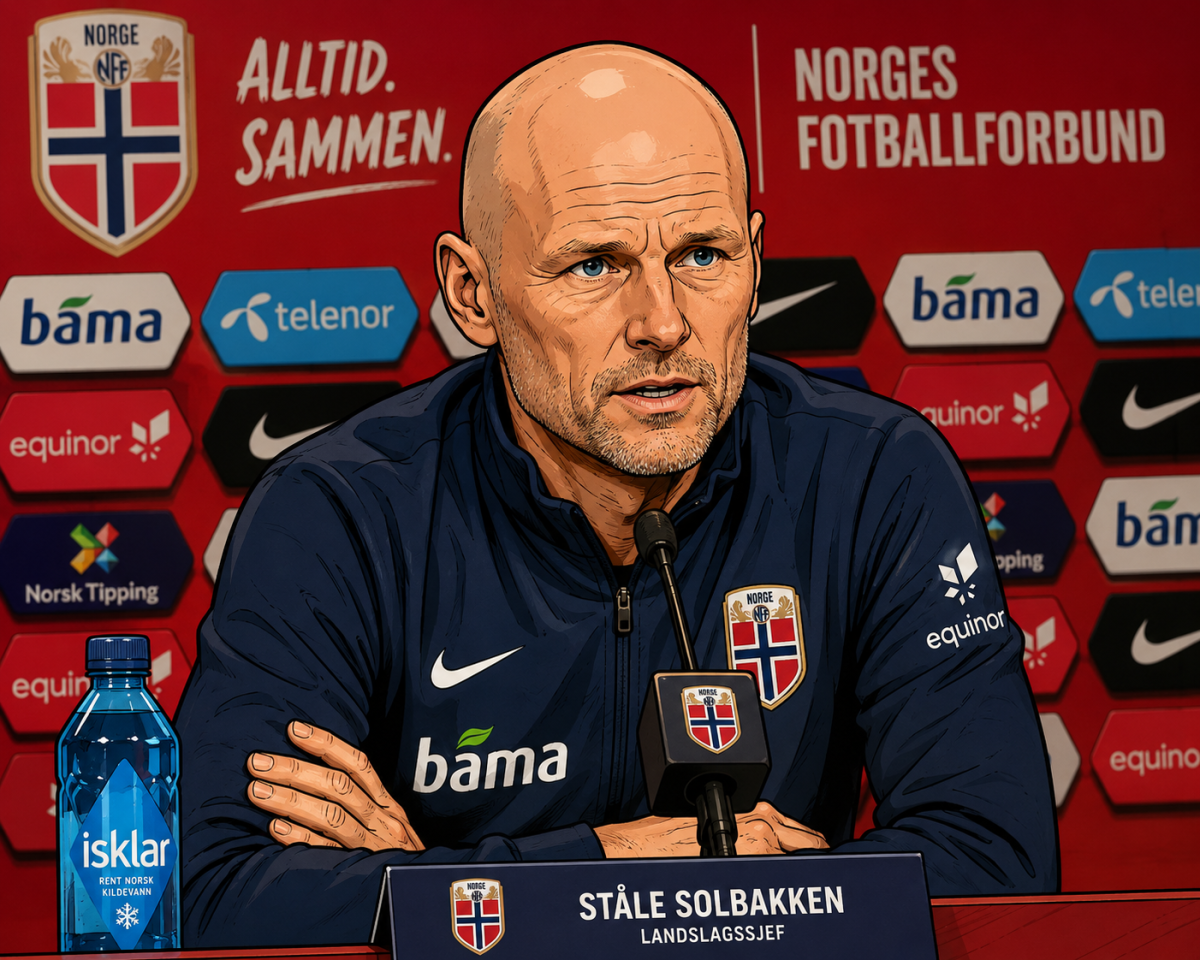
By Fabio Zarra
Tonight, at MetLife Stadium in East Rutherford, Brazil and Norway are playing for a place in the World Cup quarterfinals. On the Norwegian bench sits a man who, nineteen years ago, was declared clinically dead for seven minutes. In recent days, a video of the Scandinavian locker room has gone viral: Ståle Solbakken turns to the camera and issues a direct challenge to his Italian colleague — “Carlo Ancelotti, we’re coming for you.” It’s not the outburst of a coach seeking visibility. It’s consistent with a personal trajectory that post-traumatic growth psychology allows us to read more precisely than sports reporting.
Visit our website www.sportpsychologycenter.com
01 – The fact
In 2007, Solbakken, then still a registered football coach, suffered a sudden cardiac arrest during a training session, caused by a previously undiagnosed congenital heart defect. His heart stopped for seven minutes. He remained in a coma for thirty hours. Upon awakening, he received a pacemaker; at 33, he chose to retire from football, declaring he did not want to "tempt fate" a second time. He returned to the bench, and today, at 58, he leads Norway to its first World Cup knockout stage since 1998.
During the same tournament, another incident attracted media attention: before the match against Iraq, Solbakken publicly downplayed the absence from training of a player suffering from a fever, in a tone deemed excessively harsh by some observers. Two signs of the same trait: a coach who communicates, both to his own players and to his opponents, an abnormal relationship with risk and fear.
02 – What research says about post-traumatic growth
It is neither possible nor correct to make a psychological diagnosis on a person we are not treating—and that is not the aim of this article. What we can do, with scientific honesty, is frame the phenomenon through a solid construct from the literature: post-traumatic growth, first systematically described by Tedeschi and Calhoun (1996) in the Journal of Traumatic Stress. The model describes how, in a significant minority of people who survive life-threatening events—cardiac arrests, serious diagnoses, accidents—not only recover but experience positive and lasting change in at least one of five areas: appreciation for life, relationships with others, perceived new possibilities, perceived personal strength, and spiritual or existential change.
A central element of the model is the restructuring of risk perception: those who have experienced a direct confrontation with their own mortality tend to recalibrate what they consider "dangerous" or "to be avoided" in their daily and professional lives. A public challenge to a world-renowned coach, in this context, is less psychologically burdensome for those who have already experienced the extreme experience of clinical death. It's not recklessness: it's a recalibrated hierarchy of risks.
It must be equally clear that post-traumatic growth is neither automatic nor universal—the literature also documents patterns of chronic stress, health anxiety, and avoidance following sudden cardiac events. The model describes a possibility, not a rule, and the two pathways (growth and prolonged vulnerability) can coexist in the same person at different times.
03 – Provocation as a tool, not as a character trait
The viral video—“we're coming for you”—is part of a lesser-known but well-established line of research: pre-game verbal gamesmanship, or trash talk. The reference study on the topic, conducted by Rainey and Granito (2010) on over 400 university athletes (Journal of Sport Behavior, 33[3], 276-294), shows that those who practice it declare multiple and co-present motivations: psychological self-activation, destabilizing the opponent, and communicating confidence to their team. Therefore, there is no single dominant function—the research urges us to be wary of overly linear interpretations (“it's just to motivate your players” or “it's just to intimidate the opponent”). What can be documented, in this specific case, is that the Norwegian dressing room erupted in jubilation immediately after Solbakken's goal: a signal consistent with the group self-activation component described in the literature, alongside—not instead of—the potential destabilizing effect on Ancelotti and his players.
04 – Two leadership styles compared
Tonight's match pits two pressure-management philosophies, well-documented in sports leadership literature. Ancelotti has been described by Brazil's press as the "calm leader," attributing the comeback against Japan to the "calmness and confidence" he conveyed to the team—an approach consistent with low-emotion-activation transformational leadership models, which emphasize perceived stability as a resource under acute pressure. Solbakken represents the opposite extreme: high-activation leadership, which uses external provocation and internal severity (as in the case of the feverish player) as motivational levers.
Caution is warranted here: the literature on the coach-athlete relationship, particularly studies conducted within the framework of self-determination theory (Mageau and Vallerand, 2003, Journal of Sports Sciences), shows that coaching styles that are more controlling and less supportive of autonomy only work within narrow limits, and over time tend to correlate with weaker motivation and a greater risk of burnout in the athlete. Solbakken's style may be effective in the short term of a knockout tournament—where immediate activation is more important than long-term sustainability—but it should not be mistaken for a leadership model to be replicated across contexts.
05 – A reading, not a verdict
We'll never know for sure how much of Solbakken's leadership is a direct result of those seven minutes in 2007, and how much is simply a product of his pre-existing temperament. What sports psychology can offer isn't a definitive explanation, but a more rigorous lens than the usual locker room motivational narratives: a coach who has recalibrated his risk hierarchy, who uses provocation as a team glue rather than a weapon against the opponent, and who tonight is playing—with Ancelotti, not just against him—one of the most anticipated matches of this World Cup.
Main sources
Tedeschi, R.G. & Calhoun, L.G. (1996). The Posttraumatic Growth Inventory: Measuring the positive legacy of trauma. Journal of Traumatic Stress, 9(3), 455–471. https://pubmed.ncbi.nlm.nih.gov/8827649/
Mageau, G.A. & Vallerand, R.J. (2003). The coach–athlete relationship: A motivational model. Journal of Sports Sciences, 21(11), 883–904.
Rainey, D.W. & Granito, V. (2010). Normative rules for trash talk among college athletes. Journal of Sport Behavior, 33(3), 276–294.

Fabio Zarra