
When life intrudes on the field: acute grief in the elite coach
24 June 2026The Psychology of Nothing to Lose: Why the Outsider Sometimes Plays Better
29 June 2026How the world's most feared striker built a model of behavioral self-regulation—and why humor is part of training. At the 2026 World Cup, a few minutes
At the 2026 World Cup, just minutes after scoring his second brace in as many games, Erling Haaland gave an interview destined to go viral. A journalist asked him if this could be his World Cup, the one that would definitively establish him as the best in his position. He responded without hesitation: France will win everything. Norway will probably be beaten.
In a World Cup full of carefully considered statements and carefully crafted soundbites, that response went viral. The media interpreted it as irony, provocation, and psychological tactics. In part, it is. But those who study sports psychology recognize something much more precise in that phrase: an athlete who hasn't built his identity around the outcome of a match.
This article is not a biography of Haaland. It is an attempt to interpret—through the lens of performance psychology—what emerges from his training, his habits, and his public communication. Because what Haaland does, often described as "bizarre" or "Viking-like," is actually a consistent and scientifically based application of principles well-known to sports psychology research.
1. Focusing on the present moment: when irony is cognitive regulation
Let's go back to that statement at the 2026 World Cup. When asked if this could become his World Cup, Haaland replied: "It depends on what you mean. Qualifying for the first time in 28 years and getting past the group stage, yes, I would say so." Then he added that France would probably win the whole thing. And he said all this with a smile, as lightheartedly as he would comment on the weather.
It wasn't performative humility. It was present-moment awareness: the ability to remain anchored to the immediate action rather than dissipating cognitive resources on uncontrollable future scenarios. Haaland said it explicitly in an interview during the tournament:
“It’s about thinking about the next action and staying in the moment.” — Erling Haaland, intervista durante i Mondiali 2026
In the literature on mindfulness applied to sport (Gardner & Moore, 2004; Birrer et al., 2012), the ability to focus on the present moment—without ruminating on previous mistakes or anticipating future outcomes—is one of the strongest predictors of flow and managing performance anxiety. It's not about not caring about results, but about recognizing that the only real point of control is the present action.
What's striking is that Haaland doesn't apply this principle as a conscious exercise during the match: he's structured it into his way of communicating, answering questions, and publicly existing as an athlete. The irony here isn't about distancing oneself from pressure. It's about cognitive decentring: a technique borrowed from Mindfulness-Based Cognitive Therapy that involves taking an external perspective on one's thoughts and roles, reducing the psychological burden of external expectations.
2. Sleep as a psychophysical intervention: recovery neuroscience, not biohacking
When Haaland revealed on Logan Paul's podcast that he sleeps with tape over his mouth, wears orange-tinted glasses for three hours before bed, and aims for ten hours of sleep a night, many laughed. He himself explained the habit with the simplicity that has become his trademark:
“I think sleep is the most important thing in the world. Simple kind of things — blue blocking glasses, shutting out all the signals. To do a lot of things is not good, but to do small things every single day for a longer period really pays off.” — Erling Haaland, Impaulsive Podcast con Logan Paul (2023)
Behind that simplicity lies chronobiology. Orange-tinted glasses filter out the short-wavelength component of digital screens, which suppresses melatonin production and delays sleep onset. The mechanism is physiologically documented (Chang et al., PNAS 2015) and is now recommended by athletic sleep specialists. It's not a social media trend.
Mouth taping promotes nasal breathing at night. A study published in Healthcare (2022, PMC9498537) demonstrated that mouth taping significantly reduces the apnea-hypopnea index and improves sleep quality in subjects with mild apnea. Nasal breathing produces more nitric oxide, improves oxygen saturation, and reduces snoring. This isn't whimsy: it's physiology applied to athletic recovery.
Finally, ten hours of sleep aren't just laziness. Growth hormone—the main driver of muscle repair—is released predominantly during slow-wave sleep in the early stages of the cycle. Sleeping ten hours instead of eight means going through additional cycles of deep sleep, with increased hormone production proportional to the physical demands of an 88-kilogram body that accelerates at up to 35 km/h. His partner, Jack Grealish, described him thus to the Daily Mail: "He is the best professional I have ever seen. He recovers in the gym, ice baths, diet. That's why he is what he is."
From a sports psychology perspective, what's truly relevant isn't the single habit, but the underlying construct: Haaland manages physical and mental recovery with the same rigor he uses for technical training. This is consistent with the literature on self-regulated athletes (Zimmerman & Schunk, 2001): excellent self-regulation isn't just about performance during competition, but the entire life ecosystem that makes it possible.
3. “Unusual” workouts: functionality, not folklore
Coach Stanislav Macek, who worked with Haaland at Red Bull Salzburg, told Tribuna.com—a story picked up and verified by Goal.com—a detail that surprised everyone: the boy did 300 push-ups and 1,000 sit-ups a day, on his own initiative. "He once went on to tell me that he was doing 1,000 sit-ups and 300 push-ups daily. Just watching him impressed me a lot. He was a boy working like a mature professional."
The lesser-reported detail concerns what Haaland does in the Norwegian mountains during the summer. He himself posted a video on X of himself cutting wood, and when the cameraman asked him, "Cutting woods in the mountains is the most Erling Haaland thing I've heard," he laughed and replied, "My father forced me. I didn't have a choice." But he still does it every year, of his own free will.
Wood chopping is a functional strength exercise that engages the core, shoulders, lats, and posterior chain in rotational patterns that mimic the power generation of soccer. It doesn't replace the weights room, but complements it with multi-joint movements in a natural setting: it's the practical application of the principle of functional training, building strength in performance-specific movement patterns.
But there's a deeper level. Training neuroscience has begun to explore the role of exposure to natural environments: Bratman et al. (PNAS 2015) have documented how nature reduces cortisol, improves heart rate variability, and promotes emotional regulation. Haaland meditates near water in his mountains, hikes on high ground, and chops wood. From the outside, these seem like Norwegian eccentricities. From performance psychology's perspective, they're grounding rituals: activities that restore a sense of control, physical presence, and reduce the cognitive load accumulated during the weeks of competition.
4. Meditation as identity: the ritual that becomes communication
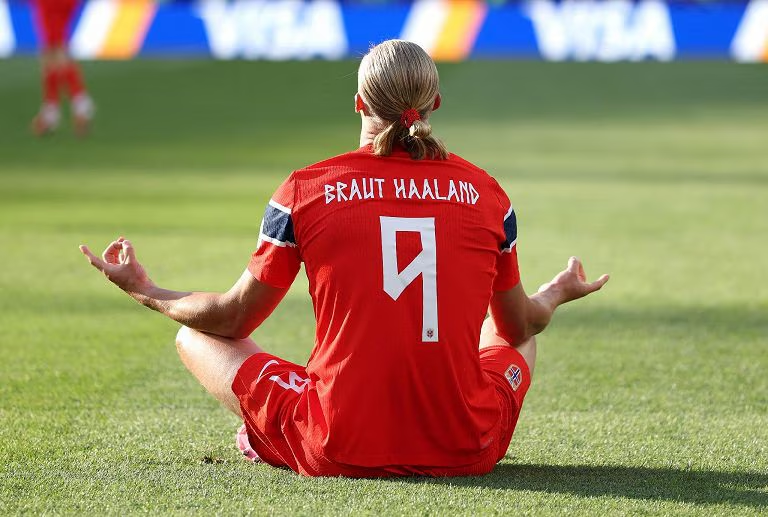
His celebration is one of the most recognizable in world football: he sits on the ground, crosses his legs, and closes his eyes. He's been doing it since his time at Borussia Dortmund, and he explained its meaning directly:
"Why do I celebrate like that? I really love meditation. It gives me serenity and calms me down. Before matches, I always listen to a song called 'Keep Dreaming' and then I meditate. It makes me feel calm." — Erling Haaland, interview with Esporte Interativo
That posture isn't a show. Haaland has said he meditates daily to find what he calls "inner peace"—and Goal.com confirmed that meditation is a regular part of his daily routine. But there's a deeper level of analysis: bringing that private ritual to the moment of scoring, in front of sixty thousand people, transforms meditation into a public statement of identity.
In psychology, this has a name: behavioral identity congruence. When an athlete publicly acts in a manner consistent with the values they practice privately, they reinforce their performance identity in both directions—toward themselves and toward their surroundings. Haaland doesn't celebrate the goal like a warrior who has defeated his enemy. He celebrates by returning to the center of gravity of his mind. It's a clear message: this is the source of my performance, not adrenaline.
Extra irony: when PSG players attempted to publicly mock his camouflage celebration after a defeat, Haaland commented that he should thank them for helping spread the message about the importance of meditation. No aggressive tone, no defensive response. Just someone who already knew where he stood.
5. Irony as a mental tool: why laughing at oneself is a psychological performance
At the 2026 World Cup, Haaland spent the weeks between matches documenting everything on Snapchat and Instagram—accounts he, strangely, still appears to manage himself. There's no visible PR team, no fabricated content. His followers have seen him eat at the legendary Katz's Delicatessen in New York, attempt a Southern accent with a fan who mistook him for the production cameraman, and post photos in an infrared sauna with the caption "infrared sauna" and nothing else.
He compared himself to Shrek. He said he ignored a message from Tom Holland because he didn't know who he was. He joked about the tape over his mouth in the same tone any twenty-five-year-old would use to talk about an experiment done out of curiosity.
From a performance psychology perspective, this self-deprecating communication isn't a casual personal branding strategy. It's a form of outcome de-identification: the athlete separates their core identity from contingent results and external expectations. They don't take themselves too seriously as "the best in the world" because that label isn't central to their mental construct.
Research on athletic self-compassion (Neff, 2003; Ferguson et al., 2014) shows that athletes who tolerate public imperfection and laugh at themselves exhibit significantly lower levels of performance anxiety, greater resilience to failure, and more consistent performance under pressure. This isn't because they worry less, but because their sense of self isn't at stake every time they step onto the field.
Haaland scores 52 goals in a season and then posts photos in silk pajamas. It's not a contradiction. It's the same system.
6. The integrated system: what an athlete (and a sports psychologist) can learn
From the outside, Haaland's profile seems like a collage of oddities: he chops wood, eats beef liver and heart, sleeps with tape over his mouth, wears orange glasses at night, meditates in the mountains, did 1,000 sit-ups a day as a teenager by choice, and posts memes of himself at the World Cup. But there's a thread that unites them all.
Each element responds to the same logic: not to maximize effort in every single action, but to build the structural conditions—physiological, cognitive, emotional—that make excellent performance the natural consequence of daily life.
In sports psychology, this is called self-regulatory system design: not the management of performance at the moment of competition, but the design of the entire life context that supports it. It's the transition that separates the athlete who "prepares for the competition" from the athlete who "lives in such a way that the competition is already prepared."
What makes Haaland an exceptional case study—more than his extraordinary physical abilities—is the coherence of the system. Sleep is not separate from meditation. Meditation is not separate from public irony. Irony is not separate from the post-match statement at the World Cup. Everything converges on the same point: an athlete who knows where his performance comes from, and who has built his life accordingly.
For a sports psychology professional, this suggests a question worth bringing into work with athletes: not just how much they train, but how much their lifestyle—sleep, recovery, rituals, self-communication—is consistent with what they want to express on the field.
Haaland at the 2026 World Cup is the spectacle we all expected: goals, pace, and off-the-charts physicality. But the most interesting thing isn't what he does on the pitch. It's the quiet consistency of everything else.
An athlete who meditates before matches and celebrates by sitting on the floor in front of sixty thousand people. Who sleeps ten hours and unfurls the tape over his mouth with the same ease with which he talks about his next opponent. Who chops firewood in the summer and then declares in a press conference that France will win the World Cup. Who compares himself to Shrek and then scores a brace.
It's not eccentricity. It's a behavioral self-regulation system that works because it's integrated, coherent, and rooted in a real—not superficial—understanding of how mind and body interact in high-level performance.
Sports psychology has been teaching for decades that physical talent isn't enough. Haaland proves this in the most ironic way possible: by being exactly what he says he is.
Fonti e riferimenti
- Macek, S. – statement to Tribuna.com (2020), verified and taken from Goal.com: «He was doing 1,000 sit-ups and 300 push-ups daily»
- Haaland, E. – Impaulsive Podcast con Logan Paul (2023): routine del sonno, nastro sulla bocca, occhiali anti-luce blu
- Haaland, E. – Impaulsive Podcast with Logan Paul (2023): Sleep routine, mouth tape, blue light glasses
- Haaland, E. – interview Fox Sports, Mondiali 2026: «It’s about thinking about the next action and staying in the moment»
- Haaland, E. – Documentary «Haaland – The Big Decision» (2020): nutrition and food quality
- Haaland, E. – post on X (Twitter): video of wood cutting in Norway
- Grealish, J. – declaration to Daily Mail: «He is the best professional I have ever seen»
- Jau, H.C. et al. – The Impact of Mouth-Taping in Mouth-Breathers with Mild OSA. Healthcare, 2022 (PMC9498537)
- Chang, A.M. et al. – Evening use of light-emitting eReaders negatively affects sleep. PNAS, 2015
- Bratman, G.N. et al. – Nature experience reduces rumination and subgenual prefrontal cortex activation. PNAS, 2015
- Gardner, F.L. & Moore, Z.E. – A Mindfulness-Acceptance-Commitment-Based Approach to Athletic Performance Enhancement. Behavior Therapy, 2004
- Neff, K.D. – Self-Compassion: An Alternative Conceptualization. Self and Identity, 2003
- Euronews – Why Erling Haaland has become the World Cup’s most entertaining star (giugno 2026)
- Strikerreport.com – Erling Haaland’s diet, sleep & recovery: the science behind the machine (giugno 2026)
