
Sinner win at Rome: When the body screams and the mind commands
17 May 2026Guardiola leaves City: the psychology of knowing how to stop
23 May 2026The 2025/26 season ends amid record injuries, impossible schedules, and a question rippling through the dressing rooms of Europe's top clubs: what price to play for?
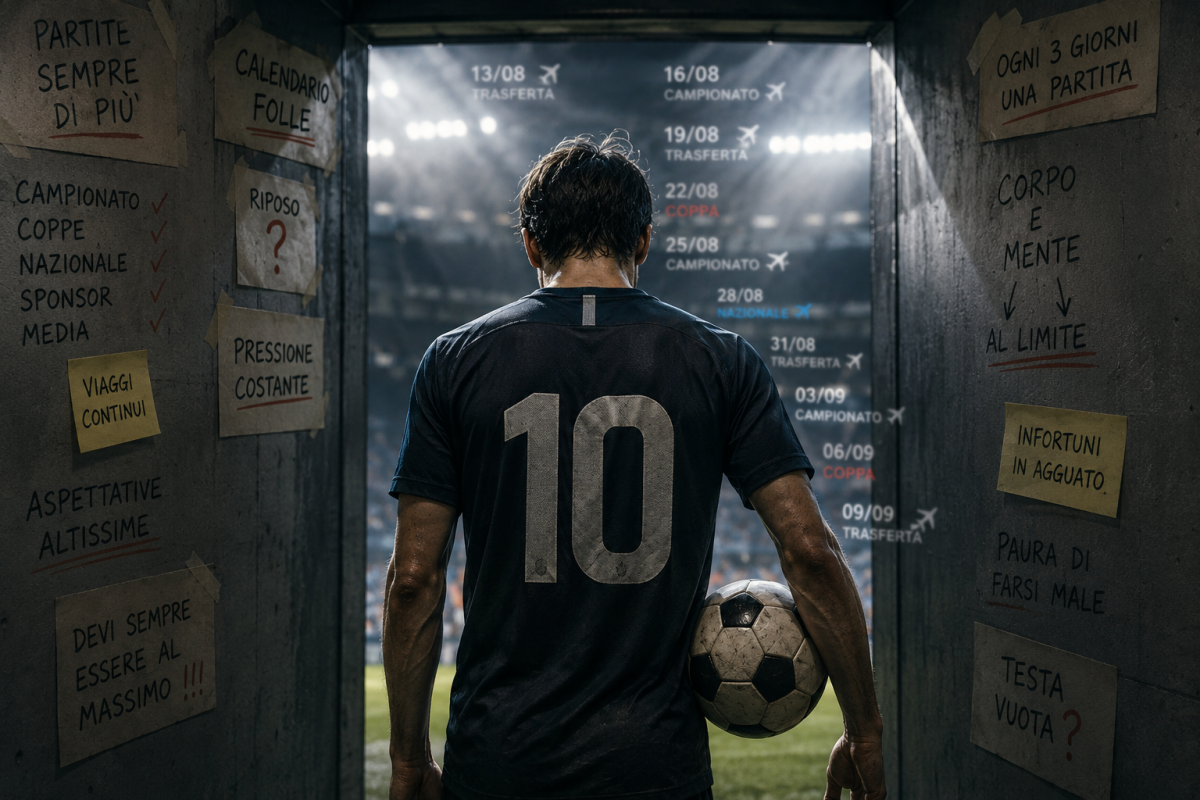
La corsa Champions in Serie A si decide all’ultima giornata. Juventus, Milan e Roma si giocano una stagione e decine di milioni di euro. Ma dietro i verdetti del campo c’è una verità che la psicologia dello sport conosce bene da anni: il burnout nei calciatori, ovvero l’esaurimento mentale degli atleti sta diventando il vero infortunio invisibile del calcio professionistico.
While the fans watch the final round of Serie A with bated breath, the locker room of those chasing qualification for next season's Champions League tells a different story. A story of muscles that no longer respond, joints that give way at the wrong time, and—above all—a mental fatigue that sports psychology experts now bluntly define as athlete burnout.
Juventus, for example, went through a real physical emergency this 2025/26 season: in early October 2025, defensive leader Gleison Bremer underwent surgery on the medial meniscus in his left knee—the same joint that had already torn his anterior cruciate ligament the previous year, costing him almost the entire 2024/25 season. In February 2026, during Galatasaray-Juve in the Champions League, he suffered another injury. A story that, in itself, illustrates the cumulative nature of wear and tear in modern football.
The numbers of an unsustainable calendar
To understand the scale of the phenomenon, it's best to start with the data. The world's footballers' union, FIFPRO, publishes an annual report monitoring the workload of professionals using a dedicated tool called the Player Workload Monitoring Tool, which tracks approximately 1,500 footballers worldwide. The latest report, published in the summer of 2025 with the telling title "Overworked and Underprotected," is a veritable autopsy of the system. Let's look at the key numbers, one by one, along with their clinical and psychological significance.
The 55-game threshold: the red line
FIFPRO recommends an annual ceiling of approximately 55 official matches per player. This is not a random number: it's the threshold beyond which, according to studies compiled by a panel of 70 medical and high-performance experts consulted by the union, athletes begin to lose physical intensity in matches, experience a reduction in their ability to recover between matches, and become significantly more susceptible to muscle injuries (particularly hamstring injuries) and mental exhaustion. It's, in other words, the point at which the risk/benefit ratio reverses: every match played beyond this threshold costs more than it brings in, both for the athlete and—paradoxically—for the quality of the show.
69-70 games per season: well over the limit
In the 2024/25 season, a growing group of top players played 69-70 matches for club and country. This represents approximately 25-30% more than the safe limit, in an activity where every match involves repeated sprints, tackles, jumps, and changes of direction at top speed. To give a physiological comparison: it's like asking a marathon runner to run 13 more marathons than his body is prepared for, knowing that each competition produces micro-tears in his muscles that take days to repair.
Federico Valverde and the 58 "back-to-back" matches
The case of the Uruguayan Real Madrid midfielder is cited by the FIFPRO report as emblematic. "Back-to-back" means matches played within five days of each other: 58 such episodes in a single season. Five days is the minimum biological recovery window for a muscle subjected to intense eccentric stress. Below that threshold, the return to the field occurs on a neuromuscular system still in the repair phase. The consequence, from a psychological standpoint, is that the athlete quickly develops a chronic perception of fatigue—what the literature calls chronic perceived fatigue—which in turn reduces motivation, sleep quality, and decision-making ability on the field.
Only 13% of athletes had adequate rest
This is perhaps the most alarming statistic. After major summer tournaments such as Euro 2024 and the Copa América 2024, FIFPRO recommends – based on sports medicine literature – a complete rest period of at least 28 consecutive days: the minimum time for the autonomic nervous system to recover its sympathetic-parasympathetic balance, for glycogen stores to normalize, and for the athlete to restart mentally energized. Only 13% of the monitored players actually received this break. The data on post-tournament pre-season preparation is even more dramatic: just 15% of European players and 4% of Copa América participants had an adequate recovery window before restarting. In other words, the vast majority of top players entered the 2024/25 season already with a recovery deficit.
Physical and mental fatigue: the numbers from the FIFPRO survey
In addition to objectively monitoring workloads, FIFPRO conducts direct surveys with players. The results, gathered after one of the busiest seasons ever, are revealing: 44% of players reported extreme or above-normal physical fatigue, while between 20% and 23% reported extremely high levels of mental and emotional fatigue. It's not just a single top player under pressure: it's a widespread condition among world football's elite. This prevalence explains why coaches like Guardiola, Ancelotti, and Xabi Alonso speak of an "impoverishment of the spectacle": when such a large proportion of players work beyond their sustainable limits, the collective technical quality declines.
More than half fear injury: the psychological alarm
This is the data that, from our point of view as sports psychologists, rings true. Over half of professional soccer players (54%) say they have been injured or fear they might be injured due to the congested schedule. We're not talking about an episodic fear linked to a single situation, but a chronic anticipatory anxiety—what clinical literature calls injury-related fear—which affects playing choices, reduces executive fluidity, and paves the way for post-injury kinesiophobia, which we'll discuss later.
And there's one piece of data that unequivocally closes the circle. A study conducted by the same union FIFPRO (Gouttabarge et al., on a sample of 826 footballers) found that active players who have suffered three or more serious injuries are four times more likely to develop mental health problems—symptoms of anxiety and depression—than their colleagues. This proves that physical injury and psychological distress are not two separate factors: they feed each other. In short, the phenomenon is no longer manageable as an individual issue: it has become a public health problem for the entire profession.
| IN SUMMARY — THE OVERLOAD NUMBERS |
| ? 55 partite/anno: tetto di sicurezza FIFPRO • 69-70 partite raggiunte dai top player • 58 match back-to-back (Valverde) • 54% dei giocatori infortunato o teme di infortunarsi • 13% con i 28 giorni di stop raccomandati • 4× più rischio di problemi di salute mentale dopo 3+ infortuni gravi |
Source: FIFPRO Player Workload Monitoring Report 2024/25 “Overworked and Underprotected”; data taken from Inside World Football (June 2025), The Football Week (July 2025), and fifpro.org (September 2025).
Comparison with other sports: football is the exception
To properly frame these numbers, a comparison is needed. Dr. Darren Burgess, president of FIFPRO's High-Performance Advisory Network, explained in September 2025 that football is the only major global professional sport that does not guarantee its athletes a minimum seasonal break. The NBA and the Australian AFL guarantee their players a 14-week seasonal break, while the American baseball league MLB guarantees 15 weeks. These are numbers that, in football, don't even exist as a target: top European players, between leagues, cups, national teams, and summer tournaments, often get less than two weeks of complete rest per year. This is what FIFPRO Europe president David Terrier bluntly defined: after 55 games per season, a player loses physical intensity, is more exposed to injury, and accumulates mental fatigue. A safety threshold, not an opinion.
The voices from the locker room
When a protest comes simultaneously from key players, top coaches, and unions, it becomes difficult to dismiss it as a seasonal outburst. Over the past eighteen months, verifiable public statements have multiplied, reported by major Italian and international sports publications, reflecting the same concerns.
2024 Ballon d'Or winner Rodri, who suffered a serious cruciate ligament injury just days after raising the possibility of a players' strike, told Sky Sports News (September 2024) that the possibility of a strike was "getting closer" and that in his personal experience, 40-50 games represent the maximum number of matches to play at your best level. His words were reported by Diretta.it and Ultimo Uomo.
"Someone has to take care of us, because we are the main players in this sport."
— Rodri, Manchester City, September 2024
— Rodri, Manchester City, settembre 2024
Along the same lines, Carlo Ancelotti, currently Brazil's national coach, spoke at the "Passione in campo" event organized by the AIC and AIAC in Reggio Emilia (June 2025): the schedule not only increases the risk of injury, but directly degrades the spectacle, because without adequate recovery, the best players can't perform at their full potential. His point is also interesting from a methodological perspective: coaches, Ancelotti says, now prepare for matches only with videos, no longer on the pitch. Practice is lost, and so is quality.
Pep Guardiola has also repeatedly called for union intervention. Liverpool goalkeeper Alisson Becker summed up his frustration with a phrase that later went viral: "Nobody asks us what we think if new matches are added." And in Italy, Alessandro Bastoni called the fixture list "crazy": "It's as if the seasons never end, it's hard to cope mentally" (interview reported by Ultimo Uomo, 2024).
These statements are part of a specific context: on 14 October 2024, FIFPRO Europe and the European Leagues – including Serie A, the Premier League and La Liga – filed a complaint with the EU Commission against FIFA for alleged abuse of its dominant position in the management of the international calendar.
What Athlete Burnout Really Is
Dal punto di vista clinico, il burnout dell’atleta non è semplice “stanchezza”. La letteratura scientifica – sintetizzata da una recente scoping review pubblicata su Frontiers in Psychology (Dišlere, M?rtinsone e Ko?es?ikova, 2025), che ha analizzato 32 studi longitudinali tra il 2014 e il 2024 – descrive il fenomeno come una sindrome multidimensionale, strutturata in tre componenti centrali secondo il modello di Raedeke e Smith (Athlete Burnout Questionnaire, ABQ):
| 1 | Emotional and physical exhaustion | Sensazione persistente di non avere più risorse per allenarsi e competere, stanchezza che non rientra con il riposo. |
| 2 | Reduced sense of accomplishment | A decline in the perception of personal effectiveness; talent seems "not enough" despite objective results. |
| 3 | Devaluation of sport | Emotional detachment from the beloved discipline, loss of meaning, feeling that sport has become a burden. |
Modello di Raedeke & Smith (2001), ripreso nella scoping review di Dišlere et al. (2025), Frontiers in Psychology.
The review also highlights a crucial fact: burnout is nonlinear, evolving over time, and seasonal workload combined with contextual stressors (media pressure, intercontinental travel, poor sleep quality, conflicts with staff) accelerates its development. When it emerges, the sporting consequences are severe: early retirement, injuries, depression, and anxiety disorders.
The invisible fear: post-injury kinesiophobia
There is also a specific phenomenon that links burnout to repetitive injuries, and in Bremer's case, it is almost textbook. It is called kinesiophobia, or fear of movement, and was defined by Kori and colleagues as early as 1990 as "an excessive, irrational, and debilitating fear of movement and physical activity resulting from a sense of vulnerability to possible injury or re-injury."
A systematic review published in PubMed Central (Hsu et al., 2024) collected the latest evidence: athletes with high levels of kinesiophobia after an injury – particularly to the anterior cruciate ligament – are less likely to return to sport, are at greater risk of reinjury, have poorer functional outcomes, and have stiffened movement patterns. The standard measurement is the Tampa Scale for Kinesiophobia (TSK), which has been validated in numerous languages.
«Fear of movement can be triggered by the same contexts in which the athlete was initially injured.»
— Sintesi della letteratura sulla kinesiofobia post-infortunio, Sports Health (PMC, 2024)
This explains why many soccer players, after ACL reconstruction, return physically "ready" based on isokinetic testing—Limb Symmetry Index above 90%, full ROM—but unconsciously adopt compensatory strategies on the pitch that expose them to secondary injuries. This is a classic case where musculoskeletal rehabilitation must be accompanied by a targeted sports psychology program.
What sports psychology can do
Perhaps the most alarming finding in the literature on post-injury recovery concerns relapses. A narrative review published in 2026 in the International Journal of Sports Science & Coaching (Dixon, Alexander & Harper) documents extremely high relapse rates: from 12% to 43% for hamstring injuries, and similar percentages for knee sprains and groin injuries. Another source (Barça Innovation Hub, 2026) reports that 38% of footballers suffer a hamstring relapse within six months of returning. A significant portion of these relapses, the authors emphasize, are attributable to incomplete rehabilitation or premature return—that is, managed only physically and not psychologically.
That the psychological dimension makes a difference is not an opinion, but a measured fact. A two-year prospective cohort study published in PubMed Central (PMC12441798, 2026) compared two groups of soccer players who had undergone cruciate ligament surgery: the group that followed rehabilitation also oriented towards psychological readiness for return – measured with the ACL-RSI scale – obtained significantly higher scores (73.3 versus 54.3) and a quicker return to the field, without any increase in the risk of recurrence. In other words: working on the mental aspect not only does not slow down recovery, it makes it better and safer.
However, there are effective, validated, and now standard psychological tools in elite centers. Here's a non-exhaustive summary:
Cognitive restructuring and arousal management
The cognitive-behavioral approach helps the athlete recognize the dysfunctional automatic thoughts typical of a struggling soccer player—"I can't make a mistake," "If I don't regain my position, I'm lost," "I'm disappointing everyone"—and transform them into process-oriented formulations. The goal is not to eliminate anxiety, but to maintain it within an optimal window of physiological activation.
Imagery and structured visualization
Rehabilitation imagery—mentally "seeing" the technical gesture, the game situation, and the competitive context with all the senses—is considered one of the pillars of applied sports psychology. It reduces post-injury stress, promotes pain management, increases treatment adherence, and accelerates psychological recovery (Goddard et al., 2021).
Mental training in virtual reality (VR)
Immersive technologies now allow athletes to gradually expose themselves to the injury context in a controlled environment—the classic gradual exposure paradigm applied to kinesiophobia—and train decision-making under pressure without additional physical stress. It's no coincidence that at Milan-Cortina 2026, the IOC integrated virtual reality into the MindZones of the Olympic Villages, alongside mindfulness, art therapy, and guided breathing, reporting 92% athlete satisfaction.
Continuous monitoring of mental load
The integration of objective data (resting heart rate, heart rate variability, sleep quality) and validated subjective scales—such as the Athlete Burnout Questionnaire (ABQ) or the Recovery-Stress Questionnaire for Athletes (RESTQ-Sport)—now allows for the early identification of signs of burnout before they result in injury or performance decline. Artificial intelligence-supported mental training tools make this monitoring accessible even to non-elite sports clubs.
A season that teaches something
The final matchday of the 2025/26 Serie A season will decide which two teams—Juventus, Milan, Roma, and Como—will join Inter and Napoli in the 2026/27 Champions League. For the contending clubs, the starting salary is €35-45 million, with the potential to double if they perform well in Europe. These figures alone explain why the system—for now—hasn't stopped.
Yet the lesson from the field is clear, and speaks a language that sports psychology has known for decades: the body gives out where the mind has already worn out. Coaches like Ancelotti and Guardiola say it, the protagonists on the field confirm it, scientific studies measure it. The football of the future – with the 2026 World Cup approaching, the new Champions League format, and ever-increasing commercial pressures – will need to structurally integrate psychological support into athletic preparation, not as a post-emergency accessory but as a systemic component of performance and competitive longevity.
For sports clubs, coaches, and athletes wondering where to start, the scientific answer already exists. It involves assessment, monitoring, structured mental training, and—increasingly—immersive technologies that make psychological work measurable and replicable. The real medal, even in soccer, is increasingly won in the mind rather than on the field.
| VUOI APPROFONDIRE? Sport Psychology Center offre percorsi di consulenza professionale, allenamento mentale in realtà virtuale e supporto specialistico per atleti, tecnici e società sportive. Il nostro MAT (Mental AI Trainer) integra monitoraggio continuo e protocolli evidence-based per la prevenzione del burnout e l’ottimizzazione della performance. app.sportpsychologycenter.com/signup https://pmc.ncbi.nlm.nih.gov/articles/PMC4657424/ |
References and sources
All statements and data reported in this article are verifiable through public sources, official reports, and peer-reviewed scientific literature.
Scientific studies and reports
- Dišlere, A., M?rtinsone, K., & Ko?es?ikova, J. (2025). A scoping review of longitudinal studies of athlete burnout. Frontiers in Psychology.
- FIFPRO (2024-25). Player Workload Monitoring Report: “Overworked and Underprotected”. fifpro.org/en/articles/2025/09
- Goddard, K., Roberts, C., Byron-Daniel, J., et al. (2021). Imagery and its use in athletic injury rehabilitation: A systematic review.
- Hsu, C.J., Meierbachtol, A., George, S.Z., Chmielewski, T.L. (2024). Kinesiophobia in Injured Athletes: A Systematic Review. PMC11036235.
- Kori, S.H., Miller, R.P., Todd, D.D. (1990). Kinesiophobia: a new view of chronic pain behavior. Pain Management.
- Raedeke, T.D. & Smith, A.L. (2001). Development and preliminary validation of an athlete burnout measure (ABQ). Journal of Sport & Exercise Psychology.
- Comitato Olimpico Internazionale (2025). Mental Health Action Plan – Milano Cortina 2026. Annuncio del 10 ottobre 2025.
- Dixon, B., Alexander, J., & Harper, D. (2026). Evaluating rehabilitation and return to play procedures in male professional football: A narrative review. International Journal of Sports Science & Coaching. DOI:10.1177/17479541251413466. Tassi di recidiva: hamstring 12-43%, inguine 31-50%, ginocchio 30-40%.
- Club-based vs. hospital-guided rehabilitation after ACL reconstruction in football participants (2026). A two-year prospective cohort study. PMC12441798. Prontezza psicologica (ACL-RSI) 73,3 vs 54,3 a favore del percorso sport-specifico.
- Barça Innovation Hub (2026). Sports Rehabilitation: Return-to-Play Criteria in Football. Dato sul 38% di recidive agli ischiocrurali entro sei mesi dal rientro.
- Gouttabarge, V., et al. (FIFPRO). Symptoms of common mental disorders in professional and former professional footballers. Survey su 826 calciatori: chi ha subito 3+ infortuni gravi ha 4 volte più probabilità di problemi di salute mentale. Ripreso da BBC Sport.
Statements and journalistic sources
- Sky Sports News (17 settembre 2024). Dichiarazioni di Rodri sulla possibilità di sciopero dei calciatori.
- Diretta.it (19 settembre 2024). “Reclami e scioperi: i calciatori reagiscono al calendario insostenibile”.
- Sportmediaset / Mediaset (9 giugno 2025). Dichiarazioni di Carlo Ancelotti all’evento “Passione in campo” di Reggio Emilia (AIC-AIAC).
- Tuttomercatoweb.com (21 settembre 2024). Dichiarazioni di Xabi Alonso e Pep Guardiola sul sostegno alle posizioni di Rodri.
- Ultimo Uomo. “La stagione in cui i calciatori potrebbero dire basta” – raccolta di dichiarazioni di Bastoni, Bellingham, Carvajal, Lewandowski, Tchouaméni, Timber, Bernardo Silva.
- Inside World Football (13 giugno 2025). “Fifpro’s workload bombshell exposes danger of burnout”.
- Calcioweb (29 marzo 2026). “Guerra dei calendari 2026: tra infortuni record e calciatori-cyborg”.
- Sky Sport (13 ottobre 2025; 17 febbraio 2026). Aggiornamenti sugli infortuni di Gleison Bremer.
- Eurosport (13 ottobre 2025). Dettagli clinici sull’intervento di meniscectomia di Bremer.
- Goal.com Italia. Approfondimenti sulla corsa Champions Serie A 2025/26.
- WikiMilano (febbraio 2026). “Arriva la MindZone a Milano-Cortina 2026”.
Editorial note. This article is for informational purposes only and in no way replaces a clinical evaluation or professional sports psychology training. For personalized consultations for athletes, sports teams, or coaching staff, contact Sport Psychology Center through the official website.

Fabio Zarra