
Oyarzabal: From a broken knee to a goal worth a European Championship
7 July 2026Running the unknown: what Emmanuel Wanyonyi's 1000m world record teaches us
11 July 2026Wimbledon, July 8, 2026. Flavio Cobolli, world number 10, loses in the quarterfinals to Arthur Fery, number 114 and a British wild card. Three straight sets. Then, in a press conference, he says something rare: "My subconscious thinks I'm a player to beat, and then I find myself fighting my monsters on the court." Psychology has a specific name for those monsters.
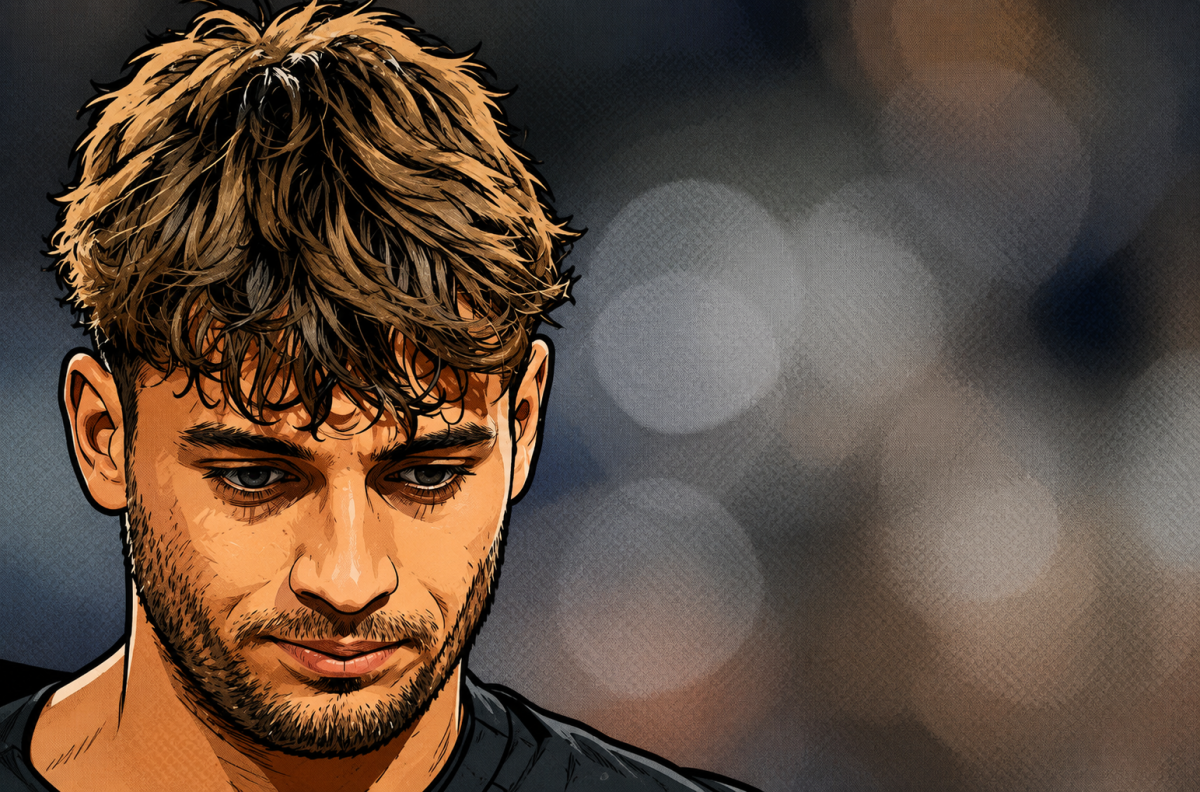
Autore Fabio Zarra
Flavio Cobolli arrives on Central Court at Wimbledon on July 8, 2026, ranked number 10 in the world, a finalist at Roland Garros a few weeks earlier, and number five in the Race. Arthur Fery arrives at number 114 in the world, a wild card at his home tournament, twenty-three years old, without a single ATP title under his belt. On paper, a match that was almost a one-sided affair. In reality, a 6-4 7-6(4) 6-0 victory for Fery, who becomes the second British wild card to reach the semifinals at Wimbledon after Goran Ivanisevic in 1992. Cobolli silently leaves the court—under the watchful eye of Queen Camilla, with his childhood friend Edoardo Bove in the box—and goes to the press conference.
What he said in that room is among the most psychologically charged things an Italian athlete has said this year. It's not a series of excuses. It's not a technical analysis of the match. It's an internal X-ray of what happens when a champion finds himself in a position he doesn't yet know how to manage: that of the favorite. It's worth reading carefully, because it touches on mechanisms that performance psychology has been studying for decades.
01 — THE MATCH
An opportunity, then the tunnel
The match got off to a rough start from the first game. Cobolli couldn't find his lines, but Fery played freely and proactively, pushing with his forehand and covering the court with unusual precision for a third-tier wild card. The decisive break came in the tenth game of the first set: Cobolli failed to convert his set point and lost 6-4. Tensions mounted in the second set: Cobolli earned his only break of the match at the start, but couldn't hold on to the lead. It went to a tie-break, and Fery opened with a mini-break, took a lead, and closed out the tie-break 7-4. At that point, something finally broke.
The third set was a 6-0 victory, with Cobolli losing sixteen of the last seventeen points of the match. He stopped winning decisive points, made unforced errors, and argued with his father Stefano in the box. Fery closed with an ace. Total duration: two hours and fourteen minutes. Cobolli consoled himself with the career-high ranking of number nine, achieved despite the defeat—but when he left the press room, that number meant almost nothing.
It wasn't the first time the two had faced each other. At the 2026 Australian Open, Fery had already defeated Cobolli in the first round in three clear sets: 7-6, 6-4, 6-1. A precedent that should have served as a warning—but instead, perhaps, it served as a burden.
| "I don't know what to say, I'm very sad with the mess I made." FLAVIO COBOLLI · POST-MATCH PRESS CONFERENCE, WIMBLEDON 8 JULY 2026 |
02 — THE WORDS
A textbook press conference
Cobolli enters the press room, frowning—"I prefer to answer questions, please"—and then constructs, answer after answer, one of the most honest analyses a professional athlete can make of himself at his worst. It's worth quoting them in sequence, because each statement is a clinical fact.
First: "I felt my style of play was perfect for him. I think I didn't play well from the first point of the match." This isn't a technical excuse: it's the recognition of a difficulty that begins before the ball even comes into play—a mental difficulty, not a muscular one.
Second, and most importantly: "I still handle matches in which I'm the favorite the wrong way. I never imagined I'd be playing a Grand Slam quarterfinal as such a clear favorite. I have to learn to manage that situation. My subconscious sometimes thinks I'm a player to beat, and then I find myself fighting my own monsters on the court." It's a statement of rare psychological precision, one that Cobolli utters without probably realizing how accurately he's describing a mechanism that science has documented in detail.
| "I still handle matches in which I'm the favorite the wrong way. My subconscious sometimes thinks I'm a player to beat, and then I find myself fighting my own monsters on the court." FLAVIO COBOLLI · POST-MATCH PRESS CONFERENCE, WIMBLEDON 8 JULY 2026 |
Third, about her father: "Arguments with my dad? They don't sap my energy, but they only fuel my opponent and silence my team. I felt awkward and a bit alone on a court like that. I felt like I needed some help. I was truly lost. I couldn't change the result, and it's difficult and frustrating. My excuse is my father, who suffers far too much than he perhaps deserves. When I'm helpless on the court, I'm not myself, and my frustration falls on him."
Fourth, the reset: "I'm not the type who needs outside help to reset. It's something we players are used to doing, and I do it better than most. In five minutes, maybe I'll be laughing with all my friends who came to watch me." And then: "It's not that hard to reset after a Slam quarterfinal. I have to be happier than disappointed." An emotional transition that, as we'll see, isn't as trivial as it seems.
03 — THE FAVORITE PARADOX
Because being the strongest can make you lose
Cobolli says he doesn't know how to handle matches in which he's the clear favorite. It's a problem that has a specific name in performance psychology: the favorite paradox. It's not a romantic invention: it's a documented phenomenon, with precise physiological and cognitive mechanisms.
Beilock and Carr's research on choking under pressure has shown that pressure creates a mental environment that diverts cognitive resources from technical automatisms toward explicit monitoring of one's performance. The result is paradoxical: under pressure, the athlete begins to "think" about the movements he normally performs automatically, and this conscious thought fragments the execution. The forehand that comes without reflection in training becomes, under pressure, a controlled movement—and the monitoring makes it less precise, not more so.
But there's a specific dimension to the favorite's case that goes beyond classic choking. Blascovich and Tomaka's challenge vs. threat model describes two distinct physiological responses to a high-stakes situation: the challenge response—when perceived resources are adequate to demand, with vasodilation and increased cardiovascular output—and the threat response—when perceived demand exceeds resources, with vasoconstriction and attentional dispersal. Logic would dictate that being the favorite activates the challenge response. The opposite happens: when the expected outcome is victory, losing comes at a huge identity cost. The asymmetry between what one has to lose and what the opponent has to gain shifts the balance toward threat. Cobolli wasn't trying to win: he was trying not to lose to someone who shouldn't have beaten him. It's a fundamental psychological difference.
| Cobolli in difficult matches BALANCED CHALLENGE → CHALLENGE RESPONSE When facing a player of his tier or higher, the risk is symmetrical. The perceived resources are adequate to the demand. The focus is on the game. | Cobolli as a clear favorite ASYMMETRY → THREATENING RESPONSE Losing is worth double. The mere possibility of defeat becomes an identity threat. The focus shifts from the match to managing the risk of losing. |
04 — THE MONSTERS
The theory of the ironic effects of the mind
"I find myself fighting my monsters on the pitch." It's the most interesting sentence of the entire press conference, and the one that's a bit surprising for its unintentional precision. Cobolli is describing—without knowing it—precisely what Daniel Wegner has called the theory of ironic processes of mind control.
Wegner's starting point is seemingly simple: when we try to suppress a thought—"don't think about the polar bear," in the classic formulation—something paradoxical happens. The brain activates two simultaneous processes: a conscious operational process that attempts to direct attention elsewhere, and an unconscious monitoring process that checks whether the unwanted thought is still present. The problem is that the monitoring process, to verify whether the thought has been suppressed, must continually search for it. And in doing so, it keeps it alive—indeed, makes it hypersalient. When cognitive resources are depleted—due to fatigue, pressure, stress—the monitoring process prevails over the operational one, and the thought we wanted to eliminate erupts with greater force.
In Cobolli's case, the "monster" is the awareness that he has to win, that he can't afford to lose to a player ranked much lower. The more he tries not to think about it—the more he wants to focus on the ball, the game, the serve—the more the monitoring process verifies whether that fear is still there. And finding it still there, it amplifies it. The result is what Cobolli lucidly describes: he can't play his tennis, not because he doesn't know how, but because part of his mind is already elsewhere—monitoring the risk.
Wegner applied this mechanism specifically to athletic gestures, with experiments on golf putting and precision movements: athletes instructed not to make mistakes commit more errors than those simply asked to do their best. The moral is counterintuitive but sound: attempting to control negative thinking makes it more powerful, not less so. Cobolli's "monsters" weren't born on the course. They were the product of the attempt to banish them.
05 — THE FATHER'S ALIBIS
Emotional Dislocation and Support Systems
The statement about his father is equally psychologically interesting, albeit for different reasons. Cobolli openly admits to having taken his frustration out on Stefano Cobolli—who was in the pit as part of the team—"My excuse is my father, who suffers far too much than he perhaps deserves. When I'm helpless on the pitch, I'm not myself, and my frustration is taken out on him."
In the psychology of emotions, this mechanism is called emotional dislocation: the tension accumulated in a situation is unleashed onto an available target, often the closest person. It's not a psychopathological anomaly—it's a poorly calibrated adaptive mechanism. The father present in the playpen unwittingly becomes both the support and the lightning rod. The fact that Cobolli explicitly names him—"he endures too much"—is already a sign of awareness. What's missing is the tool to prevent it from happening: not to acknowledge it afterward, but to manage it during.
There's another interpretation of that discussion. Cobolli says: "I felt uncomfortable and a bit alone on a pitch like that. I felt like I needed some help." An athlete on the pitch can't receive help in times of need: he must have already internalized the resources he needs. The feeling of loneliness he describes isn't physical—his team was there—but psychological: his internal support mechanisms weren't ready for the situation he was experiencing.
06 — THE RESET
Five minutes later, he was laughing
The most striking statement of the conference is the final one: "I'm not the type who needs external help to reset. In five minutes, maybe I'll be laughing with all my friends who came to see me." For those who heard the words that preceded it—sadness, loneliness, monsters—it sounds almost unbelievable. Yet, in performance psychology, this ability to transition rapidly is an indicator of mental health, not superficiality.
Fletcher and Sarkar, in their study on resilience in Olympic champions, identified reappraisal—the cognitive reevaluation of experience—as one of the most powerful tools available to a resilient athlete. It's not about denying the pain: Cobolli doesn't deny it. It's about quickly shifting the interpretative frame—"We mustn't just look at today's defeat, but what we've done in recent weeks. I must be happier than disappointed"—to prevent the defeat from becoming more burdensome. The fact that Cobolli possesses this ability, and is aware of it, is one of the strengths of his psychological profile. The fact that this same ability wasn't available during the match—when he needed it most—is the gap he needs to address.
| "You have to look not only at today's defeat, but also at the fact that these were two important weeks that I almost never managed to have. I have to be happier than disappointed." FLAVIO COBOLLI · POST-MATCH PRESS CONFERENCE, WIMBLEDON 8 JULY 2026 |
07 — IL PATTERN
A signal that repeats itself
Cobolli admits this isn't the first time: "It's happened several times this year that I've lost to players ranked significantly lower than me. I've lost to players outside the top 100." It's a pattern—not an episode. And a pattern, in sports psychology, can't be solved with a change of routine or a technical adjustment: it requires specific work on the mechanism that generates it.
The pattern of difficulty as a favorite reveals something specific about Cobolli's current profile: his technical growth has outpaced his psychological preparation for his new role. Cobolli has climbed the rankings so rapidly—Roland Garros finalist, top ten, career-high ranking of number nine—that his athletic identity hasn't yet fully integrated this new level. Part of him still perceives himself as the guy on the rise, not the number he must defend. And whenever he finds himself as the clear favorite, that discrepancy between his perceived identity and his expected role generates the threatening response that Beilock and Blascovich describe.
The solution isn't technical, and Cobolli knows it: "I have to learn to manage that situation." Learning, not solving. It's an important distinction. It's a gradual process, involving progressive exposure to the role of favorite under increasingly challenging conditions—and building the cognitive tools to keep Wegner's ironic processes at bay before the monsters take over.
| THREE AREAS OF WORK FOR THE NEXT COBOLLI The role of favorite. Building an athletic identity consistent with one's ranking: no longer "I'm climbing," but "I'm number 9 in the world." The dispute with the favorite begins in the internal narrative, not on the court. Ironic processes. Developing cognitive defusion techniques—accepting the presence of negative thoughts without fighting them, because fighting them amplifies them. Monsters can't be chased away: you let them come and go without giving them power. Support on the court. Building internal resources—routines, attentive anchors, functional self-talk—that are available when needed, before frustration finds its way to the box. |
07 — CLOSING
The awareness that awaits the tools
There's something remarkable about the honesty with which Cobolli described his defeat. He told the truth—"I'm fighting with my monsters"—without seeking a technical excuse, without blaming the court or the conditions, without downplaying Fery's performance ("her level was really high today"). This awareness is a rare and precious starting point.
But awareness alone isn't enough. As in the case of Medvedev in Paris—who knew where the problem lay but preferred not to tell anyone—the risk is that clarity about the existence of the obstacle won't translate into the ability to manage it. "I have to learn to manage that situation" is already the right step: it recognizes that it's not a character flaw, but a skill that can be developed. The work that remains to be done—on responding to the role of favorite, on ironic processes, on managing emotions on the court—is exactly the kind of work that transforms awareness into performance.
Flavio Cobolli is 23 years old and holds a career-high ranking of world number nine. He reached the quarterfinals at Wimbledon for the second time and, a few weeks earlier, had reached the final at Roland Garros. He has all the technical resources to aspire to the final stages of the Grand Slams. The gap between what he already is and what he can still become is measured, to a large extent, in psychology.
Visit our website www.sportpsychologycenter.com
| Do you manage games where you're the favorite? The favorite paradox is one of the most common themes in working with developing athletes. Building the tools to manage that role—before the monsters arrive on the field—is part of the journey with a sports psychologist. → BOOK AN INITIAL CONSULTATION Sport Psychology Center · Professional counseling, VR training, and mental training |
SCIENTIFIC REFERENCES
- Beilock, S. L., & Carr, T. H. (2001). On the fragility of skilled performance: What governs choking under pressure? Journal of Experimental Psychology: General, 130(4), 701–725. DOI: 10.1037/0096-3445.130.4.701 https://psycnet.apa.org/record/2001-05320-007
- Blascovich, J., & Tomaka, J. (1996). The biopsychosocial model of arousal regulation. In M. P. Zanna (Ed.), Advances in Experimental Social Psychology (Vol. 28, pp. 1–51). San Diego, CA: Academic Press. DOI: 10.1016/S0065-2601(08)60235-X
- Wegner, D. M. (1994). Ironic processes of mental control. Psychological Review, 101(1), 34–52. DOI: 10.1037/0033-295X.101.1.34
- Weiner, B. (1985). An attributional theory of achievement motivation and emotion. Psychological Review, 92(4), 548–573. DOI: 10.1037/0033-295X.92.4.548
- Fletcher, D., & Sarkar, M. (2012). A grounded theory of psychological resilience in Olympic champions. Psychology of Sport and Exercise, 13(5), 669–678. DOI: 10.1016/j.psychsport.2012.04.007
Sources of the reported facts: ubitennis.com, fanpage.it, lottomatica.sport, lapresse.it, italpress.com, ilfattoquotidiano.it, corrieredellosport.it, spaziotennis.com (8 July 2026). Result: A. Fery b. F. Cobolli 6-4 7-6(4) 6-0, Wimbledon quarterfinals, Central Court, 8 July 2026. Cobolli: ATP no. 10, Roland Garros 2026 finalist, reaches best ranking of no. 9 despite the defeat. Fery: ATP no. 114, wild card, first British wild card in the semifinals at Wimbledon since 1992 (Ivanisevic); in the semifinals he will face Zverev. Present in Cobolli's box: Edoardo Bove (Watford midfielder). All quotes by Cobolli are taken from the official post-match press conference (8 July 2026).

Fabio Zarra