
"I'm Not a Robot": Sinner, Physical Collapse, and the Psychology of Vulnerability
28 May 2026"We're used to penalties": PSG champions and the psychology of pressure becoming routine
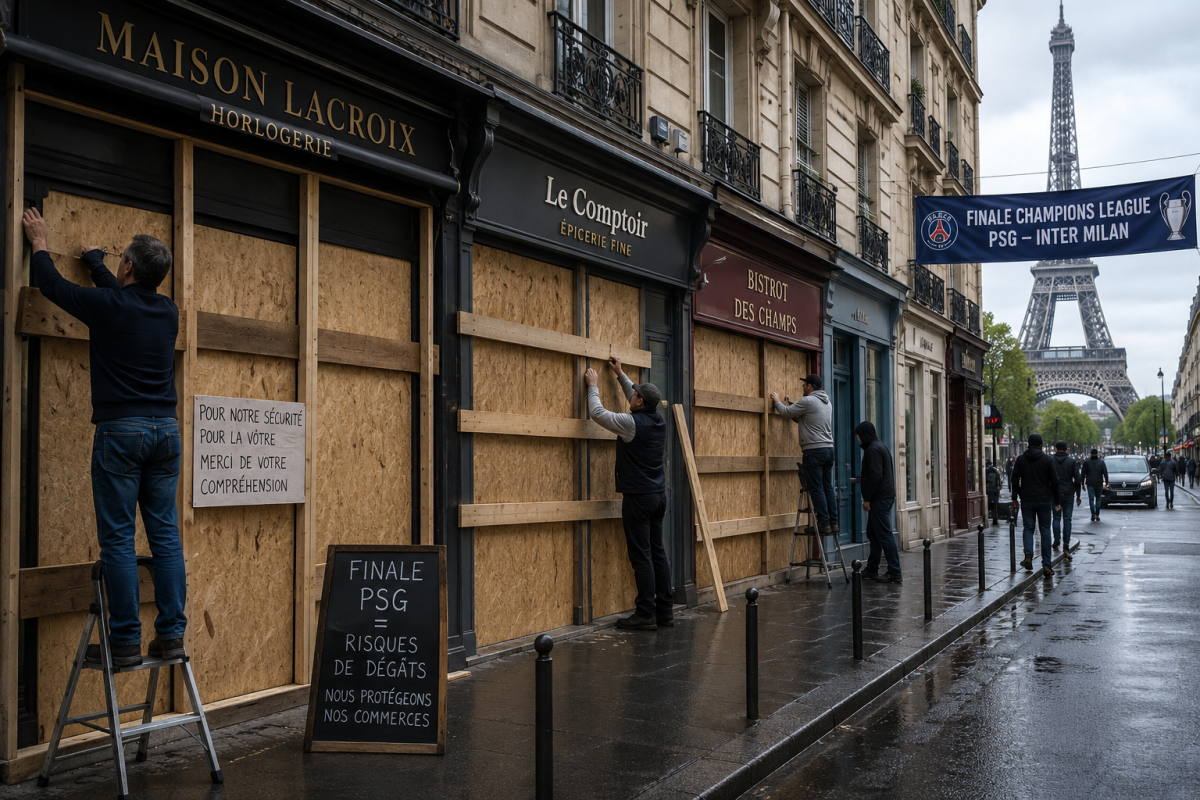
31 May 2026Ahead of the PSG-Arsenal final on May 30, 2026, shops on the Champs-Élysées were covered in wooden panels and metal grilles. Twenty thousand police officers were on high alert, the subway was closed, and orders were issued to lower shutters an hour before kickoff. Why can a sporting victory turn into destruction? The science of crowd psychology answers.
Author Fabio Zarra Event Roland Garros 2026, second round · May 28, 2026 Category Performance psychology
Friday afternoon, May 29, 2026. On the Champs-Élysées in Paris, employees of banks and large retail chains are screwing plywood panels onto windows, lowering metal grilles onto facades, and sealing doors. The Champions League final between PSG and Arsenal is being played that evening in Budapest—1,500 kilometers away. Yet Paris is preparing as if the match were being played on the streets. Eight thousand police officers and gendarmes are deployed in the city alone. Several metro stations are closed. Shopkeepers are given the official instruction: lower their shutters at 5:00 PM, an hour before kickoff.
It's a scene that reveals something specific about the collective psychology of mass sporting events. Not about crime, not about public safety in the strict sense—prefectures and police headquarters provide that. It reveals something about the relationship between sport, group identity, and collective behavior: why can the celebration of a sporting victory turn, for a segment of the crowd, into destruction?
01 — Parigi si barrica. I Fatti.
Paris in lockdown, final in Budapest
The 2025/26 UEFA Champions League final will be played on Saturday, May 30, 2026, at the Puskás Aréna in Budapest: Paris Saint-Germain face Arsenal, kicking off at 18:00. PSG are the defending champions—last season they swept Inter 5-0 in the final in Monaco—and are aiming to become the second club in the modern era to retain the title, after Real Madrid.
In Paris, the climate is twofold. On Thursday, May 28, a festive procession of PSG fans marched through the streets of the city, escorted by law enforcement. But the prefecture is wary of the celebrations. The weighty precedent is recent: on May 6, 2026, after PSG's victory over Bayern Munich in the semifinals, a photography exhibition by Yann Arthus-Bertrand set up in central Paris was vandalized by a group of fans. This alone justifies a state of alert security measure: 22,000 police officers and gendarmes were mobilized nationwide, 8,000 in Paris alone. Several metro stations were closed during the match and post-match hours.
| THE SECURITY SYSTEM — MAY 30, 2026 22,000 police officers and gendarmes mobilized across the country (source: French Ministry of the Interior)8,000 agents deployed in Paris alone5:00 PM Mandatory closing time for shops on the Champs-Élysées (one hour before kick-off)Friday 29th Bank windows and large signs already covered with wooden panels and metal grillesStations closedseveral metro stations suspended during match hours |
This isn't the first time Paris has prepared like this. The most notable precedent dates back to May 28, 2022: the Champions League final at the Stade de France between Liverpool and Real Madrid. Kick-off was delayed by 36 minutes, police used tear gas on the crowd—including in family areas, as documented by witnesses—and the final toll was 68 arrests and 238 minor injuries. Three years later, Interior Minister Gérald Darmanin publicly apologized to Liverpool fans, acknowledging that he had misplaced blame and given in to "preconceived ideas."
| "Yes, it was a failure. I gave in to preconceived ideas and I apologize to the Liverpool fans. They were right." GÉRALD DARMANIN, FORMER FRENCH INTERIOR MINISTER · YOUTUBE INTERVIEW 'LEGEND', 2025 |
02 — PSYCHOLOGY
Why victory can turn into violence
The question a sports psychologist asks when faced with these scenes isn't "Who are the violent ones?"—that's a question for law enforcement. It's: "What turns part of a cheering crowd into a destructive agent?" The answer involves well-documented psychological mechanisms, which aren't unique to soccer but to any situation in which a highly salient collective identity clashes with heightened emotional arousal.
Social Identity Theory, developed by Henri Tajfel and John Turner, describes how humans build part of their self-esteem through group membership—the nation, the team, the neighborhood. The more salient the group identity—"I'm a PSG fan"—the more the individual's behavior tends to align with what the group perceives as appropriate. In a context of collective excitement, this mechanism can amplify both prosocial behaviors (solidarity, shared joy) and antisocial behaviors (aggression toward non-members of the group, destruction as an assertion of dominance).
Added to this is the phenomenon of deindividuation, described by Philip Zimbardo in the 1970s and revisited in numerous subsequent studies. In crowds, anonymity reduces self-awareness as a responsible individual: people feel less observed, less open to judgment, and their inhibition threshold for antisocial behavior is lowered. This isn't an exemption from moral responsibility—it's a description of how context shapes the behavior of people who, individually, would never act the same way.
The third element is physiological: arousal. A Champions League match, experienced in a crowd, with music, alcohol, and weeks of built-up anticipation, produces intense psychophysiological activation. That same activation that fuels passion and joy can, in the presence of the other two factors—exaggerated group identity and anonymity—become the fuel for impulsive behavior. This is not inevitable: it's a possibility that becomes more likely as the emotional intensity of the context increases.
| Cheering crowd POSITIVELY ACTIVATED MECHANISM Shared identity, amplified joy, sense of belonging, solidarity among strangers. The same group mechanism that, under favorable conditions, produces community. | Destructive Crowd NEGATIVELY ACTIVATED MECHANISM Deindividuation, high arousal, perception of impunity, group identity against an 'enemy' (urban space, shop windows, institutions). The group as an alibi. |
03 — THE PREVIOUS
2022: When Paris couldn't handle the crowds
The final on May 28, 2022, at the Stade de France remains the most cited case study in Europe of failed crowd management at a major sporting event. Liverpool vs. Real Madrid: 68 arrests, 238 minor injuries, kick-off delayed by 36 minutes, tear gas fired even in familiar areas where no fans were causing trouble. The Paris prefecture initially attributed the disturbances to English fans—a version that proved largely inaccurate, as confirmed by the independent investigation commissioned by UEFA and by Minister Darmanin's public admission three years later.
That case highlighted a systemic flaw that crowd psychology has been describing for decades: the aggressive response of law enforcement to a crowd that is not yet violent does not reduce the risk of disorder; it increases it. Research by John Drury and colleagues on "crowd identity processing" has shown that people in crowds respond to the treatment they receive as a group: when police treat a peaceful crowd as potentially hostile, part of that crowd ends up behaving hostilely—not out of conviction, but in response to the perceived context.
Visit our website www.sportpsychologycenter.com
| An aggressive response to a non-violent crowd does not reduce the risk of disorder. Often, it increases it. DRURY, J., & REICHER, S. — CROWDS PSYCHOLOGY RESEARCH, UNIVERSITY OF SUSSEX |
04 — THE QUESTION
What does this tell us about ourselves — and about sports?
There's an easy interpretation of these scenes: there are violent people who take advantage of sporting events to cause harm, and they must be stopped. This is a true interpretation, but a partial one. A more comprehensive psychological interpretation adds: mass sporting events create conditions in which behaviors that would be unthinkable in ordinary situations become more likely, for a number of people far beyond the "usual violent perpetrators."
This doesn't mean that sport is responsible for violence, nor that fans are potentially dangerous. It does mean that sport—and especially football, with its ability to activate profound collective identities—amplifies everything: joy, solidarity, a sense of community, but also, in a minority of contexts and individuals, aggression and destructiveness. The mechanism is neutral; what drives it is the sum of individual, group, and contextual factors.
Paris, barricading itself, isn't a city afraid of its fans. It's a city that has learned, the hard way, that managing a crowd of hundreds of thousands in a state of high emotional arousal requires more than just police presence. It requires an understanding of the mechanisms that drive collective behavior—precisely the kind of understanding crowd psychology has developed over fifty years of research, and which, too often, comes after the fact.
| THREE KEY PSYCHOLOGICAL MECHANISMS Social identity (Tajfel & Turner, 1979). Belonging to the PSG group becomes part of personal identity. Victory is a victory for the self; defeat, a threat. In conditions of high identity salience, the group can legitimize behaviors that the individual alone would not produce. Deindividuation (Zimbardo, 1969). The anonymity of the crowd reduces self-awareness as a responsible individual. The inhibition threshold is lowered. Antisocial behaviors become more likely not because people are "bad," but because the context reduces the weight of social judgment. Arousal and behavior (Kerr, 1994). The high emotional activation of a mass sporting event does not have a predetermined sign. The same energy that fuels joy can, in the presence of deindividuation and exaggerated group identity, become aggression. Context determines direction. |
05 — IN CLOSING
Sport as a mirror
The wooden panels on the Champs-Élysées are an involuntary metaphor. Sport is more than just athletic performance: it is one of the few contexts in which millions of people simultaneously experience the same intense emotion, share the same identity, and feel part of the same collective destiny. This capacity is extraordinary and precious—it is what makes sport a unique social phenomenon. It is also what makes it a context that requires, beyond enthusiasm, a culture of collective behavior that cannot be formed on its own.
Sports psychology focuses primarily on the athlete—on their mind, their resilience, their ability to handle pressure. But the crowd watching that performance is also made up of people with emotional states, with identities at stake, and levels of arousal that are amplified by the context. Understanding these mechanisms—and designing events, communications, and crowd management with them in mind—is part of the same story. It's sports psychology expanded to its collective dimension.
| Competitive behavior isn't just about the athlete. Sports psychology works on individual performance, but also on the sporting culture that surrounds it. If you'd like to explore these topics further—for a team, a sports club, or an educational context—let's talk. → BOOK AN INITIAL CONSULTATION Sport Psychology Center · Professional counseling, VR training, and mental training |
SCIENTIFIC REFERENCES
- Tajfel, H., & Turner, J. C. (1979). An integrative theory of intergroup conflict. In W. G. Austin & S. Worchel (Eds.), The social psychology of intergroup relations (pp. 33–47). Brooks/Cole. https://www.scirp.org/reference/ReferencesPapers?ReferenceID=757561
- Zimbardo, P. G. (1969). The human choice: Individuation, reason, and order versus deindividuation, impulse, and chaos. Nebraska Symposium on Motivation, 17, 237–307.
- Kerr, J. H. (1994). Understanding Soccer Hooliganism. Open University Press.
- Drury, J., & Reicher, S. (2009). Collective psychological empowerment as a model of social change: Researching crowds and power. Journal of Social Issues, 65(4), 707–725. DOI: 10.1111/j.1540-4560.2009.01622.x
- Wann, D. L., Melnick, M. J., Russell, G. W., & Pease, D. G. (2001). Sport Fans: The Psychology and Social Impact of Spectators. Routledge.
- Dunning, E., Murphy, P., & Williams, J. (1988). The Roots of Football Hooliganism: An Historical and Sociological Study. Routledge.
Sources of the reported facts: France Info (29–30 May 2026), French Ministry of the Interior, UEFA.com, Sky Sport, Sport Mediaset. Darmanin's statement: interview on the YouTube show "Legend", 2025, reprinted by AP and Yahoo News. Previous 2022: official report by Paris Prefecture (68 arrests, 238 minor injuries); independent UEFA investigation. PSG vs. Arsenal, 2026 Champions League final: Puskás Aréna, Budapest, 30 May 2026, 6:00 PM.

Fabio Zarra