
Sinner returns to Chatrier, Medvedev never arrives: the psychology of venue in elite sport
27 May 2026Paris barricades itself: crowd psychology when sport becomes fear.
30 May 2026Leading 6-3, 6-2, 5-1 and ready to serve for the match, Jannik Sinner faded. What happens in the mind of an elite athlete when the body stops responding? The science of physical exhaustion, managing expectations, and fragility as part of the game.
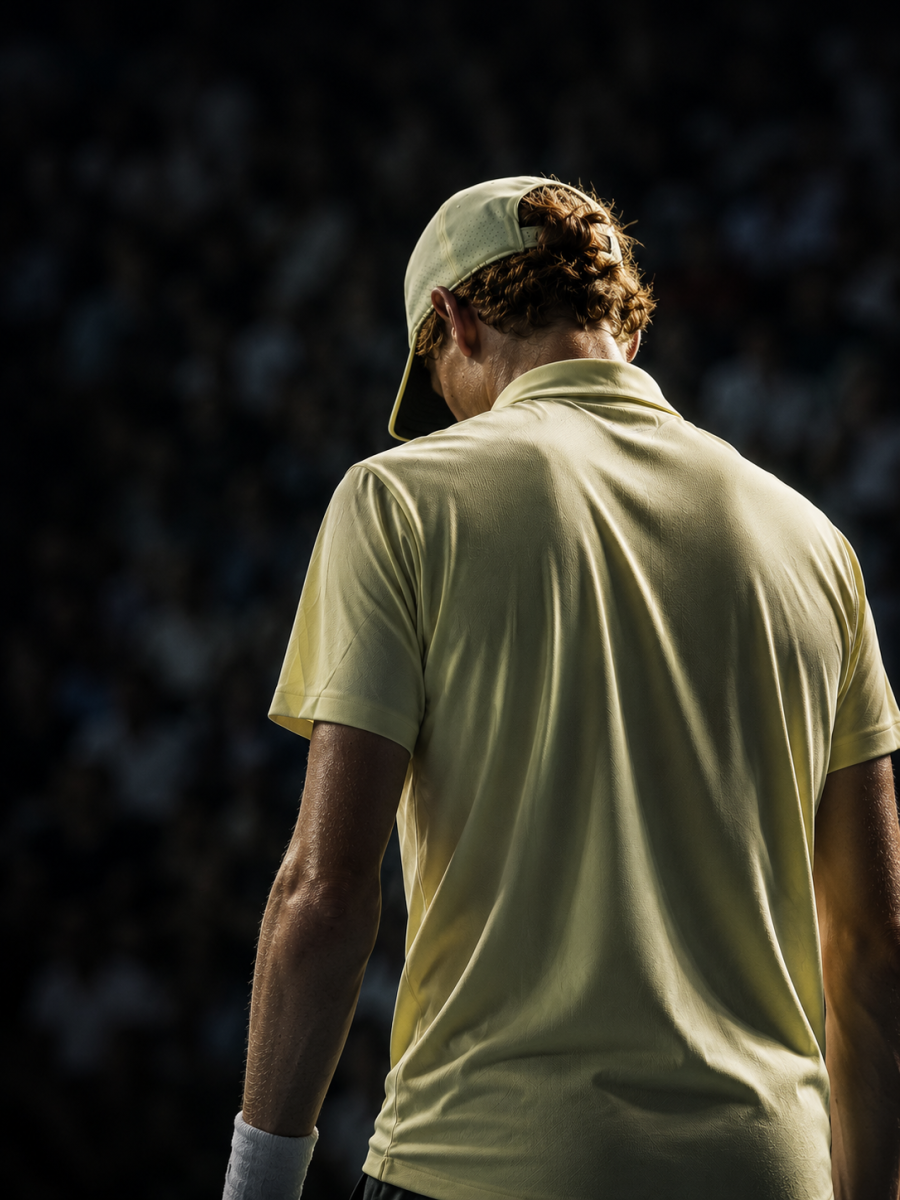
Author Fabio Zarra Event Roland Garros 2026, second round · May 28, 2026 Category Performance psychology
Some defeats can be explained by the opponent's play, by mistakes, by poor tactics. Jannik Sinner's defeat against Juan Manuel Cerundolo in the second round of Roland Garros 2026 falls into none of these categories. The South Tyrolean was dominant—6-3, 6-2, 5-1 in his favor, one game away from victory—when something inside him snapped. He suffered a physical collapse. He entered the medical area to have his blood pressure taken. He emerged without legs, without a head, and lost eighteen of his last twenty games. Cerundolo won 3-6, 2-6, 7-5, 6-1, 6-1 in three hours and nineteen minutes. It wasn't a comeback: it was the story of an athlete who hit an invisible wall, live on the world's most famous court.
01 — THE PHYSICAL COLLAPSE
The collapse on the Chatrier
Sinner enters his second round as world number one and the favorite going into the match, with a 2026 clay-court streak of 30 straight wins and three Masters 1000 titles already in his pocket—Madrid, Monte Carlo, and Rome. On the morning of May 28th, however, something was off. He explained it himself in a press conference: "This morning I woke up and didn't feel well. I tried to keep the rallies short and at first I was hitting really well, then at a certain point I hit a wall and that was it."
At Chatrier, in the morning session, the plan holds for two and a half sets. At 5-1 in the third, while preparing to serve for the match, he asks for the physiotherapist's intervention. He returns to the locker room for a blood pressure check. On the court, he tells the doctor: "I don't feel well, I feel like I need to throw up."
| COLLAPSE CHRONOLOGY — SET 3, GAME 10 | |
| 6-3 · 6-2 · 5-1 | Sinner serves for the match. He dominates completely: 80% of his first-serve points, and doesn't suffer any breaks in the first two sets. |
| Medical timeout | Sinner stops: the physiotherapist intervenes, he returns to the locker room. "I don't feel well, I have to throw up." |
| 5-7 | Cerundolo wins six games in a row. Sinner loses the set 5-1. The collapse begins: 18 of the last 20 games lost. |
| 3-6 2-6 7-5 6-1 6-1 | Final score. Duration: 3:19. Cerundolo wins the most important match of his career. |
www.sportpsychologycenter.com
He returns to the court visibly impaired. The fourth set ends 1-6, the fifth all-even. Cerundolo—world number 27, a 26-year-old Argentine—doesn't celebrate the last point. In the press conference, he says: "I was lucky. I feel sorry for Jannik. He deserves to win many Slams, I don't know what happened to him. I hope he can recover quickly."
With this defeat, Sinner ends Roland Garros prematurely: the only Slam he had yet to win. His streak of thirty consecutive victories comes to an end.
02 — PHYSIOLOGY
What happens when the body shuts down
The clinical picture described—dizziness, nausea, vomiting, and a sudden drop in energy in hot conditions—is consistent with an episode of acute heat stress, prolonged exertional hypotension, or a gastrointestinal response to hyperthermia. A review published in Sports Medicine by De Oliveira, Burini, and Jeukendrup documented how reduced splanchnic blood flow during intense exercise—especially under heat stress—leads to acute gastrointestinal symptoms such as nausea, cramps, and vomiting, which radically impair performance capacity. The authors estimate that between 30 and 50% of endurance athletes experience these symptoms during competition. Five-set tennis in hot conditions is among the highest-risk settings.
But there's a less visible aspect: mental fatigue, or accumulated cognitive fatigue. Marcora and colleagues have shown that a state of cognitive exhaustion reduces perceived physical performance and increases the rating of perceived exertion, even under the same objective load. Sinner himself acknowledges this: "I played a lot and didn't have much time to recover. I didn't sleep well last night, and this morning when I woke up, I was struggling." Cognitive and physical fatigue are compounded, and when they combine in a high-stakes context, the athlete can suddenly collapse seemingly without warning.
| "Halfway through the third set, I realized I had no energy. It was a difficult situation. The problem wasn't the heat or the conditions: the problem was me." JANNIK SINNER · PRESS CONFERENCE, SECOND ROUND ROLAND GARROS 2026 |
03 — PSYCHOLOGY
Staying on the field when there is nothing
The most interesting fact—the one a sports psychologist focuses on—isn't the collapse itself: it's what Sinner did afterward. He didn't retire. He chose to stay on court for two more sets, clearly physically impaired, in a match he could no longer win, in front of millions of spectators.
This choice isn't irrational: it's profoundly human, and sports psychology knows it well. The construct of mental toughness has been defined by Jones, Hanton, and Connaughton—in a study based on interviews with Olympic athletes and international coaches—as "the natural or developed ability to be, in general, more consistent and better than your opponents in determination, concentration, confidence, and control of pressure in adverse circumstances." Staying on the field when your body isn't responding is one of the purest manifestations of this construct. It doesn't produce victory, but it does produce something that has a specific weight in performance psychology: consistency with one's athletic identity.
04 — THE DECLARATION
"Nobody is a robot"
At the press conference, Sinner appeared grim but lucid. He said: "No one is a robot. No one is built to never fail. Today, that's what happened. I simply didn't see the exit, and that's something that doesn't normally happen to me." He continued: "It's hard to say. I think it's the result of many things combined, not just one."
In cognitive psychology, the ability to attribute a negative event to multiple, complex, and partially uncontrollable causes is associated with what Abramson, Seligman, and Teasdale have called an adaptive attributional style: the athlete does not globally blame himself, does not generalize, and does not stabilize. This type of attribution is a predictor of resilience and effective psychological recovery after adverse events.
Equally significant is the next sentence: "If I hadn't played Madrid or Rome, maybe I would have arrived here and still had a day like this when you feel bad." It's an example of real-time contextual reframing: Sinner places the event in a broader context that reduces its identity-building weight without erasing it. It's not emotional distance: it's emotional regulation.
| Jannik Sinner POST-MATCH PRESS CONFERENCE "No one is a robot. No one is built to never fail. The problem wasn't the heat or the conditions: the problem was me. I played a lot, but I didn't sleep well last night. It's the result of many things combined." | Juan Manuel Cerundolo POST-MATCH PRESS CONFERENCE "I was lucky. I feel sorry for Jannik. He deserves to win many Slams, I don't know what happened to him. I hope he can recover quickly." |
05 — THE CONTEXT
The price of the domain
Sinner played three Masters 1000 tournaments on clay, winning them all—Monte Carlo, Madrid, Rome—before arriving in Paris. Just eight days passed between the title in Rome (May 18) and the start of Roland Garros (May 26). A study in PLOS ONE by Kovalchik and Constantinou analyzed 21 calendar years of men's professional tennis, documenting how accumulated competitive load is a direct predictor of performance declines: squeezing close commitments into a short period of time produces a physiological and cognitive debt that can manifest itself suddenly, even in athletes in excellent shape. Sinner was 5-1 in the third set: he wasn't losing, he was winning. The collapse wasn't the consequence of poor play—it was the debt coming to be collected.
Added to this is the dimension of expectations. Roland Garros 2026 was the only Slam missing from Sinner's list of achievements. The implicit pressure of completing the Career Grand Slam, according to Hanin's IZOF (Individual Zones of Optimal Functioning) model, can push an athlete out of their optimal arousal zone—with effects that don't always translate into improved performance.
06 — TOOLS
How to prepare an athlete for physical vulnerability
What can a sports psychologist do when faced with this type of scenario? They can't prevent heatstroke, obviously. But they can help the athlete build a mental system that can withstand when the body gives out.
| FOUR AREAS OF PREVENTIVE WORK Managing cognitive load and sleep. Cognitive and physical fatigue feed each other. Systematic monitoring of sleep quality and perceived stress during high-intensity weeks helps prevent the silent accumulation that leads to sudden collapses. Contingency protocols in competition. Mentally preparing the athlete for scenarios of physical difficulty—"What will I do if I feel sick?"—reduces disorientation at the critical moment and preserves decision-making capacity when cognitive resources are already limited. Adaptive attributional style. Training the athlete to interpret adverse events in a specific, temporary, and non-global way—exactly as Sinner did in the conference—is work that is done in ordinary periods, not at the moment of collapse. Regulating external expectations. Work on the relationship between the athlete and the weight of expectations—their own, the team's, the public's—to maintain an optimal level of activation without the emotional stakes becoming a risk factor. |
Sinner has already announced that he will skip Halle and return directly to Wimbledon. This decision, beyond sporting strategy, signals an awareness of his need for recovery, which is itself a sign of athletic maturity.
07 — IN CLOSING
Fragility as part of the game
"No one is a robot." In the words of an athlete who over the past two years has built an image of a victory machine—steadfast, imperturbable, systematic—it takes on a different meaning. It's a public recognition of one's humanity at a time of greatest fragility. It's not an excuse: it's a correct assessment of reality.
Sinner left Roland Garros without the title, but with a narrative that holds up: he told the truth, he didn't look for excuses, he acknowledged the complexity of what happened. He left for home with work to do—physically and mentally—and with Wimbledon on his horizon. It's one of the healthiest ways, scientifically speaking, to recover from a traumatic defeat.
| How do you manage moments when your body lets you down? Physical vulnerability is part of sport. Preparing to manage it—with concrete tools—is part of psychological work. Let's talk about it. → BOOK AN INITIAL CONSULTATION Sport Psychology Center · Professional counseling, VR training, and mental training |
SCIENTIFIC REFERENCES
- De Oliveira, E. P., Burini, R. C., & Jeukendrup, A. (2014). Gastrointestinal complaints during exercise: Prevalence, etiology, and nutritional recommendations. Sports Medicine, 44(Suppl 1), S79–S85. DOI: 10.1007/s40279-014-0153-2 https://pubmed.ncbi.nlm.nih.gov/24791919/
- Marcora, S. M., Staiano, W., & Manning, V. (2009). Mental fatigue impairs physical performance in humans. Journal of Applied Physiology, 106(3), 857–864. DOI: 10.1152/japplphysiol.91324.2008
- Jones, G., Hanton, S., & Connaughton, D. (2002). What is this thing called mental toughness? An investigation of elite sport performers. Journal of Applied Sport Psychology, 14(3), 205–218. DOI: 10.1080/10413200290103509
- Abramson, L. Y., Seligman, M. E. P., & Teasdale, J. D. (1978). Learned helplessness in humans: Critique and reformulation. Journal of Abnormal Psychology, 87(1), 49–74. DOI: 10.1037/0021-843x.87.1.49
- Hanin, Y. L. (2000). Emotions in sport. Champaign, IL: Human Kinetics. [IZOF model — Individual Zones of Optimal Functioning]
- Kovalchik, S. A., & Constantinou, A. C. (2020). In search of lost time: Identifying the causative role of cumulative competition load and competition time-loss in professional tennis. PLOS ONE, 15(4), e0231568. DOI: 10.1371/journal.pone.0231568
Sources of the reported facts: Press conferences and reports from the second round of Roland Garros 2026 (May 28, 2026) — Eurosport, Adnkronos, Sky TG24, OA Sport, Fanpage.it, Open.online, Sportmediaset. Result: J.M. Cerundolo v. Sinner 3-6 2-6 7-5 6-1 6-1 in 3:19. All quotes from Sinner and Cerundolo are taken from official statements in the post-match press conference.

Fabio Zarra