
Ronaldo's Tears: What Science Tells Us About Male Emotions in Sports
26 May 2026"I'm Not a Robot": Sinner, Physical Collapse, and the Psychology of Vulnerability
28 May 2026The psychology of place in elite sport: trauma, contextual mental block, and redemption. What science tells us about athletes' ability—and inability—to revisit the "scene of defeat."
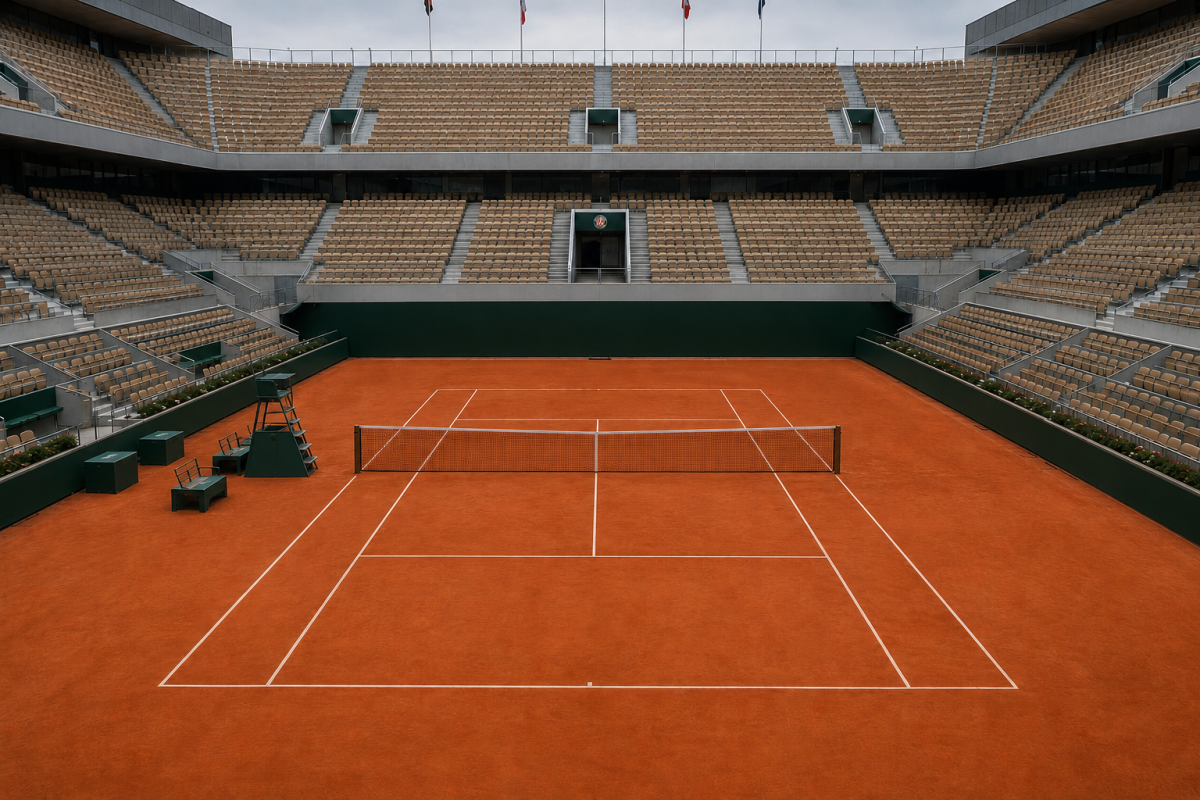
On May 26, 2026, on the same red clay in Paris, two mirrored stories unfolded in the space of a few hours. Jannik Sinner returned to Court Philippe-Chatrier for the first time since the previous year's final—the one where he had the victory in his grasp and watched it slip away—and wrapped up the matter with ease. Daniil Medvedev, just a few hundred meters away on Suzanne-Lenglen, bowed out in the first round for the seventh time in ten appearances, in an afternoon marked by mistakes, frustration, and an argument with his wife caught on camera. Same tournament, same day, two opposite relationships with a place. It's the perfect starting point to discuss one of the most underrated dimensions of performance: the emotional geography of sport.
Two scripts in the same theater
On the Chatrier, Sinner overcame French wild card Clément Tabur, ranked 171st, with a resounding 6-1, 6-3, 6-4 victory in just over two hours. It was an almost uneventful debut: 80 percent of first serve points, a handful of aces, and only one real setback—four match points saved by the Frenchman in the third set before the final. For the world number one, it was his thirtieth consecutive victory of the season and his eighteenth on clay in 2026, where he has already won all three Masters 1000 tournaments. But the most important fact for us is another: it was the first time Sinner had set foot on the court where a year earlier he had lost a final after having three match points.
That same day, at Suzanne-Lenglen, Medvedev, the sixth seed, was eliminated by Australian wild card Adam Walton, world number 97, after a five-set battle: 6-2, 1-6, 6-1, 1-6, 6-4. It was his seventh first-round exit in ten editions of Roland Garros, with his overall tournament record now sitting at a mediocre 10 wins and 10 losses—a far cry from the 76% win rate he boasts at his other three Slams. During the first set, while the Russian was loudly complaining about the heat in his corner, his wife Daria called out to him from the stands: "It's hot for everyone, everyone's suffering. You have to behave." His reply, into an open microphone, was: "When I start finding the court, I'll start behaving."
Then, at the press conference, the phrase that gives the day its psychological title. Asked about his relationship with Paris, Medvedev admits he knows the root of the problem—but refuses to reveal it:
"I know why I don't usually play my best tennis at Roland Garros, but if I said so, it would sound like an excuse. I prefer to keep it to myself."
Daniil Medvedev · Press conference, first round Roland Garros 2026
It is, without the player intending it, one of the most revealing statements a sports psychologist can hear. There's an awareness—"I know why"—and, at the same time, a barrier that prevents it from being transformed into something useful. I'll return to this point, because it's here that the real difference between the two athletes lies.
The psychology of place
Why can the same tennis court be a trampoline for one athlete and a cage for another? The answer lies in a principle that cognitive psychology has known for decades: memory is not a neutral archive, but a system deeply tied to the context in which experiences are formed. The physical place where we learn, compete, or fail is not simply a backdrop: it becomes an integral part of the memory trace.
Steven Smith and Edward Vela's review and meta-analysis of context-dependent memory showed that information retrieval is more efficient when the retrieval environment matches the encoding environment: cues from the physical context act as a key to the associated memories. This is the phenomenon of context-reinstatement. For an athlete, this means that returning to a stadium where an emotionally intense experience has been experienced can automatically reactivate the psychophysiological state of that moment—the tension, the racing heart, even the train of thought.
Added to this is state-dependent memory: memories encoded in a specific emotional or physiological state are more easily recalled when the same state is found. If the "defeat scene" was experienced in a state of acute anxiety, simply returning to that place can act as a trigger—a conditioned stimulus, in the most classically Pavlovian sense of the term. The field is no longer just grass or clay: it has become an emotional cue.
Here lies the crossroads. The same mechanism that reactivates fear for one player can reactivate determination for another. Contextual conditioning has no predetermined meaning: it depends on the emotional trace that has been consolidated and, above all, on how much reprocessing work the athlete has done on that trace. This is precisely the space in which sports psychology operates.
Medvedev's taboo: the contextual block
Medvedev's performance in Paris isn't a fluke. Three of his first-round losses—in 2019, 2023, and 2025—have come in the fifth set; this one against Walton follows a nearly identical pattern to the previous year, when he let a lead slip in the deciding set. When a pattern repeats itself with this precision, a purely technical explanation becomes insufficient. What we might call a contextual performance phobia comes into play: a specific block, anchored to a location and a tournament, that doesn't appear elsewhere.
The cognitive mechanism is well described by research on choking under pressure. In studies by Sian Beilock and Thomas Carr, pressure generates a mental environment that diverts attention to task-irrelevant stimuli—concerns about the situation and its consequences—draining cognitive resources from the execution of the technical gesture. When an automated action is subjected to explicit monitoring under stress, it fragments. The attentional control theory by Michael Eysenck and colleagues adds a piece of the puzzle: anxiety particularly compromises the executive functions of inhibition and attention shifting, reducing efficiency even when apparent effectiveness remains intact.
In the case of a location-related block, anticipatory rumination is added to all this: the athlete arrives at the tournament already haunted by the script of their defeat. They construct, often without realizing it, a negative narrative identity—"I'm not a clay-court player"—which acts as a self-fulfilling prophecy. Every mistake in the first few games isn't read as an incident, but as the confirmation of a story already written.
Medvedev's statement perfectly reflects this state. "I know why" is pure metacognition: the ability to observe one's own mental processes. But "I prefer to keep it to myself" signals the absence of the next tool: regulation. Recognizing a block without having the means to process it is like having a diagnosis without the therapy. Awareness alone doesn't untangle the knot; in some cases, it tightens it, because it fuels the very rumination that is part of the problem. The argument on the pitch with his wife, the discomfort of the heat, the irritation at the corner: these are all signs of an attentional system that has already abandoned the task at hand to address the threat.
Sinner: When Trauma Becomes a Driving Force
The 2025 final, with three missed match points, is, in effect, a sporting trauma: an event that challenges the certainties on which an athlete has built their self-image. The interesting question is not whether it hurts—it hurts—but what happens afterward. And here psychology offers a concept that reverses the perspective: post-traumatic growth.
The model developed by Richard Tedeschi and Lawrence Calhoun describes how confronting highly destabilizing events can, under certain conditions, produce positive psychological change: a renewed perception of one's resources, a redefinition of priorities, a stronger sense of personal strength. The crux of their model is that growth arises not from the event itself, but from the cognitive processing that follows it—a work of rebuilding the structures of meaning that the trauma had damaged.
It's crucial to distinguish between two processes that are often confused. Rumination is a passive, circular process: one returns to the painful event without transforming anything. Narrative reworking, on the other hand, is an active, deliberate process in which the athlete rewrites the meaning of the experience, integrates it into their story, and extracts actionable insights from it. It's the difference between reliving defeat and questioning it.
Returning to the scene of defeat is not an act of blind courage: it is the result of a reworking that transforms the place from a threat into known territory.
An athlete who has reworked his trauma returns to the scene "armed": the contextual cues that trigger fear for others have been reconditioned for him. The field of defeat becomes the field of the test to be overcome, and the context-reinstatement works in his favor, reactivating not the anguish but the clarity built in the meantime. Sinner's solid debut performance—regardless of the opponent's skill—tells of a player who doesn't bring a ghost to the Chatrier, but rather an unfinished business he intends to settle.
How to work on a place block
The good news for anyone living with a context-specific block is that these mechanisms can be modified. Sports psychology has established tools to address the very point where Medvedev has stalled: the transition from awareness to regulation.
- Mental rehearsal of the adversarial context. Repeatedly visualizing not only the technical gesture, but the environment surrounding it—the stadium, the crowd, the sensations—allows you to recondition the contextual cues in a state of controlled calm, even before taking the field.
- Cognitive reframing of the place. Replace the "I've always lost here" narrative with a reading that frames the place as a test, not a condemnation. Reframing doesn't deny history: it changes its function.
- Restructuring narrative identity. Dismantle global labels ("I'm not a player from this point on") and bring them back to specific and modifiable episodes, interrupting the self-fulfilling prophecy.
- Attentional control and arousal management. Train to redirect attention from threatening stimuli to the task, and regulate physiological arousal with breathing techniques and pre-point routines.
None of these tools is a magic formula, and none works in isolation or in the midst of a crisis on the pitch. They require structured, repeated, and—this is the crucial point—supported work. The difference between Sinner and Medvedev, in this reading, is not a question of talent or character: it's the difference between an awareness left alone and a
Regarding contextual blocks and the reprocessing of sports injuries, the program with a sports psychologist integrates clinical interviews, mental rehearsal protocols, and—when appropriate—training in simulated virtual reality environments, which allows exposure to the adversarial context in protected and gradual conditions, leading up to work on the real field.
The courage to name the block
There's something profoundly human in Medvedev's statement. He had the courage to admit, in front of everyone, that he knew where the problem lay. He stopped halfway: he mentioned the existence of the knot, but not the knot itself, and above all, he didn't show the tools to untangle it. It's a fragile position and, ultimately, a very common one—on and off the tennis court.
Awareness is the necessary first step, but it's not the finish line. Recognizing a roadblock without supporting it with concrete tools means remaining prisoners of what you've already understood. Sinner, on the same field and the same day, tells the other half of the story: the one in which the scene of defeat is confronted, reworked, and, one point at a time, rewritten. Between the two paths, there is not a boundary of nature, but of method. And the method can be learned.
Do you have a place, race, or opponent that's holding you back?
Transforming awareness into concrete tools is the work we do every day at the Sport Psychology Center, through professional counseling, VR training, and mental coaching. Schedule an initial consultation and let's talk.
Scientific references
- Tedeschi, R. G., & Calhoun, L. G. (2004). Posttraumatic growth: Conceptual foundations and empirical evidence. Psychological Inquiry, 15(1), 1–18. https://www.scirp.org/reference/referencespapers?referenceid=1904932
- Beilock, S. L., & Carr, T. H. (2001). On the fragility of skilled performance: What governs choking under pressure? Journal of Experimental Psychology: General, 130(4), 701–725.
- Smith, S. M., & Vela, E. (2001). Environmental context-dependent memory: A review and meta-analysis. Psychonomic Bulletin & Review, 8(2), 203–220.
- Eysenck, M. W., Derakshan, N., Santos, R., & Calvo, M. G. (2007). Anxiety and cognitive performance: Attentional control theory. Emotion, 7(2), 336–353.
- Hanton, S., Neil, R., & Mellalieu, S. D. (2008). Recent developments in competitive anxiety direction and competition stress research. International Review of Sport and Exercise Psychology, 1(1), 45–57.
Sources of the reported facts: Press conference and reports of the first round of Roland Garros 2026 (May 26, 2026) — Roland-Garros.com, ATP Tour, Eurosport, SuperTennis, Tennis365. Scores: Sinner v. Tabur 6-1 6-3 6-4; Walton v. Medvedev 6-2 1-6 6-1 1-6 6-4. Medvedev's quotes and exchange with Daria Medvedeva are taken from post-match statements and official tournament footage.

Fabio Zarra