
"I don't take the blame": Leclerc, the brakes, and the psychology of attribution under pressure
8 June 2026Rejected at the World Cup, chosen for the Super Cup: the psychology of inclusion in sport
13 June 2026Tomorrow, June 11, 2026, the biggest World Cup in football history opens. Forty-eight national teams, three host countries, billions of people watching. And hundreds of athletes who won't sleep tonight. What goes on in a player's mind the night before the most important match of his career? Science answers.
Author Fabio Zarra Event World Cup 2026 Category Performance psychology
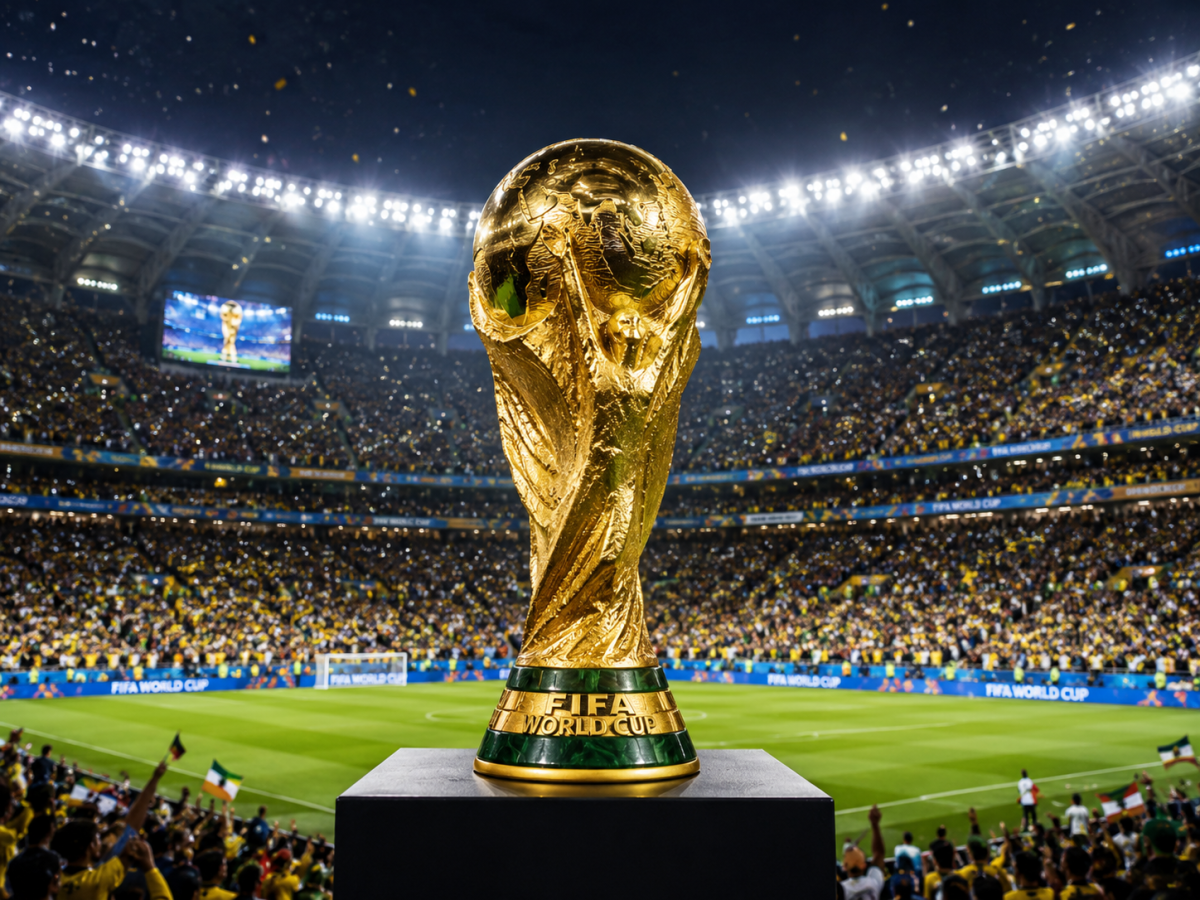
There's a moment in sports that doesn't appear in the statistics, doesn't end up in the highlights, and is never interviewed. It's the night before. The night when a player is alone with himself and what he's about to face. It's the night when butterflies in the stomach flutter in every direction, when the mind tends to jump ahead—to the game, to the opponents, to the mistakes you don't want to make, to the goals you want to achieve—before the referee has even blown the starting whistle.
Tomorrow, June 11, 2026, at 9:00 PM Italian time, Mexico takes the field against South Africa at the Estadio Azteca in Mexico City, kicking off the largest World Cup in football history: forty-eight national teams, sixteen host cities, and three co-hosts. For many of the athletes on the pitch, it's their first time on that stage. For some, it's their last. For others—like Lionel Messi, 38, with seventeen 2022 World Cup winners in his wake—it's the impossible challenge of defending what's already been won.
This article isn't about tactics or predictions. It's about what's going on in the minds of those athletes tonight. And what sports psychology has learned, through decades of research, about the most difficult—and most valuable—night of a sports career.
01 - THE CONTEXT
The biggest World Cup ever
The 2026 World Cup is a first in football history. For the first time, 48 national teams will compete instead of the usual 32, with a group stage that expands to include the eight best third-place teams. The matches will be held across Mexico, Canada, and the United States, at sixteen different venues. This is the first edition in which FIFA has introduced a new pre-match ceremony: the players of the two teams stand face-to-face at the center of the pitch during the national anthems, in what FIFA President Gianni Infantino called "a moment of unity, pride, and emotion that belongs to all the team members and everyone in the stadium."
On a human level, the tournament's greatness is measured by the stories that permeate it. Yuto Nagatomo, a 39-year-old Japanese defender, cried when he heard his name called up: it's his fifth World Cup. AC Milan forward Santiago Gimenez describes the tournament as "an incredible dream" and says he can't wait for it to begin. On the other hand, Carlo Ancelotti—the first foreign coach in Brazil's history—bears the weight of a country that hasn't won the World Cup since 2002 and has placed enormous expectations on him. His response on the eve of the tournament is as succinct as it is revealing: "The team that can hide its weaknesses will win the World Cup."
| "The team that can hide its weaknesses will win the World Cup." CARLO ANCELOTTI · PRE-WORLD CUP PRESS CONFERENCE, JUNE 2026 |
02 - THE SCIENCE
What happens in the mind the night before
Call it what you will: pre-competitive anxiety, activation, agitation. The feeling is universal: a racing heartbeat, muscle tension, racing thoughts, difficulty falling asleep. For decades, sports psychology has treated these symptoms as something to be eliminated—or at least reduced. More recent research tells a more complex and, in a certain sense, more reassuring story.
The Individual Zone of Optimal Functioning (IZOF) model, developed by Yuri Hanin, has shown that optimal emotional arousal is different for every athlete: there is no "right" level of agitation that works for everyone. For some, very high arousal is functional; for others, a state of almost detached calm produces the best performance. What matters is not the quantity of emotion, but its relationship to that individual athlete's optimal zone at that moment. A player who learns to know their zone—and recognizes when they are in or out of it—has a real competitive advantage over those who have never explored it.
But the most revolutionary contribution to understanding the night before comes from research on British Olympic swimmers. Hanton and Jones, in a study that has become a classic in the literature on sport psychology, showed that elite athletes don't try to eliminate pre-competitive anxiety: they reinterpret it. Faced with the same physical symptoms—racing heartbeat, butterflies in the stomach, sweaty palms—non-elite athletes read them as danger signals ("I'm too nervous, I won't do it"), while elite athletes read them as signals of readiness ("My body is preparing, I'm ready"). The same physiological state, two radically different narratives, two radically different performance outcomes. The title of the study has become a famous phrase in applied psychology: Making the butterflies fly in formation.
| It's not about eliminating butterflies. It's about learning to let them fly in formation. |
The underlying mechanism can be explained through Blascovich and Tomaka's Challenge vs. Threat model: when faced with a high-stakes situation (a decisive penalty in a Champions League final), the body can respond in two ways. If perceived resources are sufficient to address the demand—"I'm ready, I've already been through this, I know what to do"—a challenge response is activated, with increased cardiovascular output and cognitive focus on the task. If, however, the demand exceeds perceived resources, a threat response is activated, with vasoconstriction, attentional dispersion, and increased risk of error. Accumulated experience shifts the balance point: an athlete who has already taken decisive penalties perceives his resources as more adequate to the situation.
03 - THE PROTAGONISTS
Three stories, three vigils
The eve of the 2026 World Cup offers three very different psychological portraits—three ways of approaching the night before that, each in their own way, reveal something specific about the psychology of high-level performance.
| Lionel Messi THE PRESSURE OF A CHAMPION 38 years old, 17 2022 champions with him, the impossible goal of making history by winning two consecutive World Cups. "Being able to defend the title on the pitch is something spectacular." The weight of comparing himself. | Yuto Nagatomo THE VETERAN'S GRATITUDE 39 years old, fifth World Cup winner, he cried when he was called up. For him, the night before wasn't anxiety: it was privilege. Twenty years of career distilled in a moment of pure emotion. | Carlo Ancelotti THE LEADER'S CLEARANCE The Brazil coach doesn't talk about dreams or fear. "The team that can hide its weaknesses will win." It's the eve of the pragmatist: thinking about the task, not the emotion. |
Three stories that illustrate as many psychological profiles facing the night before. Messi carries the heaviest weight of identity: he is the symbol, he is the target of every opponent, he is the one asked to do the impossible. Research on mental toughness—conducted by Jones, Hanton, and Connaughton through interviews with Olympic athletes and top coaches—describes this ability as the determination to not be overwhelmed by what is expected of you, maintaining focus and confidence even under maximum external pressure.
Nagatomo represents the opposite: an athlete who has transformed decades of career into a positive emotional resource. For him, the eve of the tournament isn't a threat—it's memory. Every match of this World Cup will be viewed through the filter of all previous matches, and this filter lowers the perception of risk and increases the sense of mastery. Experience, in sports psychology, isn't just technique: it's an archive of events the brain uses to assess its readiness.
Finally, Ancelotti paints the portrait of a leader who has learned to manage his eve through decades of maximum pressure. His phrase—"hiding your weaknesses"—isn't cynical: it's a working definition of what sports psychology calls task orientation under stress. Don't think about how much you can lose, but what you can actually do to win.
04 - THE RESEARCH
What distinguishes those who hold the night before
The most important question in pre-competitive psychology is not "how to eliminate anxiety," but "what distinguishes athletes who manage it well from those who don't." Research has identified fairly precise answers.
Orlick and Partington's study of 235 Canadian Olympic athletes—participating in the 1984 Sarajevo and Los Angeles Games—produced one of the most comprehensive data sets on pre-competition mental preparation in the history of sport psychology. The key finding: athletes who perform at their optimal level under maximum pressure share recurring elements in their pre-competition management. It's not talent that makes the difference in major events, but the quality of pre-competition mental preparation. Among the factors identified as critical: the use of consolidated pre-competition routines, the ability to focus attention on the technical task rather than the consequences of the outcome, and the presence of a support system—coach, staff, teammates—that is perceived as solid.
This finding translates directly into practice: you don't build the night before. It's built in the months leading up to the World Championships, through the repetition of routines that become automatic, through mental simulation of adverse scenarios, through working on the athlete's narrative about themselves and the situation they're about to face. Those who arrive at the World Championships with a well-oiled mental system sleep better, not because they don't feel the pressure, but because they've already practiced how to respond to it.
| FOUR HABITS OF ATHLETES THAT HOLD THE NIGHT BEFORE Consolidated pre-race routine. A fixed sequence of actions—music, visualization, warm-up, nutrition—that brings the body and mind to a recognizable and functional state of activation. Routine reduces cognitive uncertainty and lowers the threat response. Attention to the process, not the outcome. Shifting the focus from "I have to win" to "what I have to do" reduces the emotional burden and keeps attention on the technical task. You don't win a World Cup thinking about the Cup—you win thinking about the first tackle, the first pass. Reinterpretation of activation. "I'm ready" instead of "I'm nervous." A racing heartbeat and butterflies are not symptoms of a problem: they are the physiology of an organism preparing to give its best. Reinterpretation is a skill that can be trained. A support system perceived as solid. Feeling like your staff, your teammates, and your coach are real resources reduces the feeling of loneliness in the face of pressure. Ancelotti knows it: "It's easy to work with this team. They all love the Seleção." |
05 — THE COLLECTIVE DIMENSION
The night of an entire country
The eve of the World Cup isn't just individual psychology. It's collective psychology. Hundreds of millions of people around the world—fans, families, entire countries—share the same tension, the same anticipation, the same sense of something about to happen that will change the collective mood for a month. In Italy, this feeling is amplified by absence: for the third consecutive edition, the Azzurri are not on the pitch, and the World Cup will be experienced from the sidelines—with that bittersweet feeling of watching a party they weren't invited to.
Yet there's something universal about the eve that transcends flags and jerseys. The night before the big event is one of the most shared emotional states in the sporting experience: the anticipation, the excitement, the inability to fall asleep, the imagining of how it will go. It's the moment when sport—in its deepest sense—stops being a game and becomes something bigger. Something that touches on identity, personal history, the sense of belonging.
For the athletes on the pitch tomorrow, this dimension is experienced with multiplied intensity. They're not just playing a match: they're representing their country, their history, the expectations of millions of people. This is the most difficult pressure to handle—not the pressure that comes from the opponent, but the pressure that comes from within, from the weight of everything that comes with wearing a World Cup jersey.
06 — CLOSING THOUGHTS
The night as part of the game
There's a quote from the repertoire of sports psychology worth keeping in mind tonight, for anyone reading it—athlete, coach, parent, or fan. Butterflies in your stomach aren't the problem. They're a sign that you care. They're proof that what you're about to do matters. The job isn't to eliminate them: it's to learn to let them fly together, in the same direction.
Tomorrow morning, in hotels across Mexico, Canada, and the United States, hundreds of athletes will wake up—some for better, some for worse—with that feeling in their chests. The most prepared won't try to make it go away. They'll recognize it as part of the game, they'll integrate it into their routine, they'll direct it toward the task. And then they'll take to the field.
This is the psychology of the eve of a match. Not the certainty of victory, not the absence of fear: the ability to use what you feel to do what you have to do. Good luck to everyone.
| Do you have an important competition coming up? Managing the lead-up to a competition and pre-competitive anxiety is one of the key areas of working with a sports psychologist. You can't improvise the night before: you build ahead. Let's talk about it. → BOOK AN INITIAL CONSULTATION Sport Psychology Center · Professional counseling, VR training, and mental training www.sportpsychologycenter.com |
SCIENTIFIC REFERENCES
- Hanin, Y. L. (2000). Emotions in sport. Champaign, IL: Human Kinetics. [IZOF model — Individual Zones of Optimal Functioning]
- Hanton, S., & Jones, G. (1999). The acquisition and development of cognitive skills and strategies: I. Making the butterflies fly in formation. The Sport Psychologist, 13, 1–21. DOI: 10.1123/tsp.13.1.1
- Blascovich, J., & Tomaka, J. (1996). The biopsychosocial model of arousal regulation. In M. P. Zanna (Ed.), Advances in Experimental Social Psychology (Vol. 28, pp. 1–51). San Diego, CA: Academic Press. DOI: 10.1016/S0065-2601(08)60235-X https://www.scirp.org/reference/referencespapers?referenceid=633678
- Jones, G., Hanton, S., & Connaughton, D. (2002). What is this thing called mental toughness? An investigation of elite sport performers. Journal of Applied Sport Psychology, 14(3), 205–218. DOI: 10.1080/10413200290103509
- Orlick, T., & Partington, J. (1988). Mental links to excellence. The Sport Psychologist, 2(2), 105–130. DOI: 10.1123/tsp.2.2.105
Sources of the reported facts: FIFA.com, Sky Sport, Adnkronos, Fanpage.it, Tuttocampo.it, Sportmediaset, Rivista Undici, RDS, Calciomagazine (June 2026). Ancelotti's statement on "hiding your weaknesses": pre-friendly press conference for Brazil vs. Egypt, June 5-7, 2026 (sources: Elbotola.com, Vietnam.vn, Sky Sport). Infantino's statement on the anthem ceremony: official FIFA statement (Fanpage.it, June 2026). Gimenez's statements on the eve of the World Cup: interview with Billboard Italia (Notiziemilan.it, June 10, 2026). Nagatomo's fifth World Cup appearance and reaction to the call-ups: Passionedelcalcio.it. The 2026 World Cup opens on June 11, 2026, with Mexico vs. South Africa, Estadio Azteca, at 9:00 PM Italian time.

Fabio Zarra