5 Techniques to Manage Pre-Competition Anxiety
3 May 2026After the Medal, the Void. Why Elite Athletes Struggle When Competition Ends
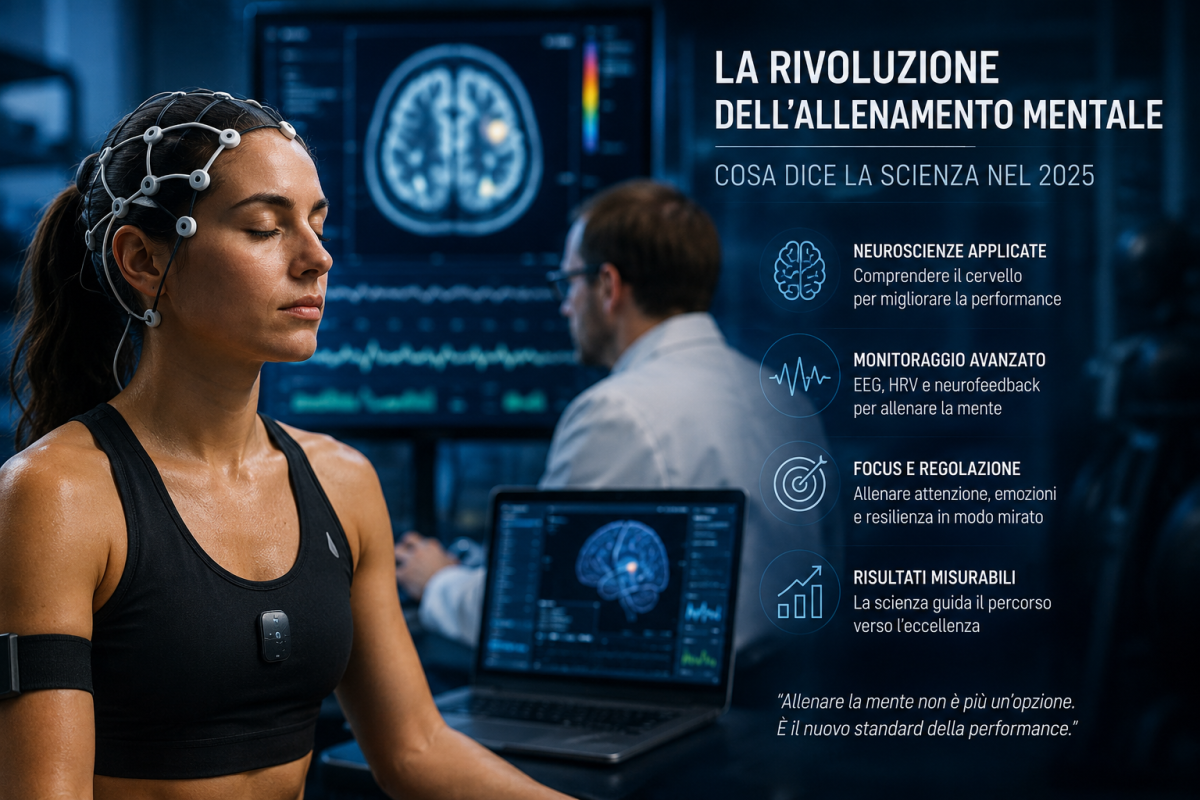
7 May 2026For decades, athlete training focused almost exclusively on the body: strength, endurance, speed. But in recent years, neuroscience and sports psychology are rewriting the rules. The latest scientific research clearly shows that the mind is not merely an accessory to performance — it is its main engine.
1. Mental training for athletes, the driving force of performance
An editorial published in Frontiers in Psychology in 2025 officially announced a new era: the 'cognitive era of sport.' Researchers from the University of Bologna and the Federal University of São Paulo found that cognitive, emotional, and motivational factors play a decisive role in athletic performance — as much as, if not more than, physical abilities.
"Two athletes with the same physical preparation can achieve completely different results: the difference is in the mind." — Frontiers in Psychology, 2025
2. Mental Toughness: The Bridge Between Commitment and Results
A 2025 study in Sports showed that mental toughness acts as a 'bridge' between an athlete's dedication and their competitive results. Analyzing hundreds of elite athletes, researchers found that mental toughness enables focus and confidence under maximum competitive pressure — and crucially, it is a trainable skill, not an innate trait.
3. Mindfulness and Neuroscience: Rewiring the Brain to Win
A study published in Scientific Reports (Nature, 2025) explored the effect of mindfulness meditation on athletic performance by measuring brain activity during virtual reality sports tasks. The results were surprising: just 15 minutes of daily practice for 18 days produced measurable changes in brain activity—particularly in the prefrontal cortex and anterior cingulate cortex, the areas responsible for attentional control and stress management.
A trial on Chinese sprinters (Frontiers in Psychology, 2025) confirmed that a seven-week mindfulness program significantly reduced competitive anxiety, improving race performance.
4. Virtual Reality: The Future of Cognitive Training
Among all recent innovations, virtual reality (VR) may be the most revolutionary breakthrough for athletes' mental training. 2025 scientific research confirms this with unequivocal data.
A study in the Journal of Science and Medicine in Sport (2025) analyzed young, semi-elite soccer players who underwent VR training. The results showed significant improvements in anticipatory cognitive processes in the prefrontal and premotor areas of the brain—precisely those that allow athletes to "read the game" before it happens and make quick and precise decisions under pressure.
“VR training enhanced anticipatory brain processes in prefrontal and premotor areas… confirming the potential of immersive technologies to integrate cognitive training in sports.” — Journal of Science and Medicine in Sport, 2025
5. Sport Psychology Center: VR + AI at Athletes' Service
This is precisely the scientific context in which Sport Psychology Center was born. Italy's first integrated sports psychology center combines immersive virtual reality, artificial intelligence, and professional sports psychology consultation to deliver personalized, measurable, scientifically-grounded cognitive training.
Through VR, athletes simulate high-stress competition scenarios in a controlled environment, training anxiety management, focus, and decision-making. AI analyzes real-time data, adapting each session to the athlete's cognitive profile. The result: an unprecedented mental growth path — measured, progressive, and genuinely transferable to field performance.
The science of 2025 is clear: training the mind is no longer optional for those who want to excel in sport — it is a necessity. Virtual reality, mindfulness, and structured cognitive training are no longer future tools; they are the present of elite performance. Sport Psychology Center brings this science directly to athletes at every level.
Try our VR mental training program. Sign up now: https://app.sportpsychologycenter.com/signin
Sources:
• de Lima-Junior et al. (2025). Editorial: The cognitive era in sports performance. Frontiers in Psychology.
• Zhang et al. (2025). Mental toughness as a bridge between commitment and performance. Sports.
• Guo et al. (2025). Mindfulness meditation and VR shooting performance. Scientific Reports, Nature.
• van Biemen et al. (2025). VR training and anticipatory brain functions in soccer. J. Science and Medicine in Sport.
• PMC Systematic Review (2025). VR and AR training effects on soccer players. PubMed Central.
• Frontiers in Psychology (2025). Mindfulness intervention in Chinese sprinters — 7-week RCT.
https://publicatt.unicatt.it/handle/10280/182865
