
After the Medal, the Void. Why Elite Athletes Struggle When Competition Ends
7 May 2026Champions' Minds: What Schuurs, Saúl, and Alcaraz Tell Us About Sport in 2026
17 May 2026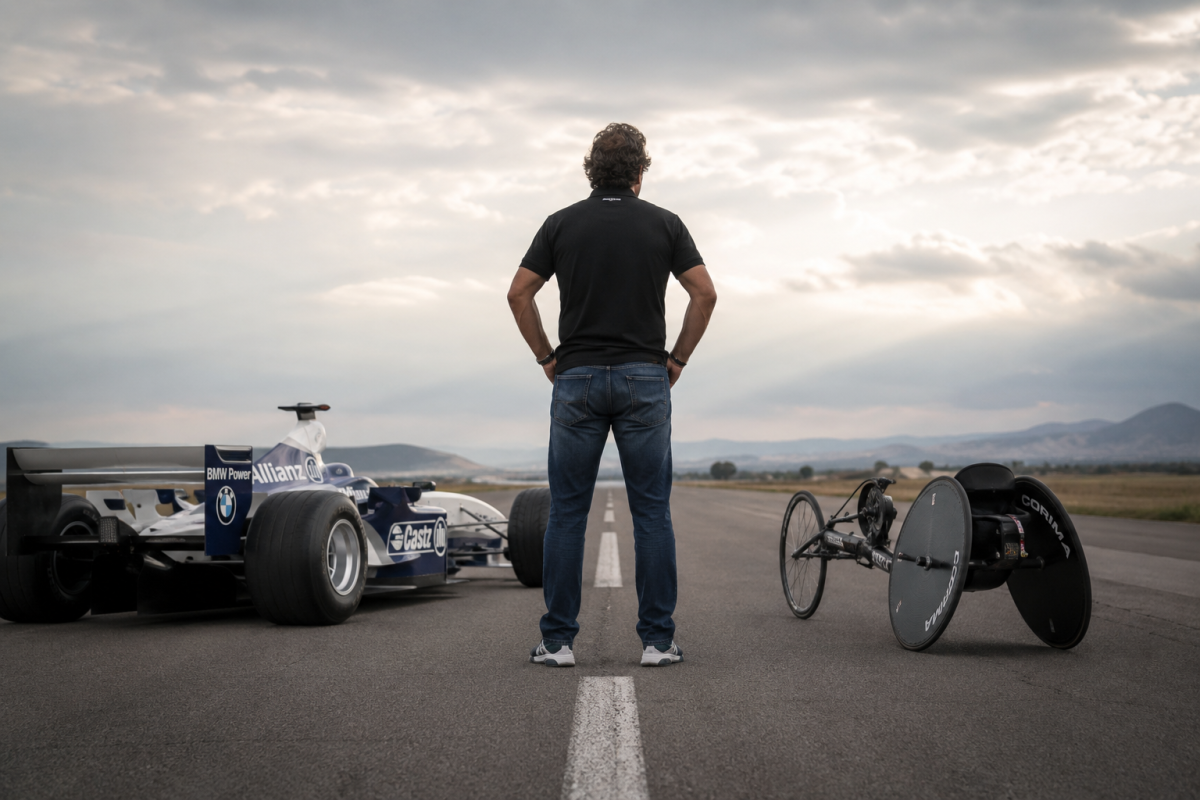
What does his story teach us about resilience, determination, and the psychology of coming back?
On May 1, 2026, as Italy came to a halt for Labor Day, news struck the world of sport like a sudden silence: Alex Zanardi, 59, Formula 1 driver, Paralympic champion, and man of a thousand lives, is no more. He passed away on the same day, 32 years ago, that Ayrton Senna died—as if fate had chosen to unite two giants of world sport on a single date. This article is not a place for mourning. It is a place for active memory: the kind that transforms an extraordinary example into useful knowledge, into real tools for anyone who wants to understand what it means to return, after something—an accident, a defeat, an illness, a loss—has shattered who he was.
September 15, 2001: The moment everything fell apart for Alex Zanardi
It's Sunday afternoon at the Lausitzring in Germany. Zanardi returns to the pits after a pit stop in the CART race. The car loses control on a dirty section of the track. The impact with Alex Tagliani's car, which is approaching at approximately 320 km/h, literally tears the chassis in half. Zanardi's legs are amputated on the spot. By the time CART doctor Steve Olvey reaches the driver on the asphalt, less than a liter of blood remains in his body.
Seventeen surgeries followed, seven cardiac arrests, and four days in a medically induced coma. The championship chaplain administered last rites. No one, at that moment, would have bet on his survival, much less on a return to sport.
«We will not tell you how he died, but how he lived.»
Rebirth: Not in spite of loss, but through it
What happened in the months that followed is difficult to conceive, even for those who witnessed it firsthand. Zanardi didn't just survive: he went back to designing. He built customized prosthetics because commercial ones didn't meet his standards. In 2003—less than two years after the accident—he returned to the track. He did so symbolically at the Lausitzring, to complete the 13 laps that fate had cut short in 2001. His fastest lap would have earned him fifth place on the grid.
It's not rhetoric. It's not communication. It's the most concrete form of response to trauma: returning to exactly where it was broken, not to exorcise, but to pick up the thread. Zanardi then competed in the WTCC with BMW, achieving four victories. Then he discovered handcycling. And there he began a second sporting career that few able-bodied athletes can match: four Paralympic gold medals at London 2012 and Rio 2016, twelve world titles between 2013 and 2019.
«You can try to see what can be done with what's left», he said a few hours before the 2020 accident, his last. «Rather than saying, 'It's over, I don't have what I had before,' maybe something will happen, let's hope.»
What science says about athletic resilience
Zanardi's story is not an isolated case of "exceptional character." It is, in its most extreme form, the manifestation of psychological mechanisms that scientific research has identified, measured, and—in part—taught.
Resilience is trainable. A narrative review published in Frontiers in Psychology in 2025 (Mei et al., Southwest University) systematically analyzed how athletic resilience develops and its consequences. The findings confirm that it is not an innate quality: it is formed through consciously processed experiences of adversity, through social support, and through targeted interventions—mindfulness, cognitive reframing, and gradual exposure to stress.
The mind determines a return, not just the body. A meta-analysis cited in orthopedic and sports literature shows that, after anterior cruciate ligament reconstruction, approximately 90% of athletes recover physical function, but only 63% return to their previous competitive level. The gap—nearly 30 percentage points—is explained by psychological factors: fear of re-injury, loss of athletic identity, and performance anxiety. Resilience measured before surgery is one of the most reliable predictors of actual return.
Peer support speeds recovery. A randomized controlled trial published in Frontiers in Psychology in 2025 (Liu et al., Shanghai University of Sport) tested peer support programs on injured athletes: after six weeks, the group receiving structured support showed significantly higher psychological resilience and significantly lower perceived stress than the control group.
63%
of athletes return to pre-injury — the rest is stopped by the mind, not the body
~30pp
The gap between physical recovery and competitive return: explained by resilience and psychology
6 weeks
Structured peer support is enough to measurably increase resilience
La «regola dei 5 secondi alla volta»: un metodo mentale
Zanardi has spoken many times about his approach to rehabilitation. One phrase in particular has stuck: his "five-second rule." Don't think about the week, don't think about the month, don't think about your career. Think about the next five seconds. Get it done in those five seconds. Then another five.
In sports psychology, this approach has a name: process focus, as opposed to outcome focus. The research is unanimous: athletes who focus on the immediate process manage anxiety better, maintain more stable performance under pressure, and—crucially in the case of injury recovery—better tolerate the uncertainty of the final outcome.
This isn't philosophical abstraction. It's applied neuroscience: the autonomic nervous system responds differently to immediate and concrete goals than to distant and uncertain ones. Maintaining focus on the "next step" lowers the activation of the threat system, reduces cortisol, and makes an effort that would otherwise seem insurmountable sustainable.
«You can try to see what can be done with what's left. Rather than saying, 'It's over,' maybe something will happen, let's hope.» — Alex Zanardi, last interview before the 2020 accident
Identity beyond performance: the most important lesson
There's an aspect of Zanardi's story that goes beyond athletic resilience and touches something deeper: his identity wasn't his performance. It was curiosity, the challenge, the pleasure of movement. When he lost his legs, he lost a modality—not a meaning. And this allowed him to find another.
In the previous blog post, we discussed the emptiness many athletes feel when they stop competing. Zanardi shows us the opposite: an athlete who, violently stripped of his athletic form, was able to reinvent himself because his identity was greater than the result.
Science calls this athletic identity broadening: the expansion of athletic identity beyond the specific discipline, beyond the result, towards values and qualities that withstand adversity. It is one of the psychological skills most predictive of athletic longevity and post-career well-being.
What can we learn, concretely?
Zanardi's story isn't an unattainable benchmark. It's a roadmap. The mechanisms that enabled his comeback are identifiable and, to a large extent, trainable:
— Focus on the immediate process. Reduce your time horizon when the load is at its highest. The next five minutes, not the next five months.
— Plural identity. Don't just be "X's athlete." Cultivate a sense of self that survives injury, defeat, and a change in discipline.
— Structured support. Resilience isn't loneliness. Data confirms that peer support, psychological coaching, and community measurably accelerate recovery.
—Rework, don't erase. Trauma that isn't integrated remains active. Zanardi's symbolic return to the Lausitzring wasn't therapy—it was concrete processing.
Goodbye, Alex
There are people who teach us what it means to win. And then there are people who teach us what it means to never give up—which is something rarer, and more valuable. Alex Zanardi was both. And he will be, in the stories we will continue to tell, in the athletes who get up knowing there is a way to succeed.
In sport, and in life, mental strength isn't the absence of fear. It's the ability to act despite it. To do what's left.
Start your mental training today. Try MAT for free at sportpsychologycenter.com
Sources
• Mei Z. et al. (2025). Bounce back from adversity: a narrative review and perspective on the formation and consequences of athlete resilience. Frontiers in Psychology. DOI: 10.3389/fpsyg.2025.1599145
• Liu J. et al. (2025). The effect of peer support on psychological rehabilitation in injured collegiate athletes: the mediating roles of resilience and perceived stress. Frontiers in Psychology. DOI: 10.3389/fpsyg.2025.1567812
• St. Louis University / ClinicalTrials.gov (NCT03013231). Effect of Patient Resilience on Return to Sport Post ACL Reconstruction Surgery
• Sky TG24 / ANSA / La Nazione / Il Fatto Quotidiano (maggio 2026). Necrologi e ricostruzioni biografiche su Alex Zanardi
• sportpsychologycenter.com — Blog Articolo #4: Dopo la Medaglia, il Vuoto (maggio 2026)
